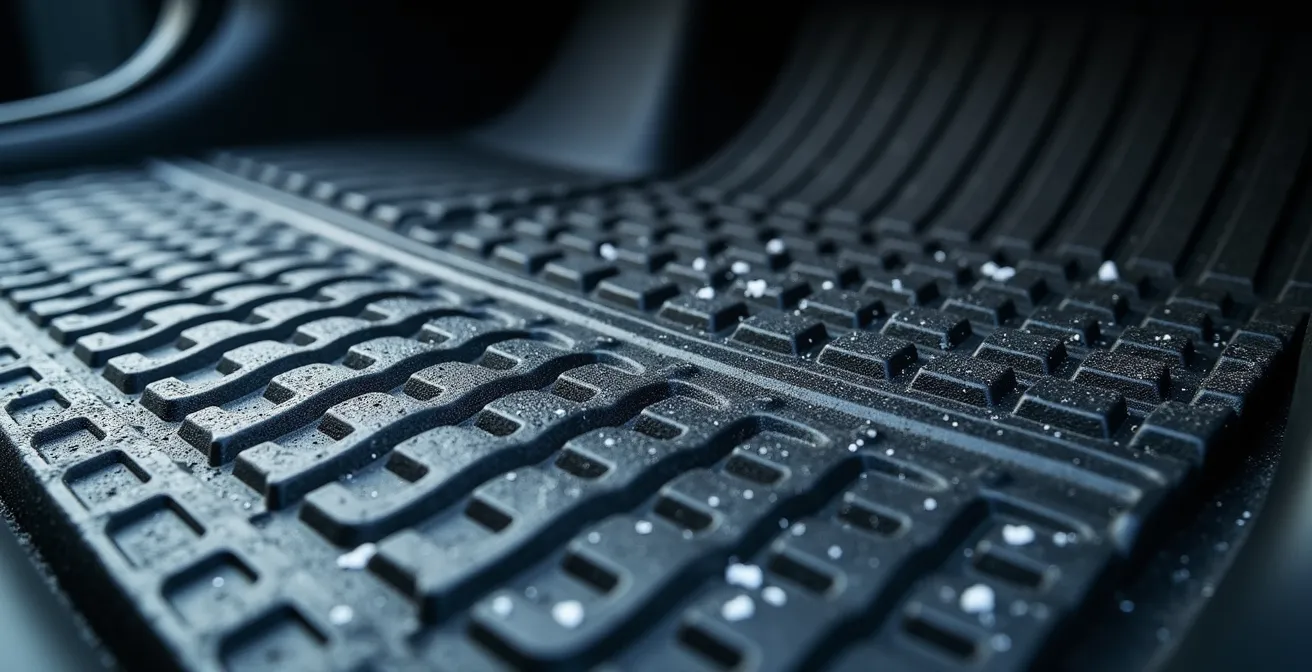
The white salt stains on your car’s carpet are not just ugly; they are a permanent chemical scar that savvy buyers will use to devalue your vehicle significantly.
- Cheap, flat mats fail because they can’t contain the sheer volume of water from melting snow, allowing corrosive calcium chloride to saturate your carpet’s fibres and the floor pan below.
- Premium, laser-measured liners from brands like WeatherTech and Husky act as a “containment system,” trapping corrosive slush and preventing it from causing irreversible damage.
Recommendation: Investing in high-walled, custom-molded liners is the single most effective step to protect your vehicle’s interior and preserve its resale value against the harsh reality of a Canadian winter.
As a car detailing expert, I see the same tragedy play out every spring. A proud owner brings in their beautiful, year-old vehicle, but the interior tells a story of a brutal Canadian winter. The culprit? Fine, white, crusty lines that have wicked their way across the black carpet. They’ve scrubbed, they’ve shampooed, but the stain remains, a ghostly reminder of road salt. This isn’t just dirt; it’s a chemical reaction that has permanently damaged the carpet fibres, and it’s a glaring red flag for any potential buyer down the road.
Most people think any floor mat will do. They see a $40 set at a big-box store and assume it offers protection. This is a critical misunderstanding of the enemy. The real threat isn’t just water and mud; it’s the highly corrosive calcium chloride solution that soaks into your carpets. This is where the debate between generic mats and a premium, laser-measured liner system like those from WeatherTech or Husky Liners becomes less about cleanliness and more about asset preservation. Protecting your vehicle isn’t just about the exterior; the interior condition, especially the floors, is a primary indicator of how well a car has been maintained.
This guide goes beyond a simple product comparison. We will dissect the science of salt damage and demonstrate why a proper containment system is not an expense, but a non-negotiable investment in your vehicle’s long-term value. We’ll explore the fundamental differences in engineering, the hidden safety risks of improper installation, and how this one choice can prevent thousands of dollars in depreciation and future rust repair. This is the definitive strategy for winning the war against winter in your footwell.
To help you make an informed decision and protect your investment, we’ll break down every critical aspect of vehicle floor protection. From the chemistry of salt damage to the specific features that define a quality liner, this guide provides the expert insights you need.
Summary: A Detailer’s Guide to Preserving Your Car’s Interior from Salt Damage
- Why is it impossible to clean a carpet impregnated with crystallized calcium?
- Why pay $200 for molded liners instead of $40 at Costco?
- How to remove white salt stains from black rubber without making it grayish?
- The danger of a stuck pedal: why never put a winter mat over a summer mat?
- Why are high walls mandatory to contain melting snow?
- Why do rocker panels rot from the inside out before becoming visible?
- How do the steering wheel and pedals betray a car’s true mileage?
- Cargo Liners for Pet Owners and DIYers: Preventing Damage to Your Trunk
Why is it impossible to clean a carpet impregnated with crystallized calcium?
The stubborn white stains that plague Canadian vehicles are not simply dried salt. They are the result of a chemical process called calcium crystallization. When the slush from treated roads—a mixture of water, rock salt (sodium chloride), and calcium chloride—is carried into your car, it soaks deep into the carpet fibres. As the water evaporates, the calcium chloride molecules recrystallize, physically bonding with the synthetic fibres of the carpet. Unlike simple dirt that sits on the surface, these crystals become enmeshed within the very structure of the material.
Standard carpet shampoos and steam cleaners are ineffective because they can’t dissolve these resilient crystals. They might temporarily lift some of the surface residue, but the core of the problem remains embedded deep in the carpet pile and its backing. This saturation does more than just create an unsightly stain; it introduces corrosive moisture directly against the vehicle’s floor pan. This is the first step in a long process of depreciation, as savvy buyers know that interior salt damage often signals bigger problems underneath. The impact is real, as studies confirm that vehicles exposed to winter salt conditions experience accelerated depreciation.
While different regions in Canada use varying winter road treatments—for instance, Alberta often uses sand while Ontario relies heavily on salt—the outcome is damage. While sand can cause paint chips, salt initiates this insidious chemical process. Once calcium has crystallized within the carpet, it’s a permanent scar, a clear sign of a winter’s assault that no amount of scrubbing can truly erase. The only winning move is to prevent the liquid from ever reaching the carpet in the first place.
Why pay $200 for molded liners instead of $40 at Costco?
The price difference between a generic, flat rubber mat and a premium molded liner from WeatherTech or Husky Liners reflects a fundamental difference in philosophy: containment versus coverage. A $40 mat simply covers a portion of the floor. It’s a passive, flat barrier with no ability to control liquid. The first time you get in the car with boots covered in melting snow, that slush will pool and inevitably spill over the edges, carrying corrosive salt directly onto your carpet. You haven’t solved the problem; you’ve only delayed it by a few seconds.
A premium liner is an engineered containment system. Using precise laser measurements of your specific vehicle’s footwell, these liners create a custom-fit bucket. They extend up the sides of the footwell, covering the front, back, and sides. This design ensures that every drop of melted snow, mud, and salt-laden slush is captured and held within the liner. It’s an active defense. The investment is not just for a piece of rubber, but for the technology and design that perfectly seals your carpet off from the elements. This is a crucial factor, as experts note that in Canada, the rough winters with salt and dirt cause extra damage that accelerates a car’s loss of value.
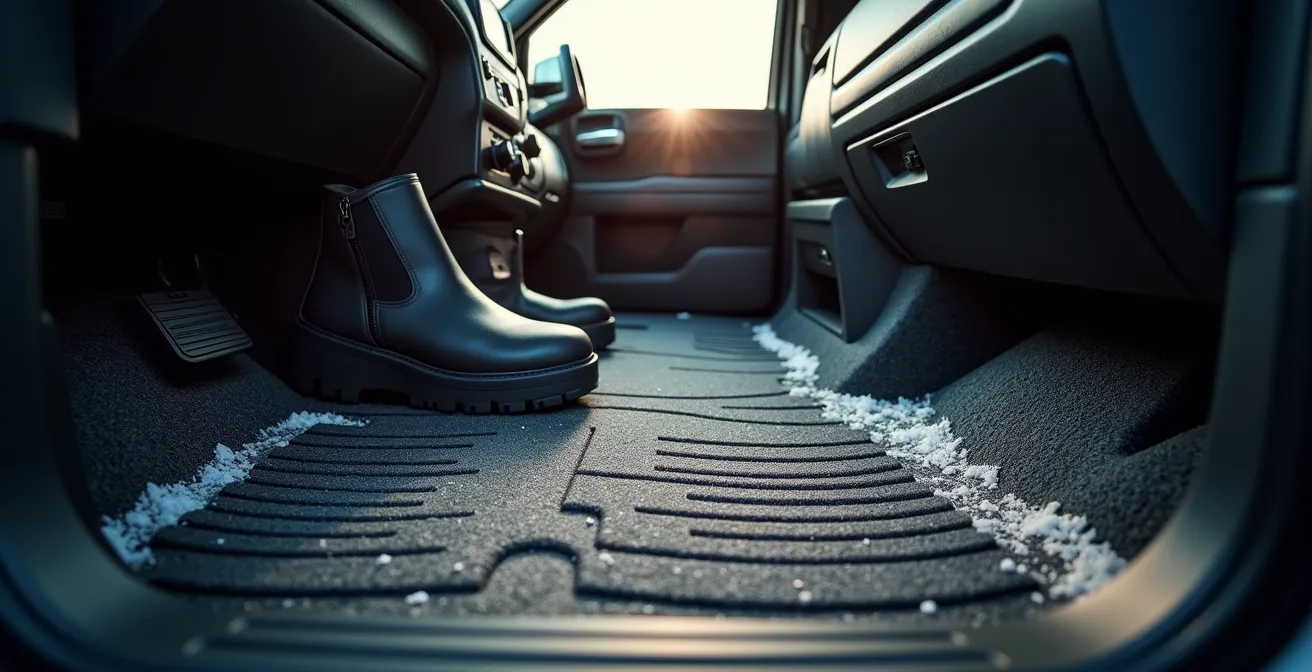
As the image above demonstrates, deep channels and reservoirs are designed to hold large volumes of liquid away from your feet, preventing it from sloshing around. The choice between WeatherTech and Husky Liners often comes down to material preference and specific design features, but both are built on this principle of total containment. Paying more is for this peace of mind—the certainty that your vehicle’s floor and underlying metal are shielded from the chemical assault of winter.
To understand the nuances between the leading brands, this comparative analysis based on data from automotive experts is invaluable. As one review highlights, both brands offer robust protection, though their approach to material and fit differs, giving consumers a meaningful choice in how they protect their interior.
| Feature | WeatherTech | Husky Liners |
|---|---|---|
| Material | Digital-fit premium density Tri-Extruded (HDTE) material with rigid core and gripping surface | Rubberized thermoplastic and flexible elastomeric material |
| Warranty | Limited lifetime warranty | Lifetime warranty |
| Price Point | Higher premium pricing | Often at a lower price than comparable WeatherTech offerings |
| Key Benefit | Computer configured and laser-measured for precise specifications, tri-extruded material unfazed by harsh temperatures | Flexible material options, immune to damage from harsh chemicals and extreme temperatures |
How to remove white salt stains from black rubber without making it grayish?
Even the best rubber floor liners will eventually show the tell-tale white residue of calcium. However, unlike on carpet, this is a surface problem that can be corrected with the right process. The key is to neutralize the alkaline salt chemically before you attempt to restore the rubber’s finish. A common mistake is simply scrubbing with soap and water, which often just smears the residue and can leave the black rubber with a dull, grayish haze. As a detailer, my approach is methodical to ensure a perfect, factory-fresh finish.
First, you must address the salt itself. A simple solution of equal parts white vinegar and water is the perfect neutralizing agent. The acid in the vinegar breaks down the alkaline salt crystals. After removing the mats from the vehicle and rinsing off loose debris, apply this solution and use a stiff-bristle brush to agitate the stained areas. This step is crucial; it does the chemical work that brute force scrubbing cannot. Once you’ve thoroughly worked the solution in, rinse the mats completely with clean water.
After the mats are completely dry, you can address the finish. The grayish look comes from the salt leaching plasticizers from the rubber and from micro-scratches. To fix this, use a high-quality, water-based rubber or vinyl conditioner. Avoid greasy, solvent-based tire shines, as they will create a dangerously slick surface. Apply a small amount of the conditioner with an applicator pad, working it into the rubber. Let it penetrate for a few minutes, then wipe away any excess with a clean microfiber towel. This rehydrates the rubber and restores its deep black color without leaving a slippery residue. This two-step process—neutralize then condition—is the secret to keeping your liners looking as pristine as the carpet they protect.
Your Action Plan: Restoring Salt-Stained Rubber Mats
- Remove and Prep: Take mats out of the vehicle and shake or rinse off all loose dirt and debris.
- Neutralize the Salt: Apply a 1:1 solution of white vinegar and water to the mats, focusing on the white-stained areas.
- Agitate and Scrub: Use a stiff-bristle brush to thoroughly scrub the vinegar solution into the rubber, breaking down the calcium crystals.
- Rinse and Dry: Rinse the mats completely with clean, fresh water and allow them to air dry fully. Do not proceed while they are wet.
- Condition and Restore: Apply a thin, even coat of a water-based rubber conditioner, then buff off any excess with a microfiber towel to restore the deep black finish.
The danger of a stuck pedal: why never put a winter mat over a summer mat?
This is not a suggestion; it is one of the most critical safety rules in vehicle operation. Never stack floor mats. Placing a heavy winter mat on top of the factory-installed carpeted mat is a recipe for disaster. Vehicle manufacturers go to great lengths to design safety features that prevent any interference with the pedals, and stacking mats completely defeats these systems. The primary safety feature is the retention hook or post on the vehicle’s floor. This hook is designed to anchor ONE mat—the factory mat—and prevent it from sliding forward.
When you place a second mat on top, it covers these essential retention hooks. The top mat is now completely unsecured. Under normal driving, with the repeated pressure of your feet, this top mat can and will creep forward. Eventually, it can slide far enough to get wedged underneath the brake or accelerator pedal. The result can be catastrophic: either you can’t apply the brake when you need to, or worse, the accelerator becomes stuck, leading to unintended acceleration. This isn’t a theoretical risk; it has been the cause of major vehicle recalls and serious accidents.
This is why premium, laser-measured liners are not just about cleanliness, but also about safety. They are designed to be the *only* mat in the footwell. They precisely match the floor’s contours and, most importantly, are designed to work with your vehicle’s specific retention system. As Transport Canada safety guidelines emphasize, this is a non-negotiable aspect of interior vehicle safety. As one safety advisory bluntly states:
Stacking mats covers factory retention hooks, defeating the entire safety system.
– Safety Advisory, Transport Canada Floor Mat Safety Guidelines
Tests consistently show that factory-specific mats are laser-measured to ensure they don’t interfere with pedal operation while also ensuring they stay locked in place. Always remove the factory mats before installing your winter liners. Your safety, and the safety of others on the road, depends on it.
Why are high walls mandatory to contain melting snow?
The single most important design feature of an effective winter floor liner is its high walls. A flat mat is useless against the primary threat in a Canadian winter: liquid volume. Think about the amount of snow and slush that can accumulate on a pair of winter boots after walking through a parking lot. When that melts, it doesn’t just create a damp spot; it creates a significant pool of water. On a flat mat, that water has nowhere to go but over the edge and onto your carpet.
This is where the term “liner” becomes more accurate than “mat.” Premium liners from WeatherTech and Husky are designed like a tray or a tub. The edges, or walls, are raised several inches along the sides of the footwell, including the transmission tunnel and against the door sill. This creates a waterproof basin that can safely contain a large volume of liquid. That pool of melted snow, full of corrosive salt, is held securely within the liner until you can remove and empty it.
Without these high walls, protection is an illusion. The water will inevitably breach the perimeter, soak the carpet, and begin its destructive work on the carpet fibres and the metal floor pan beneath. This feature is the very essence of the containment system. It’s what you’re paying for. Testing in harsh winter climates consistently proves this point, with one extensive review noting that high-wall floor liners proved essential for containing the slush and water from a Michigan winter boot season. A liner without high walls is like a boat with no sides; it’s destined to fail when you need it most.
The engineering behind this concept is simple but profoundly effective. By transforming the footwell into a controlled basin, you isolate the threat completely. The water stays in the liner, your carpet stays dry, and the vehicle’s structural integrity remains uncompromised.
Why do rocker panels rot from the inside out before becoming visible?
Rocker panels—the structural metal beams running along the bottom of your vehicle between the front and rear wheel wells—are notorious for rusting. What many owners don’t realize is that this corrosion often starts from the inside, and the culprit can be the very moisture they are letting pool on their car’s floor. When carpets become saturated with melted snow and salt from inadequate floor mats, that moisture doesn’t just stay in the carpet. It soaks through the backing and comes into direct, prolonged contact with the vehicle’s metal floor pan.
Modern vehicles have drainage channels and seams within their construction. This trapped moisture on the floor pan can slowly seep into these hidden areas, including the interior of the rocker panels. Once inside this enclosed space, the water has no way to evaporate. It sits there, combined with the highly corrosive road salt, and begins to eat away at the metal from the inside. You won’t see it for years. The exterior paint will look perfect, but silently, the structural integrity of your vehicle is being compromised.
By the time you see the first “bubble” of rust appearing on the outside of your rocker panel, it’s too late. That bubble means the metal has already rusted all the way through from the inside. The repair is no longer a simple touch-up; it’s a major, expensive job involving cutting out the rotted metal and welding in new pieces. This is why a savvy car buyer or mechanic will always tap on the rocker panels; they are listening for the solid sound of healthy metal, not the soft, flaky crunch of advanced rust. This is a direct hit to your car’s value, as Canadian road salt significantly accelerates undercarriage rust, drastically reducing long-term resale value. A proper, high-walled floor liner is your first and best line of defense, preventing the moisture from ever reaching the floor pan and starting this destructive chain reaction.
How do the steering wheel and pedals betray a car’s true mileage?
As a detailer and vehicle inspector, I know that an odometer can be misleading. The true story of a car’s life is told through its high-touch surfaces. While a worn steering wheel often indicates high mileage, the pedals and the floor area around them provide an even more detailed account, especially in Canada. The same abrasive materials that damage your car’s exterior—salt, sand, and grime—are ground into the pedals and floor by the driver’s feet every single day.
A car with genuinely low mileage should have pedals with minimal wear. The rubber should be firm, with crisp patterns. In a high-mileage vehicle, or one used heavily in harsh conditions, you’ll see the rubber worn smooth, especially on the brake pedal. More importantly, an inspector will look at the area *under* the floor mats. If they lift a pristine-looking mat to find a carpet heavily stained with crystallized salt and see corrosion on the pedal mounting points, it’s a huge red flag. It indicates that the car has seen heavy use in harsh conditions, and the owner only recently tried to cover it up with new mats. This discrepancy instantly destroys a seller’s credibility.
A vehicle that has been protected since day one with high-quality liners tells a different story. The pedals will show wear consistent with the mileage, but the carpet underneath will be immaculate. There will be no salt stains, no dampness, and no corrosion around the pedal assembly. This consistency is what builds trust with a potential buyer. It proves the owner was meticulous and cared for the vehicle’s preservation, not just its superficial appearance. When assessing a vehicle, an expert looks for these telltale signs of wear:
- Pedal Rubber: Check for worn-down patterns or smooth spots on the brake and accelerator.
- Mounting Points: Look for rust or salt residue on the metal arms and bolts where the pedals are attached to the firewall.
- Carpet Condition: Always inspect the carpet under the mats for salt stains, dampness, or wear holes from the driver’s heel.
- Mat and Pedal Consistency: Worn-out pedals paired with brand-new floor mats is a classic sign of someone trying to hide a car’s hard life.
Key Takeaways
- Permanent Damage: Road salt doesn’t just stain carpet; it causes irreversible chemical crystallization that is impossible to fully remove.
- Containment is Key: The value of a premium liner (WeatherTech, Husky) lies in its high walls and laser-fit design, which create a “containment system” to trap liquid, unlike cheap flat mats.
- Safety First: Never stack floor mats. Doing so defeats the factory retention hooks and creates a serious risk of pedal interference and unintended acceleration.
Cargo Liners for Pet Owners and DIYers: Preventing Damage to Your Trunk
The same principle of asset preservation that applies to your passenger footwells is equally critical for your trunk or cargo area. This space is often subjected to even more abuse, from the sharp claws and shedding fur of pets to leaky bags of soil for a gardening project or the sharp edges of hockey equipment. The factory-installed carpet in a trunk is typically thin and not designed to withstand moisture, abrasion, or dirt. A single spilled liquid or a muddy dog can instantly stain and devalue this part of your vehicle.
This is where a custom-fitted cargo liner becomes an essential part of a complete protection system. Much like their floor liner counterparts, premium cargo liners from brands like WeatherTech and Husky are laser-measured for a perfect fit. They feature a raised lip around the perimeter to contain spills and are made from the same durable, puncture-resistant, and easy-to-clean materials. For pet owners, this is a game-changer. It means a trip to the dog park doesn’t have to end with an hour of vacuuming and shampooing. You can simply remove the liner, hose it off, and it’s as good as new.
For the DIYer or sports enthusiast, it provides the freedom to use your vehicle as intended without fear of damage. Hauling bags of mulch, wet ski boots, or messy tools becomes a stress-free activity. Comprehensive testing has repeatedly shown that a full vehicle protection system is remarkably effective. As one long-term test concluded, after months of exposure to a full Canadian winter, a vehicle equipped with a full set of quality liners looked phenomenal, and the carpet underneath remained absolutely immaculate. A cargo liner completes the system, ensuring that from the front footwell to the rear tailgate, your vehicle’s interior is shielded, preserving its condition and maximizing its future resale value.
Ultimately, choosing to equip your vehicle with a complete set of high-quality, molded liners is one of the smartest financial decisions you can make as a car owner in Canada. It’s a direct investment in preserving its value and preventing costly, irreversible damage. Evaluate the options now and give your vehicle the protection it deserves.