Confidently towing in Canada isn’t about memorizing rules; it’s about mastering the non-negotiable laws of physics that govern your truck and trailer.
- Your truck’s payload capacity—not its advertised tow rating—is often the first and most critical limit you will hit, as it includes passengers, cargo, and the trailer’s tongue weight.
- Properly balancing your trailer so that 10-15% of its total weight presses down on your hitch is the single most important factor in preventing catastrophic trailer sway at highway speeds.
Recommendation: Before your first trip, weigh your fully loaded truck and trailer at a CAT scale to know your real-world numbers; it’s the only way to turn theoretical safety into practical reality.
The feeling is familiar for any new truck or SUV owner in Canada: a heavy trailer hitched up for the first time, the open highway ahead, and a knot of anxiety in your stomach. You’ve been told to “not tow too much” and to “balance the load,” but these fragments of advice feel dangerously abstract. The numbers on the door jamb sticker—GVWR, GAWR, Payload—seem like a foreign language, and the consequences of misinterpreting them are severe, ranging from mechanical failure to a terrifying loss of control.
The common approach is to focus on the maximum towing capacity advertised in glossy brochures. This is the first mistake. True towing safety isn’t a list of arbitrary rules to follow; it’s a direct and uncompromising application of physics. Gravity, leverage, and friction are not suggestions. They are the forces that will dictate whether your journey is smooth and safe or ends in disaster. This guide abandons vague advice in favour of treating every towing decision as an engineering calculation, where gravity is the ultimate arbiter.
We will dissect the fundamental forces at play, translating abstract ratings into tangible, real-world consequences on Canadian roads. By understanding the *why* behind the numbers, you will gain the competence and confidence to manage your load safely, from the dense traffic of the 401 to the steep grades of the Coquihalla.
This comprehensive guide breaks down the critical calculations and physical principles you need to master. Each section tackles a core question, providing the mathematical and legal framework for safe towing across Canada.
Summary: A Practical Guide to Towing Physics and Canadian Law
- Why can’t you pull 10,000 pounds if your truck is full of passengers?
- Too far forward or too far back: how to avoid deadly trailer sway?
- Ratchet straps or nets: how to stop your load from becoming a projectile?
- The blowout risk: why inflate your rear tires to max PSI when loaded?
- When is a brake controller mandatory by the provincial law?
- Why does a soft suspension increase your stopping distance by 3 meters?
- Half-ton or three-quarter-ton: which truck for your construction trailer?
- The calculation error that costs $1500 in extra fuel per year
Why can’t you pull 10,000 pounds if your truck is full of passengers?
This is the most common and dangerous misconception in towing, born from focusing on a single marketing number. The answer lies not in what your truck can pull, but in what it can carry. Every vehicle has a Gross Vehicle Weight Rating (GVWR), which is the absolute maximum weight of the truck itself, plus everything inside and on it. This includes you, your passengers, your cargo in the bed, and, crucially, the tongue weight of your trailer.
The calculation is simple but unforgiving: Payload Capacity = GVWR – Curb Weight (the weight of the empty truck). If your light-duty truck has a GVWR of 9,000 pounds and a curb weight of 6,000 pounds, its payload is 3,000 pounds. This isn’t just for lumber or tools. Four 200-pound friends (800 lbs), a cooler and gear (200 lbs), and the 1,000-lb tongue weight of your “10,000-lb” trailer consume 2,000 pounds of that payload. Suddenly, your 3,000-pound capacity feels much smaller.
Exceeding GVWR overloads your truck’s frame, suspension, axles, and tires. It compromises your ability to brake and steer safely. Furthermore, it can have severe financial consequences; exceeding your vehicle’s GVWR violates most insurance contracts, meaning you may not be protected if you cause an accident while overloaded. The GVWR is the first and most important number to respect.
Too far forward or too far back: how to avoid deadly trailer sway?
Deadly trailer sway is a terrifying oscillation that can lead to a complete loss of control. Its root cause is almost always improper tongue weight. Think of your trailer as a lever on a pivot point—the hitch ball. If there is too little weight on the hitch (e.g., you’ve loaded heavy items at the very back of the trailer), the trailer’s center of gravity shifts behind its axles. The slightest crosswind or steering input can lift the rear of your truck, initiating a sway that quickly becomes uncontrollable.
The non-negotiable rule of physics is to maintain a tongue weight that is 10% to 15% of the total loaded trailer weight. For a 7,000-pound travel trailer, this means 700 to 1,050 pounds must be pressing down on the hitch. This positive pressure keeps the pivot point firmly planted and ensures the trailer follows the truck obediently. You can measure this by weighing your truck with and without the trailer at a CAT scale or by using a specialized tongue weight scale.
For heavier trailers, a Weight Distribution Hitch (WDH) with integrated sway control becomes a critical piece of engineering. It uses spring bars to act as levers, redistributing a portion of the heavy tongue weight from your truck’s rear axle to its front axle and the trailer’s axles. This levels the entire rig, restoring steering control and braking performance that was lost due to the rear suspension sagging under the load.
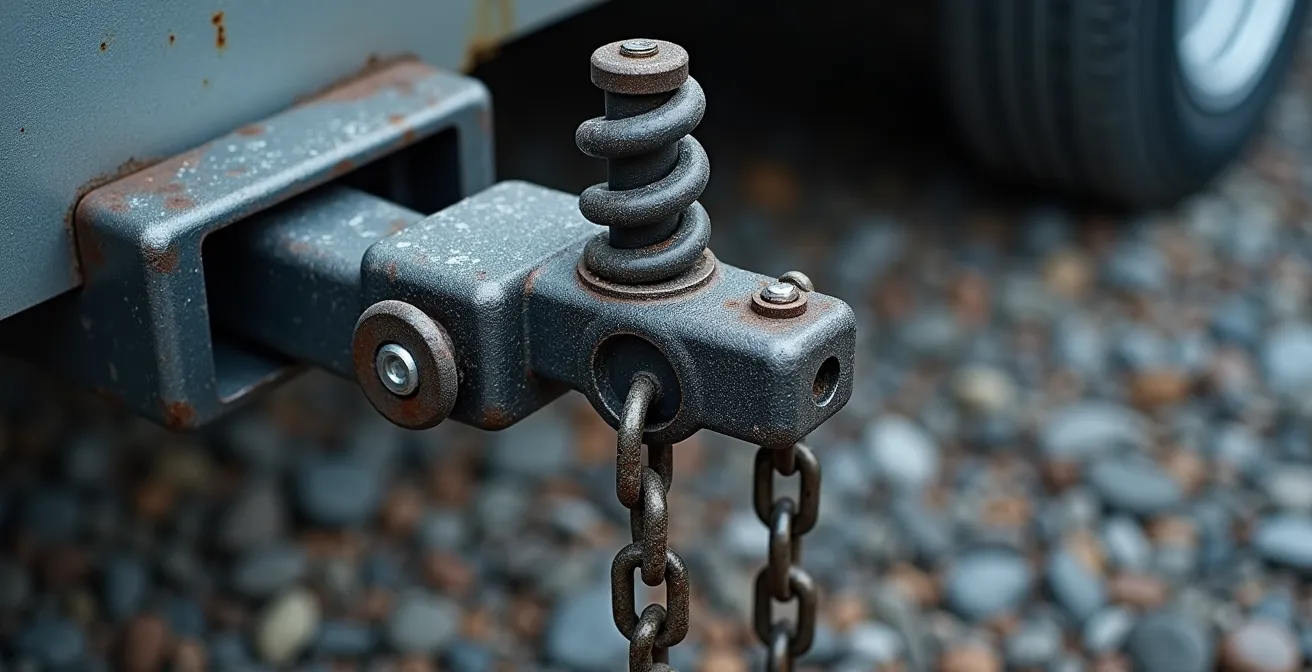
As seen in this detailed view, a WDH is not just an accessory; it’s a dynamic system. Adjusting the chain links and bracket angle changes the amount of leverage applied, allowing you to fine-tune the weight transfer for a perfectly balanced and stable towing experience, even on the demanding, weathered roads found across Canada.
Ratchet straps or nets: how to stop your load from becoming a projectile?
An unsecured or improperly secured load is governed by one simple law of physics: inertia. When your truck brakes or swerves, an object with mass will continue in its original direction of travel unless an opposing force stops it. A ratchet strap or a cargo net is simply a tool for applying that opposing force. The key is ensuring the force it can apply—its Working Load Limit (WLL)—is sufficient for the mass it needs to restrain.
In Canada, cargo securement is governed by the National Safety Code (NSC) Standard 10. The fundamental rule is that the aggregate WLL of all your tie-downs must be at least 50% of the weight of the cargo. So, to secure a 1,000-pound ATV, you need straps with a combined WLL of at least 500 pounds. It is critical to note that the break strength of a strap is not its WLL; the WLL is typically one-third of the break strength and is the only legally relevant number.
The configuration of the straps is just as important as their strength, as it determines the direction of the restraining force vectors. Different types of cargo require different patterns to prevent shifting, lifting, or tipping.
This table, based on guidelines from sources like an official Alberta Recreational Vehicle Towing Guide, illustrates how NSC Standard 10 applies to common loads.
| Load Type | Minimum WLL Required | Strap Configuration |
|---|---|---|
| Lumber/Building Materials | 50% of cargo weight | 4-point diagonal pattern |
| ATV/Quad | Combined WLL = 50% vehicle weight | Front & rear axle straps |
| Pallet of Salt/Sand | Working load limit 50% of load | Cross-pattern over top |
Whether you choose straps, chains, or nets, the principle remains: you must apply enough force in the correct directions to overcome the inertia your cargo will have during an emergency maneuver. A study of the working load of the strap should be more than the weight of the item you’re hauling for maximum security.
The blowout risk: why inflate your rear tires to max PSI when loaded?
A tire is not just a rubber donut; it’s a pneumatic vessel designed to operate under specific pressures. The PSI (pounds per square inch) recommendation on your driver’s door sticker is for an *unloaded* vehicle, optimized for ride comfort. When you add hundreds or thousands of pounds of payload and tongue weight, the physics change dramatically. That comfortable, lower PSI allows the tire’s sidewall to flex excessively under the heavy load.
This constant, exaggerated flexing generates an enormous amount of heat. Heat is the number one enemy of rubber, causing it to break down and eventually fail, leading to a catastrophic blowout at highway speed. The “Max PSI” number moulded into the tire’s sidewall is the pressure required to give the sidewall maximum stiffness, enabling it to support its maximum rated load without dangerous flexing.
Therefore, when towing or hauling heavy loads, you must inflate your tow vehicle’s rear tires to this maximum PSI. This minimizes flex, reduces heat buildup, and ensures the tire can safely support the load. Remember that an overloaded trailer is harder to stop and more prone to swaying, and under-inflated tires are a critical failure point in this dangerous equation. In Canada’s variable climate, pressure must be checked cold, as it can fluctuate significantly with temperature changes.
Action Plan: Cold Weather Tire Pressure Checklist
- Consult the Door Sticker: Note the recommended PSI for normal, unloaded driving conditions as your baseline.
- Find the Sidewall Max: Refer to the tire’s sidewall to find the maximum cold inflation pressure required when carrying a heavy load.
- Adjust for Temperature: In cold Canadian weather, remember that you lose approximately 1 PSI for every 5.6°C drop in ambient temperature. Check and adjust before you drive.
- Perform a Visual Squat Test: Look at the rear tires. If the sidewalls are visibly bulging, they are under-inflated for the load they are carrying.
- Consider Upgrading: If you tow heavy and often, consider upgrading to Load Range E tires, which are built with more plies for superior stiffness and load-carrying capacity.
When is a brake controller mandatory by the provincial law?
Relying solely on your truck’s brakes to stop a heavy trailer is a recipe for disaster. The trailer’s momentum will push your truck, overwhelming its braking capacity and dramatically increasing stopping distances. Electric trailer brakes are essential, but they are useless without a brake controller in the cab to activate them. A brake controller senses when you apply the brakes and sends a proportional electrical signal to the trailer’s brakes.
In Canada, the requirement for a brake controller is not optional; it is dictated by provincial law and is based on the gross weight of the trailer. While regulations are broadly similar, the exact weight thresholds vary from province to province. For a first-time tower, knowing the specific law in your home province and any you plan to travel through is a legal necessity.
The following table outlines the minimum trailer weight at which trailer brakes (and therefore a brake controller) become mandatory in several major Canadian provinces, based on data compiled from various provincial MTO and transportation guides.
This data, drawn from official sources like Alberta’s Recreational Vehicle Towing Guide, provides a clear legal picture across the country.
| Province | Brake Controller Required Above | Breakaway System Required |
|---|---|---|
| British Columbia | 1,400 kg (3,086 lbs) | Yes, if brakes are required |
| Alberta | 910 kg (2,006 lbs) | Yes, if brakes are required |
| Ontario | 1,360 kg (3,000 lbs) | Yes, if brakes are required |
| Quebec | 1,300 kg (2,866 lbs) | Yes, if brakes are required |
Beyond the controller itself, the law also requires a vital safety component. As the Keep Your Daydream RV Guide points out in its advice on payload:
you also have to have a breakaway switch to lock the trailer brakes should it become disconnected from the tow vehicle
– Keep Your Daydream RV Guide, Understanding GVWR & Payload
Why does a soft suspension increase your stopping distance by 3 meters?
When you apply your truck’s brakes, the vehicle’s weight shifts forward, pressing the front tires into the pavement. This pressure is what creates the friction necessary for effective braking. However, when you attach a heavy trailer, its tongue weight forces your truck’s rear suspension to compress, or “squat.” This action creates a lever effect, lifting the front end of your truck and reducing the weight over the front axle.
With less weight pressing them into the road, the front tires lose a significant amount of their braking grip. Your truck’s braking system is designed with a forward bias (typically 60-70% of braking force is applied by the front wheels), so this loss of traction is critical. The result is a tangible increase in your stopping distance—often by several meters—which can be the difference in an emergency situation. Furthermore, this lightened front end also compromises steering response, making it harder to make evasive maneuvers.
There’s a simple, effective way to see this effect in action: the headlight test. Park your unloaded truck on level ground about 25 feet from a wall and mark the center of your headlight beams with tape. Then, hook up your trailer. If the beams now point significantly above the tape marks, your front end has been lifted and your suspension is overloaded. This visual proof confirms that your steering and braking capabilities have been compromised.

On a steep descent like a Canadian mountain pass, managing your vehicle’s energy is paramount. The compromised braking from a squatting suspension, combined with the immense momentum of the trailer, puts incredible strain on the entire system. Research shows that exceeding GVWR causes serious damage to the frame, suspension, axles, and wheels, and a soft suspension is an early warning sign of this overload.
Half-ton or three-quarter-ton: which truck for your construction trailer?
For a contractor or serious tradesperson, choosing between a half-ton (e.g., F-150, Ram 1500) and a three-quarter-ton (e.g., F-250, Ram 2500) truck involves more than just towing capacity. It’s a calculation of durability, legality, and operational reality. While a modern, high-spec half-ton might have a tow rating that *seems* adequate for a heavy construction trailer, it will constantly be operating at its absolute payload and axle limits.
A three-quarter-ton truck is engineered differently. It has a stronger, stiffer frame, heavier-duty axles (GAWR), more robust brakes, and typically comes with Load Range E tires as standard. This means it can handle its maximum payload day in and day out without the accelerated wear and tear a half-ton would experience. It’s the difference between being *capable* of lifting a heavy weight once and being able to do it for a living.
In Canada, this choice also has significant legal implications, especially for commercial operators who may need a Commercial Vehicle Operator’s Registration (CVOR) in provinces like Ontario. The Gross Vehicle Weight Rating (GVWR) of both the truck and the trailer are key factors.
Case Study: The De-Rated Trailer Dilemma
Consider a tandem axle dump trailer with two 6,000-pound axles, giving it a physical capacity of 12,000 pounds. To make the trailer appeal to non-commercial buyers, a manufacturer might affix a GVWR sticker “de-rating” it to 9,990 pounds. This often allows someone without a commercial driver’s license to legally tow it *when empty*. However, a contractor who loads that trailer with 11,000 pounds of gravel is now operating illegally, as they are exceeding the trailer’s legal GVWR, even if its axles could physically handle the load. A three-quarter-ton truck is typically paired with trailers that have a higher, commercially appropriate GVWR, avoiding this legal trap.
For the professional who tows heavy equipment daily, the three-quarter-ton isn’t just about more power; it’s about having the legal and structural margin to do the job safely and reliably without constantly pushing the engineering limits of the vehicle.
Key takeaways
- Towing safety is governed by physics, not marketing. Your truck’s payload capacity is the most critical number, not its maximum tow rating.
- Maintaining a tongue weight of 10-15% of the gross trailer weight is the single most effective way to prevent dangerous trailer sway.
- Adhering to provincial laws for brake controllers and the National Safety Code for load securement (WLL of 50% of cargo weight) is a non-negotiable legal and safety requirement.
The calculation error that costs $1500 in extra fuel per year
The final law of physics to master in towing is that of energy consumption. It takes a tremendous amount of energy to move a heavy, un-aerodynamic brick—your trailer—through the air. The force of aerodynamic drag doesn’t increase linearly with speed; it increases with the square of the velocity. This means that the jump from 90 km/h to 120 km/h requires far more than 33% more power; it requires exponentially more.
For a tow vehicle, this translates directly into fuel consumption. While the exact numbers vary, transport efficiency studies demonstrate that you can expect up to 20% better fuel economy by cruising at a steady 90 km/h instead of 110-120 km/h on the highway. This isn’t just about saving a few cents; it’s a significant operational cost.
Let’s do the math for a typical Canadian RVer. Assume you tow your trailer for 10,000 km in a season. Your truck gets 25 L/100km while towing at 120 km/h, but this improves by 20% to 20 L/100km at 90 km/h. At a fuel price of $1.50 per litre, the faster speed costs you $3,750 for the season (2500 L x $1.50). The slower speed costs $3,000 (2000 L x $1.50). The simple act of slowing down saves you $750. If your base fuel consumption is higher, that saving can easily double to $1,500 per year. Other factors, such as ensuring proper tire pressure and maintaining a 10-15% tongue weight to reduce tire scrubbing, further contribute to fuel savings.
Slowing down isn’t just a matter of frugality. It reduces strain on your engine and transmission, lowers the risk of overheating, and, most importantly, gives you more time to react in an emergency. Respecting the physics of drag doesn’t just save you money; it makes you a safer tower.
By treating towing as an exercise in applied physics rather than a guessing game, you can ensure every journey is not only compliant with the law but is fundamentally safer for you, your family, and everyone else on the road. The next logical step is to take these principles and apply them to your specific truck and trailer combination with a visit to a certified scale.