Contrary to popular belief, the “3-second rule” is not a cautious suggestion; it’s a simplified expression of immutable physical laws. Your total stopping distance is a non-negotiable sum of perception-reaction time and braking capability. This article deconstructs this formula, demonstrating mathematically how factors like vehicle mass, speed, tire composition, and road friction dictate the life-or-death gap you must maintain on Canadian roads.
Every driver has felt it: that heart-stopping moment when the car ahead brakes abruptly. Your foot slams down, your heart lurches, and the world narrows to the space between your bumper and theirs. In that instant, you are at the mercy of physics. We are often told to follow the “3-second rule” or to “leave enough space,” but these are treated as vague guidelines rather than the critical safety margins they represent. They are the practical application of complex kinetic principles.
The common approach is to focus on the act of braking itself. But this overlooks the most significant variable: the distance your vehicle travels before your foot even touches the brake pedal. This is the domain of human reaction time, a factor far less instantaneous than we like to believe. This article moves beyond simple advice. We will dissect the stopping distance equation into its core components: reaction distance, which is governed by human biology and attention, and braking distance, which is dictated by the laws of kinetic energy, mass, and friction.
By understanding the “why” behind the rules, you cease to be a passive follower of instructions and become an active manager of physical forces. We will demonstrate irrefutably why a loaded SUV requires more space than a sedan, why wet pavement fundamentally alters the braking equation, and why your all-season tires become a liability the moment the temperature drops. This is not a driving lesson; it is an applied physics lesson where the stakes are measured in metres and milliseconds.
For those who prefer a condensed visual format, the following video highlights the immediate dangers of misjudging these physical principles, particularly in tailgating scenarios.
To fully grasp how these forces interact, this analysis breaks down the total stopping distance into its critical, non-negotiable components. The following sections will guide you through each variable of this crucial safety equation.
Summary: Stopping Distances Explained: The 3-Second Rule and Weather Factors
- Why do you lose 30 metres before even touching the brake pedal at 100 km/h?
- Why does a loaded SUV take 20% more distance to stop than a small car?
- Why double your following distance on a wet road (hydroplaning)?
- The danger of aggressive tailgating: why blocking others increases your own risk of an accident?
- What to do when someone is too close behind you without creating conflict?
- Why do your summer tires become ‘hockey pucks’ below 7°C?
- Why does a soft suspension increase your stopping distance by 3 meters?
- Preventing Rear-End Collisions: Safe Following Distances on Snowy Highways
Why do you lose 30 metres before even touching the brake pedal at 100 km/h?
The premise of the question is fundamentally flawed; the reality is far more alarming. At 100 km/h, your vehicle is traveling at approximately 27.8 metres per second. The critical factor here is not braking, but reaction. Total driver reaction is a three-step neurological process: perception (seeing the hazard), decision (deciding to brake), and action (moving your foot to the pedal). This is not instantaneous.
Total Driver Reaction Time, on average, is 2.5 seconds
– Ottawa Safety Council, Stopping Distance + Braking Safely
A simple calculation reveals the startling truth. In those 2.5 seconds, before your brake pads make any contact with the rotors, your vehicle has already traveled 69.5 metres (27.8 m/s * 2.5 s). You don’t lose 30 metres; you lose the length of nearly three semi-trailers. This is the “reaction distance,” an immutable component of your total stopping distance. Any distraction, from a text message to changing the radio station, extends this time, and therefore this distance.
This is not a theoretical problem. In Canada, its consequences are measured in lives. An analysis of national crash data reveals a stark connection. According to the latest figures, distracted driving contributed to 22.5% of fatal collisions and over a quarter of all serious injury collisions. Every fraction of a second of added reaction time translates directly into metres of unbraked travel, dramatically increasing the lethality of an impact.
Why does a loaded SUV take 20% more distance to stop than a small car?
The difference in stopping distance between a small car and a loaded SUV is a direct consequence of one of the most fundamental laws of motion: kinetic energy. The formula for kinetic energy is E = ½mv², where ‘m’ is mass and ‘v’ is velocity. To stop a vehicle, the braking system must convert all of this kinetic energy into heat through friction. The key takeaway is that the energy that needs to be dissipated is directly proportional to the vehicle’s mass.
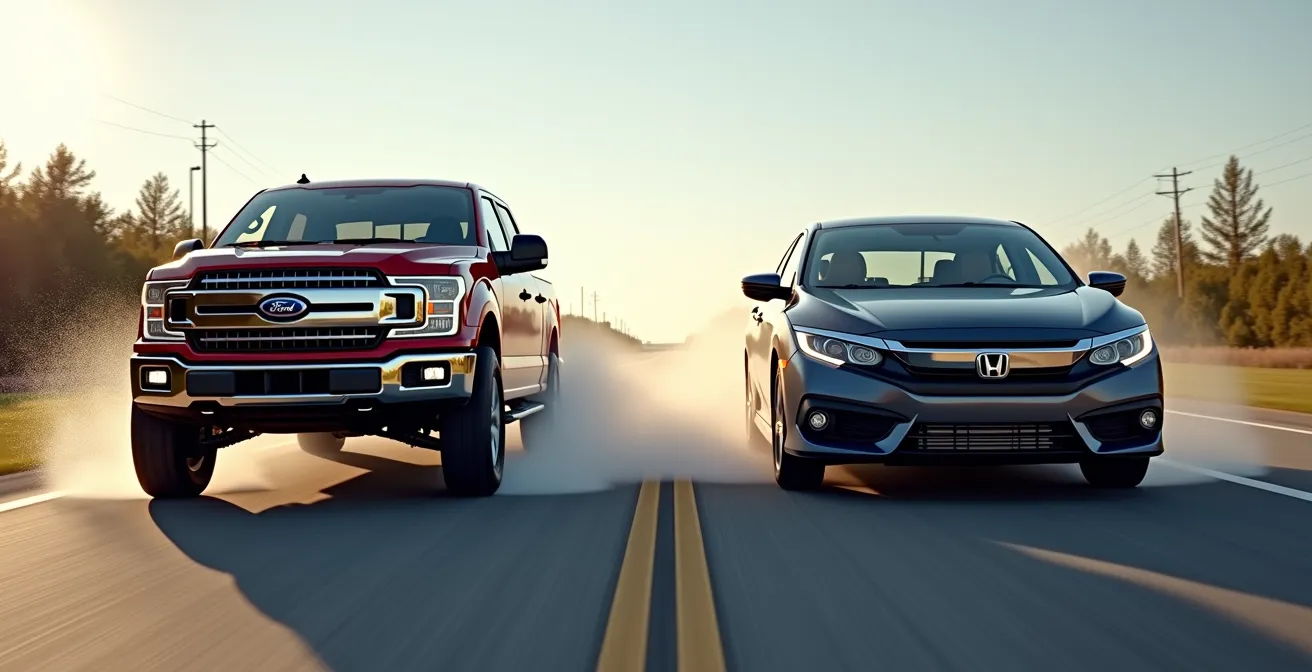
An average Honda Civic has a curb weight of about 1,300 kg. A loaded Ford F-150 can easily exceed 2,600 kg—double the mass. At the same speed, the truck possesses double the kinetic energy. Your brakes, therefore, have twice the work to do. This increased energy load not only lengthens the braking distance but also generates significantly more heat, which can lead to brake fade during prolonged or repeated hard stops.
Furthermore, mass influences braking dynamics through weight transfer. During hard braking, a vehicle’s centre of gravity shifts forward. In a heavier, taller vehicle like an SUV, this “nose dive” is more pronounced. The front suspension compresses, and the rear of the vehicle lifts, reducing the load on the rear tires. This lessens their grip and braking effectiveness, forcing the front brakes to handle an even greater proportion of the stopping force. This phenomenon is why the National Safety Council calculates that stopping distance increases dramatically with speed; for example, at 70 mph (approx. 112 km/h), it’s nearly 490 feet (150 metres) for an average vehicle, a figure that only grows with increased mass.
Why double your following distance on a wet road (hydroplaning)?
Doubling your following distance in the rain is not an arbitrary number; it is a necessary compensation for a drastic reduction in the coefficient of friction (μ) between your tires and the road surface. Friction is the force that allows your tires to grip the road and, consequently, allows your car to slow down. When the road is wet, a thin layer of water acts as a lubricant, fundamentally altering this physical interaction.
Under ideal dry conditions, the rubber of your tires makes direct, solid contact with the asphalt. When it rains, your tire treads are designed to channel water away from this contact patch. However, if the volume of water is greater than the treads can disperse, or if your speed is too high, a wedge of water can build up in front of the tire. This leads to hydroplaning, where the tire lifts off the road surface and rides on the layer of water. At this point, the coefficient of friction drops to nearly zero. You are no longer driving; you are skimming. Steering and braking control are effectively lost.
Even short of full hydroplaning, the presence of water significantly reduces grip. This physical reality is why a significant number of accidents are linked to weather. In fact, studies indicate that 21% of vehicle crashes are weather-related. To counteract this loss of friction, you must give your brakes more time—and therefore more distance—to work. Doubling your following distance from three seconds to six seconds or more is the minimum required adjustment. This increased buffer provides the necessary margin to brake more gently and avoid locking the wheels, which is critical for maintaining control on a low-friction surface. Your strategy should adapt to these conditions:
- In rain, snow, or icy conditions, stopping distances are significantly longer. It is wise to double the rule to six seconds or more.
- If you’re following a large truck or bus that blocks your view ahead, increase your following distance for a better view of the road and more time to react.
- When towing or carrying heavy loads, allow extra time between vehicles to compensate for the increased kinetic energy.
The danger of aggressive tailgating: why blocking others increases your own risk of an accident?
Aggressive tailgating is often perceived as an act of intimidation, a way to pressure the driver ahead. From a physics perspective, however, it is an act of self-sabotage. By tailgating, you are voluntarily eliminating your own temporal safety margin—the crucial buffer of time needed to execute the perception-decision-action sequence. You are betting your life, and the structural integrity of your vehicle, on the assumption of a perfect, instantaneous reaction from both yourself and the driver in front.
When you tailgate, you create a tightly coupled system where any small perturbation can lead to catastrophic failure. If the driver ahead needs to brake suddenly for an unforeseen obstacle—a deer, a piece of debris, another vehicle—they will use their full reaction and braking distance. Because you have eliminated your own reaction distance buffer, a collision becomes a mathematical certainty. You have created a scenario where the only way to avoid a crash is to violate the laws of physics.
This behaviour dramatically amplifies risk. You are not just reducing your own safety; you are increasing the cognitive load on the driver in front, potentially causing them to make erratic decisions. This is why driving safety organizations consistently link such behaviours to higher crash rates. For instance, data shows that any activity which diverts a driver’s attention, even for a moment, has severe consequences. According to CAA, using an electronic device increases collision risk by 3.6 times—a risk profile that is functionally similar to the constant, high-alert distraction imposed by tailgating.
Ultimately, by attempting to block or intimidate another driver, you are simply pre-positioning your own vehicle at the epicentre of an entirely preventable collision. You are not saving time; you are systematically dismantling your own safety net, one metre at a time.
What to do when someone is too close behind you without creating conflict?
When a driver is tailgating you, your immediate physical environment has been compromised. Your primary objective is not to teach them a lesson or to engage in a battle of wills, but to restore a safe operating margin within the system. “Brake checking” is the worst possible response, as it intentionally triggers the very collision you should be trying to avoid. Instead, the correct approach involves calm, deliberate actions to increase the space and time available to all parties.
Your first step is to increase the distance to the vehicle *in front of you*. Gently ease off the accelerator to slowly increase your own following distance to four, five, or even six seconds. This may seem counter-intuitive, but you are creating a larger buffer zone. This expanded space in front of you means that if the lead car brakes suddenly, you can slow down more gradually. This gradual deceleration gives the tailgater behind you more time to react, significantly reducing the chance of a rear-end collision. You are single-handedly injecting safety back into the system.
If creating this buffer does not deter the tailgater and you feel unsafe, the next step is to remove yourself from the situation entirely. Your goal is to let the dangerous driver pass. The following steps should be executed smoothly and predictably:
- Maintain a consistent speed and avoid any sudden movements that could be misinterpreted.
- Signal early and clearly your intention to change lanes.
- When it is completely safe to do so, move smoothly into an adjacent lane.
- Allow the aggressive driver to pass. By letting them go, you have effectively removed the hazard from your immediate proximity.
Resist the urge to escalate. Your only concern should be the physics of the situation: maximizing time and space to prevent an impact. Letting a tailgater “win” is, in fact, a victory for your own safety.
Why do your summer tires become ‘hockey pucks’ below 7°C?
The 7°C threshold is not a marketing gimmick; it is a critical temperature rooted in the material science of rubber compounds. Summer and all-season tires are formulated with a specific type of rubber designed for optimal performance in warm conditions. This compound provides excellent grip and durability on hot pavement. However, as the temperature drops, this rubber undergoes a physical change known as a glass transition.
Below approximately 7°C, the polymer chains within the rubber lose their flexibility. The tire compound begins to harden and stiffen, losing its ability to conform to the microscopic imperfections of the road surface. This drastically reduces the coefficient of friction. The tire, which was once pliable and grippy, now has the consistency and traction properties of a hockey puck on ice—hard, brittle, and slick. This is not a gradual decline; it’s a fundamental change in the material’s physical properties.

Winter tires, by contrast, are engineered with a different philosophy. They use a rubber compound rich in silica and other natural rubbers that remains soft and pliable at low temperatures. This allows the tire to maintain its grip on cold, dry pavement, as well as on snow and ice. The difference is not just in the tread pattern, but in the very chemistry of the tire. As experts point out, this is a non-negotiable aspect of cold-weather safety.
When the temperature drops below 7°C, all-season tires start to lose their elasticity, which results in poorer traction, handling and braking capacity. Winter tires retain their elasticity at temperatures far below 7°C.
– CAA-Quebec, Mandatory winter tires: important clarifications
The real-world impact of this science is undeniable. An analysis of provincial data confirms the effectiveness of using the correct tire for the temperature. For instance, Transport Canada reports that since Quebec’s winter tire law update, the province has seen a 19% decrease in winter road collision injuries, a figure far exceeding the national average. This is a direct testament to the importance of respecting the physics of tire compounds.
Why does a soft suspension increase your stopping distance by 3 meters?
A vehicle’s suspension system is not merely for comfort; it is a critical component of braking dynamics. Worn or “soft” shock absorbers and struts can significantly increase your stopping distance by disrupting the delicate balance of tire-to-road contact during deceleration. The 3-metre figure is a conservative estimate of the distance lost due to uncontrolled chassis dynamics.
When you apply the brakes firmly, a massive amount of weight transfers to the front axle. A healthy suspension system manages this weight transfer, controlling the rate at which the front of the car “dives” and the rear “lifts.” This control is essential for keeping all four tires pressed firmly and evenly against the pavement. When shock absorbers are worn, they can no longer effectively dampen this motion. The result is an exaggerated and often oscillating nose dive.
This excessive movement is detrimental to braking for two physical reasons. First, as the rear of the car lifts excessively, the rear tires lose a significant amount of downforce, and thus, traction. Their contribution to the overall braking effort is severely diminished. Second, the bouncing and instability of the chassis means the contact patch of all four tires can fluctuate, momentarily losing optimal grip. The braking system can only be as effective as the traction provided by the tires. If the suspension allows that traction to be compromised, braking distance inevitably increases. Therefore, maintaining your suspension is as critical as maintaining your brakes. Young Drivers of Canada recommends a baseline 3-second following distance on highways, a margin that assumes all vehicle systems are functioning optimally. A compromised suspension eats into this vital safety buffer.
Action Plan: Vehicle Dynamics Audit for Optimal Braking
- The “Bounce Test”: With the vehicle parked, press down firmly on each corner of the car and release. The vehicle should rebound once and settle. If it continues to bounce, your shocks or struts are likely worn.
- Tire Wear Inspection: Examine your tires for “cupping” or scalloping—uneven, scooped-out patches of wear. This is a classic sign that the tire is bouncing on the road due to poor damping.
- Braking Observation: In a safe, empty area, perform a firm (not panic) stop from a moderate speed. Pay close attention to excessive nose dive or a feeling of instability from the chassis.
- Steering and Handling Review: Note any unusual body roll in corners, swaying in crosswinds, or a general feeling of being disconnected from the road. These are all symptoms of a worn suspension.
- Professional Inspection: If any of the above are noted, have a qualified mechanic inspect your shocks, struts, ball joints, and bushings. Replacing worn components is a direct investment in reducing your stopping distance.
Key Takeaways
- Your total stopping distance is the sum of reaction distance (governed by your attention) and braking distance (governed by physics). The distance traveled before you brake is often longer than the braking itself.
- Kinetic energy (E = ½mv²) dictates that stopping distance increases with the square of your speed and is directly proportional to your vehicle’s mass. Heavier vehicles require exponentially more distance to stop.
- Friction is everything. Rain, snow, and ice drastically reduce the coefficient of friction. Below 7°C, the rubber compound of all-season tires hardens, severely compromising grip.
Preventing Rear-End Collisions: Safe Following Distances on Snowy Highways
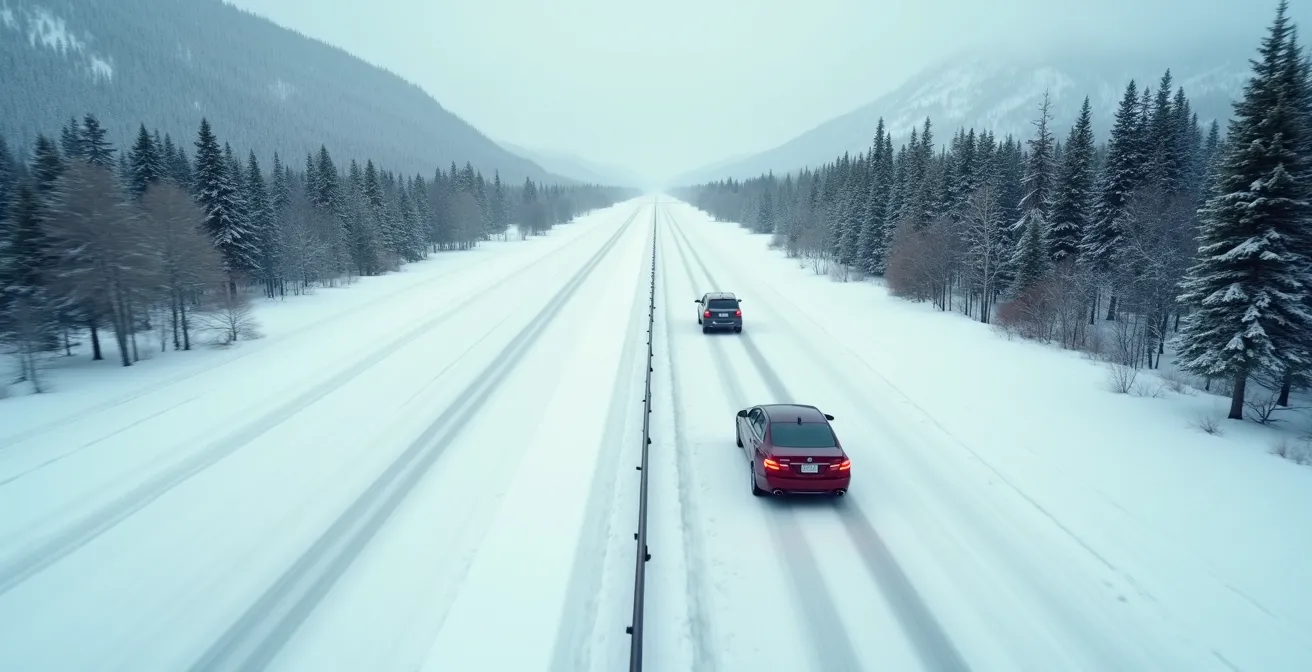
On a snowy or icy Canadian highway, all the physical principles we have discussed converge into their most dangerous form. The coefficient of friction is at its lowest, reaction times can be hampered by poor visibility, and the potential for multi-vehicle chain reactions is at its peak. Preventing rear-end collisions in these conditions requires abandoning standard following distances and adopting a strategy of extreme spatial awareness.
The “3-second rule” is a dry-pavement benchmark. On snow, it should be extended to 8-10 seconds or more. This is not an exaggeration. This massive buffer is necessary to compensate for the near-total loss of braking efficiency. Gentle, progressive braking is the only way to slow down without locking the wheels and initiating a skid. Executing this requires a vast amount of space. You are not just braking for yourself; you are managing your deceleration to avoid being a hazard to the vehicle behind you.
Case Study: The 1999 Ontario Highway 401 “Carnage Alley” Pile-Up
On September 3, 1999, near Windsor, Ontario, a patch of dense fog descended upon Highway 401. A chain reaction of collisions began when drivers failed to adjust their speed and following distance to the near-zero visibility conditions. The result was a catastrophic 87-vehicle pile-up that claimed eight lives and injured 45. This tragic event serves as a stark reminder that when visibility and friction are compromised, standard safety margins become meaningless. The only defence is a dramatic increase in following distance and a reduction in speed.
One of the most insidious winter hazards is black ice. It is a thin, transparent layer of ice that is nearly impossible to see, often forming on surfaces that are exposed to cold air from above and below. Understanding its formation is key to anticipating its presence.
Black ice can be present on roads with temperatures between 4 C and -4 C. Ice can form on bridges and overpasses before roads as the cold air underneath causes surface moisture to freeze.
– Transport Canada, RCMP Gazette – Just the Facts: Winter driving
In winter conditions, your primary responsibility shifts from simply driving to actively managing risk. This means assuming that the worst possible traction exists and leaving a space buffer that reflects that grim physical reality. It is the only way to give yourself the time and distance needed to overcome the unforgiving laws of physics on a frozen road.
Understanding these physical laws is the first and most critical step. The next is to apply this knowledge consistently, treating every second of following distance not as empty space, but as a non-negotiable safety buffer you are actively managing.