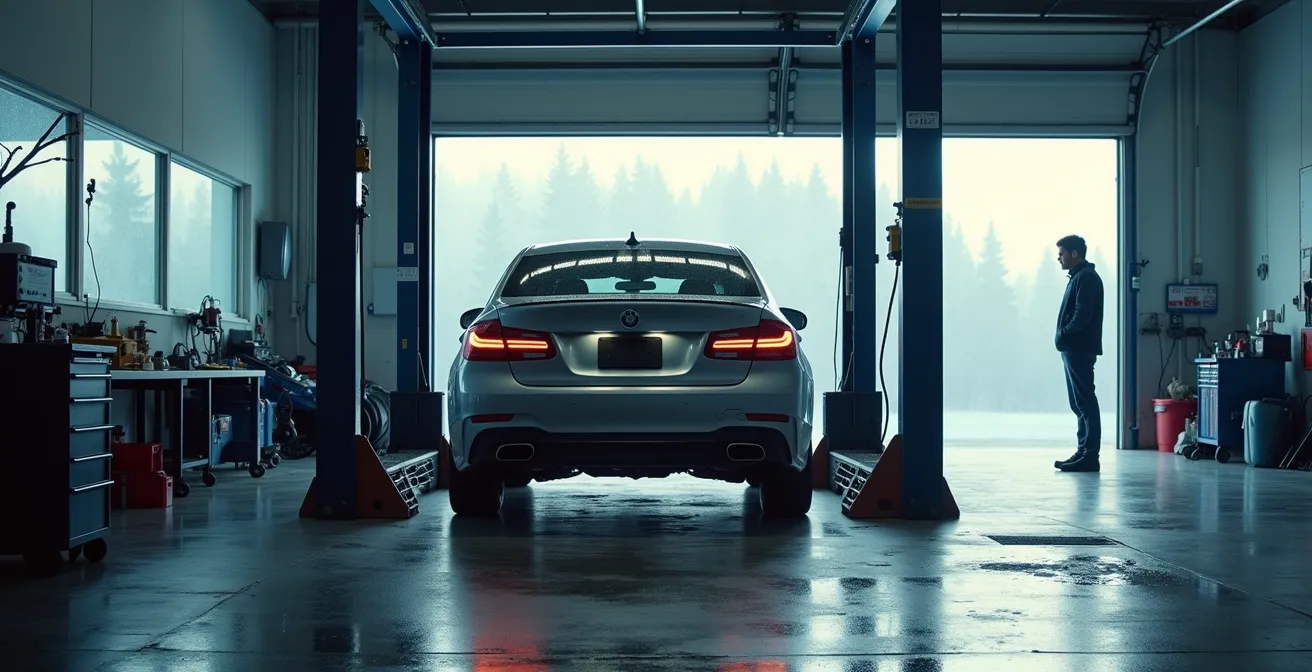
The most dangerous rust on a used car in Canada isn’t the visible surface spots; it’s the structural cancer rotting the vehicle from the inside out, often deliberately concealed by sellers.
- Internal corrosion begins in hidden areas like rocker panels and subframes due to blocked drainage channels trapping corrosive road salt slush.
- A fresh, thick black undercoating is a major red flag, often used to hide perforated frames and shoddy repairs rather than prevent rust.
- Distinguishing between minor cosmetic rust and a structural safety hazard is non-negotiable and determines whether you walk away from a deal.
Recommendation: Stop inspecting like a typical buyer and start thinking like a forensic investigator. Your goal is not to find rust but to uncover the evidence of decay and deception.
In the Canadian used car market, rust is the great equalizer. It doesn’t care if the badge on the hood is premium or economy; the relentless assault of road salt, especially in Eastern Canada and Quebec, seeks to return every vehicle to the earth. Most buyers know to look for the tell-tale bubbling on fenders or the orange stains on a trunk lid. This is a fundamental, and often costly, mistake. Focusing on this superficial “cosmetic” rust is like diagnosing a terminal illness by looking at a skin rash.
The brutal truth is that the most catastrophic corrosion happens where you can’t see it. It’s a slow-moving infection that starts deep within the car’s structural bones—the rocker panels, the subframe, the floor pans. It’s a pathology driven by design flaws, where drainage holes meant to release water become clogged, trapping a corrosive slurry of salt and moisture. Unscrupulous sellers are well aware of this, and a fresh coat of thick, rubberized undercoating is often not protection, but a tombstone sealing away the evidence of a fatally compromised frame.
But what if you could shift your perspective? What if, instead of just looking for rust, you started hunting for the mechanisms of rust? This guide is not about spotting the obvious. It’s about becoming a forensic inspector for a single, crucial hour. We will arm you with the knowledge to identify the hidden signs of structural decay, to differentiate between a minor blemish and a safety-critical failure, and to recognize the classic scams designed to fool the untrained eye. This is your defence against buying a shiny death trap.
This article provides a surgical approach to inspecting a used car for the kind of rust that truly matters. We will dissect the most common failure points, expose the tricks used to hide them, and provide a clear framework for making a go/no-go decision. Follow this guide, and you will be able to assess a vehicle’s structural health with confidence.
Summary: The Used Car Buyer’s Guide to Uncovering Hidden Corrosion in Canada
- Why do rocker panels rot from the inside out before being visible?
- How to check the subframe’s condition with just a flashlight and a mirror?
- Cosmetic rust or a safety hazard: when to walk away from a car?
- The fresh rubberized undercoating scam: what’s that black layer hiding?
- When to use a rust converter to stop the bleeding?
- The mistake that cuts your car’s resale value by 30% in 4 years
- Why is it impossible to clean carpets impregnated with crystallized calcium?
- The Canadian Maintenance Schedule: Adjusting for Severe Weather Conditions
Why do rocker panels rot from the inside out before being visible?
Rocker panels, the metal beams running beneath your doors, are ground zero for structural rust. Think of them not as solid steel, but as hollow channels. By design, they have drainage holes to allow water that enters the door frames and chassis to escape. In a Canadian winter, these channels become a death trap. They fill with snow, ice, and highly corrosive road salt. When the drainage holes clog with debris, this salty slush has nowhere to go. It sits inside the panel, slowly eating the metal from the inside out.
This is the core of the issue: structural oncology. The cancer starts internally. By the time you see a rust bubble on the outside of a rocker panel, it’s not the beginning of the problem; it’s the end. That bubble signifies that the corrosion has already eaten through the entire thickness of the metal. What you’re seeing is the final, catastrophic failure of the panel’s integrity. The structure is already compromised.
This process is why repair costs are so high. You aren’t just sanding down a surface spot. The repair involves cutting out entire sections of the car’s frame and welding in new metal, a process that can quickly lead to bills for $500 to $2,500 CAD for extensive rocker panel rust repair. The key for a buyer is to detect this internal decay before it becomes visible. A simple, effective method is the “Drainage Test”: carefully pour a bottle of water into the cowl (the grille at the base of the windshield) and check if it drains freely from under the car. If it doesn’t, it’s a massive red flag for blocked drainage and probable internal rot.
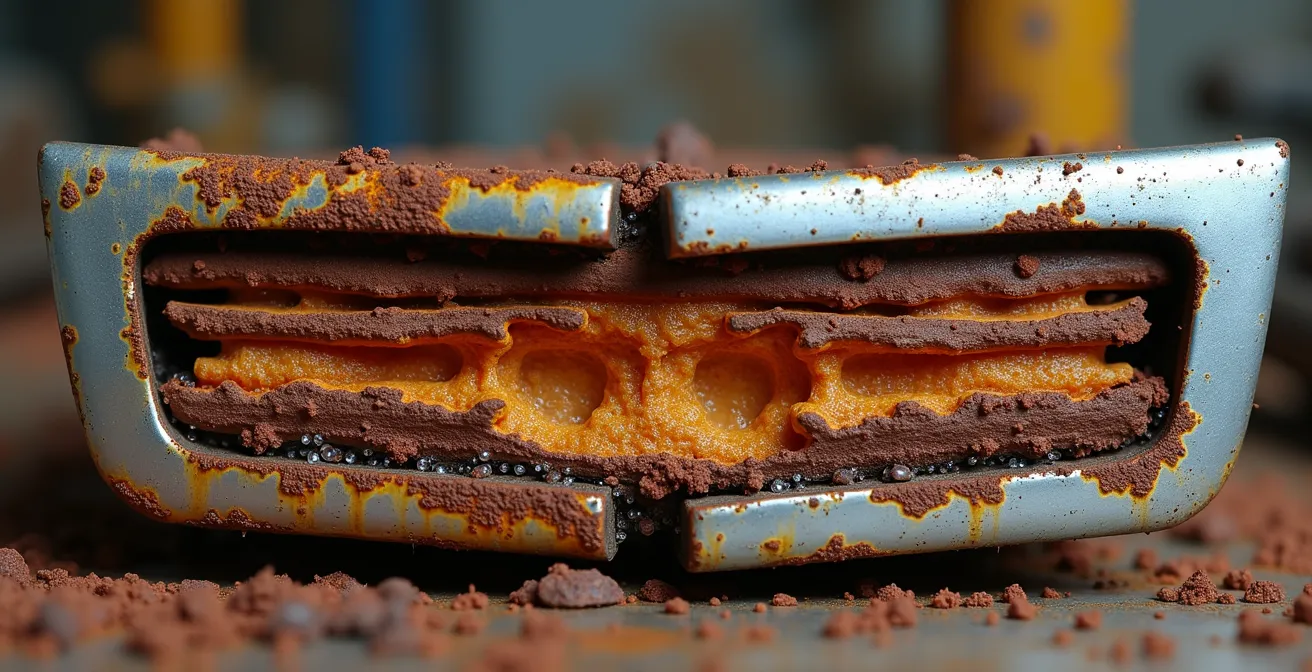
As this cross-section vividly illustrates, the outer painted surface can look relatively intact while the inner layers are turning to dust. This is the deception of rocker panel rust. Your inspection must focus on finding evidence of this internal drainage pathology, not just looking for paint bubbles.
How to check the subframe’s condition with just a flashlight and a mirror?
If the rocker panels are the car’s ribs, the subframe is its spine. This is the heavy steel structure that holds the engine, suspension, and steering components. Subframe corrosion is not a cosmetic issue; it’s a life-threatening failure waiting to happen. A compromised subframe can lead to catastrophic loss of vehicle control. Yet, it’s an area most buyers completely ignore.
You don’t need a hydraulic lift to perform a basic but effective subframe inspection. Your essential tools are a powerful flashlight and a small, extendable inspection mirror. As professional inspectors know, the worst rust hides in hard-to-see areas. Lie on the ground and methodically work your way around the vehicle. Use the mirror to inspect the top and back sides of the subframe, paying close attention to suspension mounting points and control arm mounts. These are areas where stress is high and moisture gets trapped.
What are you looking for? Forget light surface rust. You are hunting for flaking, scaling, or “pitting”. If you see layers of rust that you can flake off with a fingernail or, even worse, if the metal looks like a piece of swiss cheese, you are looking at advanced decay. A classic test, if you can reach, is to tap the area firmly with the handle of a screwdriver. A solid frame will produce a sharp “ping.” A rotted frame will produce a dull “thud,” or worse, your tap might go right through the metal.
Certain vehicles are notoriously prone to subframe rust in the Canadian climate. Knowing where to focus your attention can save you valuable time during an inspection. The following table highlights critical failure points on some popular models, though these areas should be checked on any vehicle.
| Vehicle Model | Critical Failure Points | Inspection Priority |
|---|---|---|
| Honda CR-V (older) | Rear subframe | High |
| Ford Escape | Front subframe | High |
| Mazda 3 | Front subframe | High |
| All Models | Control arm mounts | Critical |
| All Models | Suspension mounting points | Critical |
Cosmetic rust or a safety hazard: when to walk away from a car?
This is the most important question a used car buyer in Canada can ask. The line between a manageable cosmetic issue and a non-negotiable safety hazard can seem blurry, but it’s actually razor-sharp. Your decision to walk away shouldn’t be based on emotion; it should be a cold, hard calculation based on safety standards and financial viability. The key is to identify rust on components where structural integrity is non-negotiable.
Surface rust on a replaceable body panel like a fender or door skin is a cosmetic problem. It will affect resale value and is a good point for negotiation, but it won’t kill you. However, any significant rust on the frame, subframe, suspension components (like control arms), brake lines, or fuel lines is an immediate “FAIL.” This isn’t just a potential problem; it’s a clear and present danger. A rusted brake line can burst under pressure, leading to total brake failure. A rotted control arm can snap, causing a wheel to detach from the car.
Financially, you must identify the “Point of No Return.” This is the threshold where the cost of a proper repair exceeds the value of the car or a significant fraction of it. When it comes to structural components like rocker panels, where $2,200 to $5,600 average replacement cost is common, you are often past this point on an older used car. Paying $4,000 to repair a car you bought for $6,000 is a financial catastrophe.
To remove all ambiguity, here is a pass/fail checklist based on the principles of Canadian provincial safety inspections. If the car fails any of these points, you must walk away, no matter how good the deal seems.
Your Non-Negotiable Rust Inspection Checklist
- Structural Perforation: Find any hole larger than a coin in the floor pan, frame rails, or rocker panels. (FAIL)
- Frame Weakness: Tap all accessible frame members with a screwdriver handle. If the sound is a dull thud or the metal flexes, it’s compromised. (FAIL)
- Critical Component Corrosion: Inspect all suspension parts, brake lines, and fuel tanks. Any sign of deep pitting, flaking, or swelling is an absolute no-go. (FAIL)
- Hidden Damage Indication: Look for bubbling or blistering paint on rocker panels, cab corners, or near pinch welds. This indicates advanced rust from within. (FAIL)
- Cosmetic vs. Structural: Differentiate between surface rust on a bolt-on panel (e.g., front fender) and rust on a welded structural member (e.g., rocker panel). The former is a negotiation point; the latter is a deal-breaker. (PASS/FAIL)
The fresh rubberized undercoating scam: what’s that black layer hiding?
You slide under a prospective car and see a fresh, thick, uniform layer of black rubberized undercoating. Your first thought might be, “Great, this owner really took care of the car!” This is precisely what a dishonest seller wants you to think. In reality, this is one of the biggest red flags in the Canadian used car market. This is not protection; it’s a cover-up.
Legitimate annual rust proofing, like Krown or Rust Check, is a thin, light, drippy oil designed to creep into seams and displace moisture. It’s messy, but it works. The thick, tar-like undercoating, especially when freshly applied, is the exact opposite. It’s an opaque mask that can be used to hide a multitude of sins. It’s perfect for covering up rust holes, previous shoddy repairs, and even perforated frame rails. It traps moisture against the metal, accelerating corrosion underneath while looking pristine on the surface.
Your job as an inspector is to treat this black layer with extreme suspicion. This is forensic undercoating analysis. Run your hand over it. Is it still tacky? A recent application is highly suspect. Look for signs of overspray on the exhaust or suspension components, indicating a quick, careless job. Most importantly, probe it. Get your screwdriver and push firmly in key areas like the pinch welds, the frame rails near the wheels, and the floor pans. If the screwdriver sinks in or feels soft, you are likely pushing into body filler (Bondo) or straight into a rust hole that has been concealed.

As the CARCHEX Research Center points out in their guide, “How To Inspect A Car For Rust & Repainting,” there’s a simple, effective tool for this part of the inspection:
If you suspect that a part of the body was repaired with body filler, test it with a small magnet. If the magnet doesn’t stick, then there’s filler underneath.
– CARCHEX Research Center, How To Inspect A Car For Rust & Repainting
When to use a rust converter to stop the bleeding?
Let’s be clear: a rust converter is not a magic wand. It cannot resurrect a perforated frame or rebuild a rotted-out rocker panel. A rust converter is a chemical solution designed for a very specific task: to stop manageable surface rust from spreading. It works by chemically converting iron oxide (rust) into a stable, inert, paintable compound. It’s a tool for triage, not for surgery.
You should only consider dealing with rust yourself if it meets three strict criteria:
- It is purely surface-level, with no pitting or flaking.
- It is on a non-structural or easily replaceable component (e.g., a battery tray, a small spot on a door, a surface blemish on a solid frame).
- You can access the entire affected area to properly grind or sand it down to bare metal before application.
If the rust is on a critical component or is anything more than a light dusting, you are in professional repair territory.
However, finding treatable surface rust during an inspection isn’t a reason to walk away; it’s a powerful negotiation tool. Instead of just saying “it’s a bit rusty,” you can present a calculated, evidence-based argument for a price reduction. Your strategy should be methodical:
- Document Everything: Take clear photos of every single rust spot you find.
- Estimate Material Costs: Research the cost of quality rust converter products (like POR-15 or Tremclad Rust Reformer) and the necessary primers and topcoats.
- Calculate Labour: Estimate the hours required for proper preparation—grinding, sanding, cleaning—which is the most time-consuming part. A small 10cm spot can easily take an hour of prep work.
- Present an Itemized Demand: Show the seller your photos and your itemized cost estimate. Propose a price reduction that is at least 150% of your estimated cost. This premium accounts for your time, labour, and the risk that the rust may be worse than it appears.
This transforms you from a complaining buyer into a prepared negotiator who has done their homework. You’re not just asking for money off; you’re demonstrating the real-world cost to remedy the defects you’ve found.
The mistake that cuts your car’s resale value by 30% in 4 years
The single biggest mistake a Canadian car owner can make is viewing rust prevention as an optional expense rather than a core part of the vehicle’s maintenance schedule. Neglecting annual rust proofing is the financial equivalent of setting money on fire. The cosmetic and structural decay caused by road salt is the primary driver of depreciation in the Canadian market, far outpacing mileage or mechanical wear and tear on otherwise reliable vehicles.
Think of it this way: a potential buyer can’t easily see a well-maintained engine, but they can instantly see a rusting fender or a decaying rocker panel. That visual evidence of neglect obliterates their confidence and, consequently, the car’s value. Industry analysis consistently confirms that vehicles with a documented history of annual rust proofing from reputable providers like Krown or Rust Check sell faster and command significantly higher resale prices. The small annual investment protects the much larger asset.
The logic is simple. As Burlington Krown states, the condition of the vehicle’s body is a top factor in determining its worth.
Vehicles that are rust-free sell quicker and for more money. One key factor for higher resale value is the vehicle’s body condition.
– Burlington Krown, Burlington’s #1 Krown Rust Protection
Ignoring this reality means that after just a few Canadian winters, your vehicle’s body can be so compromised that its value plummets. A car that might have been worth $10,000 could struggle to fetch $7,000, not because of its mileage, but because a potential buyer sees the visual evidence of decay and factors in thousands of dollars in potential repairs. This 30% drop in value due to rust is a conservative estimate in many cases. The mistake is not seeing rust proofing as a repair, but as an investment in preserving equity.
Why is it impossible to clean carpets impregnated with crystallized calcium?
The white, chalky stains on a car’s carpets are not just dirt. They are the chemical footprint of a Canadian winter and a sign of deeper problems. Those stains are primarily crystallized calcium chloride or magnesium chloride, the active ingredients in modern, aggressive road de-icers. And unlike simple road salt (sodium chloride), these chemicals are uniquely destructive to a car’s interior.
Here’s the problem: these chemicals are highly hygroscopic, meaning they aggressively attract and retain moisture. When you bring snow and slush into your car on your boots, the water eventually evaporates, but the calcium chloride remains. It then recrystallizes, forming sharp, needle-like crystals that physically bond with and cut into the carpet fibers. At this point, no amount of scrubbing or vacuuming will remove them. They are chemically and physically embedded in the fabric. This is the “calcium dagger” effect.
This isn’t just an aesthetic issue. Because these chemicals hold moisture, they keep the carpet and the padding underneath perpetually damp, creating the perfect environment for mold, mildew, and, most importantly, for rusting the floor pan from the inside out. If you see heavy calcium staining on the carpets, you must be highly suspicious of the condition of the metal floor underneath. Pull back the carpet in a corner if you can and inspect the floor pan directly.
Prevention is the only viable strategy. Once the damage is done, it’s largely irreversible. Protecting a car’s interior from salt requires a proactive approach:
- Install High-Walled Liners: Before winter, invest in custom-fit, high-walled floor liners (like WeatherTech or Husky Liners). These act as a basin to contain slush and prevent it from ever touching the carpet.
- Clean Mats Regularly: Remove and clean the liners weekly to get the salt-laden water out of the car’s interior.
- Vacuum Before It Sets: If any salt residue does get on the carpet, vacuum it up immediately before it has a chance to absorb moisture and crystallize.
- Spring Cleaning is an Inspection: During your annual spring cleaning, remove all mats and thoroughly inspect the carpets and the floor pans underneath for any signs of rust.
Key Takeaways
- Structural rust begins inside hollow components like rocker panels due to blocked drainage, long before it’s visible outside.
- A fresh, thick black undercoating is a major red flag, often used to hide serious frame damage rather than prevent it.
- The line between cosmetic rust and a safety hazard is defined by the component: any significant rust on the frame, subframe, or brake lines is a deal-breaker.
The Canadian Maintenance Schedule: Adjusting for Severe Weather Conditions
Owning a car in Canada requires a different mindset. You cannot follow a “standard” maintenance schedule designed for more temperate climates. You must operate on a Canadian schedule, one that is aggressively proactive about combating the single greatest threat to your vehicle’s lifespan: corrosion. This isn’t about just washing your car; it’s about a systematic, region-specific defence strategy.
The first step is to understand your specific risk level. Not all parts of Canada are equal when it comes to rust. The combination of heavy road salt use, high humidity, and freeze-thaw cycles creates a perfect storm for corrosion. The Maritimes, Quebec, and Ontario represent the highest-risk zones in the country.
This regional risk assessment dictates the required frequency and type of rust protection. The following table provides a general guideline for Canadian drivers, highlighting the extreme risk posed by the heavy use of calcium chloride in central and eastern provinces.
| Region | Rust Risk Level | Primary Factors | Recommended Protection |
|---|---|---|---|
| Maritimes | Very High | Salty air + road salt | Annual treatment essential |
| Quebec/Ontario | Very High | Heavy calcium chloride use | Annual treatment essential |
| Prairies | High | Extreme cold + salt | Annual treatment recommended |
| BC Coast | Moderate | High humidity, minimal salt | Bi-annual treatment |
A core component of the Canadian maintenance schedule is budgeting for professional annual rust proofing. This is not an “if I can afford it” item; it’s as critical as an oil change. According to the Automobile Protection Association (APA), a quality treatment is an affordable and essential investment, with the typical Canadian budget including $120-$150 for an annual rust-proofing treatment. When you compare this small annual cost to the thousands of dollars in lost resale value or structural repairs, the choice is obvious.
Now that you are armed with the forensic knowledge to see what others miss, the next step is to put it into practice. Approach every used car inspection not as a buyer, but as an investigator determined to uncover the truth hidden beneath the paint and panels.