
The final price of your Canadian car rental is not fixed; it’s a series of choices where rental agencies bet on you making the wrong one.
- Your credit card’s “free” insurance likely has a major blind spot: third-party liability coverage.
- Documenting pre-existing damage requires a forensic video approach, not just a few casual photos, to be effective.
Recommendation: Treat every step, from booking to return, as a strategic move to counter predictable hidden fees and protect your wallet.
You found a great deal online: a rental car in Canada for a week, seemingly for a bargain. You click, book, and feel savvy. But when you return the keys, the final bill is a shock—hundreds of dollars more than you expected. Sound familiar? This isn’t bad luck; it’s the business model. As a former rental agency manager, I can tell you the system is designed with predictable points of failure where a rushed or uninformed customer will hemorrhage money through opaque insurance, damage claims, and last-minute fees.
Most online guides offer the same tired advice: “book in advance” or “compare prices.” That’s not a strategy; it’s common sense. They tell you to check for damage but don’t explain how to create evidence that will actually stand up in a dispute. They mention insurance but fail to highlight the critical, wallet-draining gaps in coverage that rental agents are trained to exploit. This guide is different. We’re not just listing tips; we’re revealing the playbook used by rental agencies themselves.
Forget being a passive customer. To truly avoid hidden fees, you need to think like an auditor. This means understanding the “why” behind each potential charge—from the subtle differences in provincial insurance laws that make renting in Toronto a different financial game than in Montreal, to the precise way to document a pre-existing scratch so it’s indisputable. This article will equip you with the insider knowledge to navigate the rental counter with confidence, turning a process designed to confuse you into a series of clear, money-saving decisions.
This comprehensive guide breaks down the eight critical areas where renters lose money. We’ll provide you with the exact knowledge and actionable steps needed to counter each potential pitfall, ensuring the price you’re quoted is the price you actually pay.
Summary: A Strategic Guide to Canadian Car Rentals
- Does Your Credit Card Really Cover Collisions? (LDW/CDW Explained)
- How to Document Existing Scratches to Avoid Paying for Them on Return
- Unlimited or 200 km/Day: Which Plan to Choose for an Interprovincial Road Trip?
- The Exorbitant Cost of Agency Gasoline: How to Avoid It
- What Documents to Ask the Agency to Avoid Customs Issues?
- Why Does Insuring a Car in Toronto Cost 50% More Than in Montreal?
- Wired to Wireless Adapter: Is It Reliable or Does It Constantly Cut Out?
- Why Standard HD Isn’t Enough to Read a License Plate in Motion
Does Your Credit Card Really Cover Collisions? (LDW/CDW Explained)
The single biggest point of confusion—and profit—at the rental counter is insurance. The agent asks if you want the “Loss Damage Waiver” (LDW) or “Collision Damage Waiver” (CDW). You confidently say, “No thanks, my credit card covers me.” This is the moment where your insurance blind spot can cost you thousands. While most premium credit cards do offer CDW, this coverage is almost exclusively for damage to, or theft of, the rental car itself. It does not cover third-party liability—meaning damage to another vehicle, property, or injury to another person.
This is the critical detail agents bank on you not knowing. In a private insurance province like Ontario, if you don’t have your own auto insurance policy that extends to rentals, you are legally required to purchase the rental company’s third-party liability insurance, which can be a significant daily cost. Furthermore, credit card coverage isn’t infinite. Many cards have limits on the Manufacturer’s Suggested Retail Price (MSRP) of the vehicle they’ll cover and the duration of the rental. Some plans offer coverage for up to 48 consecutive days, but others cap it at 31, a crucial detail for longer trips.
Before you rent, call your credit card provider and ask two specific questions: “What is the maximum vehicle MSRP covered?” and “Does my card provide any third-party liability coverage in Canada?” The answer to the second question is almost always no. Understanding this distinction is your first line of defense against overpaying.
To illustrate the differences, a review of premium Canadian credit cards highlights the varying coverage limits. As this comparative analysis from a leading financial site shows, not all “premium” cards are created equal.
| Credit Card | MSRP Coverage Limit | Coverage Duration | Type of Coverage |
|---|---|---|---|
| BMO CashBack World Elite Mastercard | $65,000 | 48 days | Primary |
| American Express Cobalt | $85,000 | 48 days | Secondary |
| Scotiabank Momentum Visa Infinite | $65,000 | 48 days | Secondary |
| TD Aeroplan Visa Infinite | $65,000 | 48 days | Secondary |
Ultimately, relying on your credit card is a valid strategy, but only if you’ve done your homework and understand its precise limitations before you arrive at the counter.
How to Document Existing Scratches to Avoid Paying for Them on Return
Here’s a scene I saw play out a hundred times: a customer returns a car, and the agent spots a small scratch on the bumper. The customer swears it was already there, but they have no proof. The agent points to the signed agreement stating the car was damage-free. Result: a hefty bill for a repair you didn’t cause. Taking a few blurry photos in a dark parking garage is not enough. You need to engage in forensic documentation—creating a record so thorough it’s indisputable.
The key is a continuous, narrated video. Before you even put your luggage in the car, start recording on your smartphone with GPS geotagging enabled in your camera settings. This time-stamps and location-stamps your evidence. Walk slowly around the entire vehicle, narrating what you see. Say, “Driver’s side door, no damage. Hood, no damage. Front bumper, small two-inch scratch on the lower right side.” Zoom in on every single ding, chip, and scuff. Don’t forget high-risk areas like the windshield, wheel rims, and the underside of the front bumper. After your walk-around, film the dashboard to show the mileage and fuel level.
This video is your ultimate protection. When you point out the damage to the agent, insist they note every single item on the Vehicle Inspection Form. If they refuse or rush you, simply write “See video documentation for pre-existing damage” on the form yourself, then take a photo of the signed form. This approach shifts the burden of proof entirely.
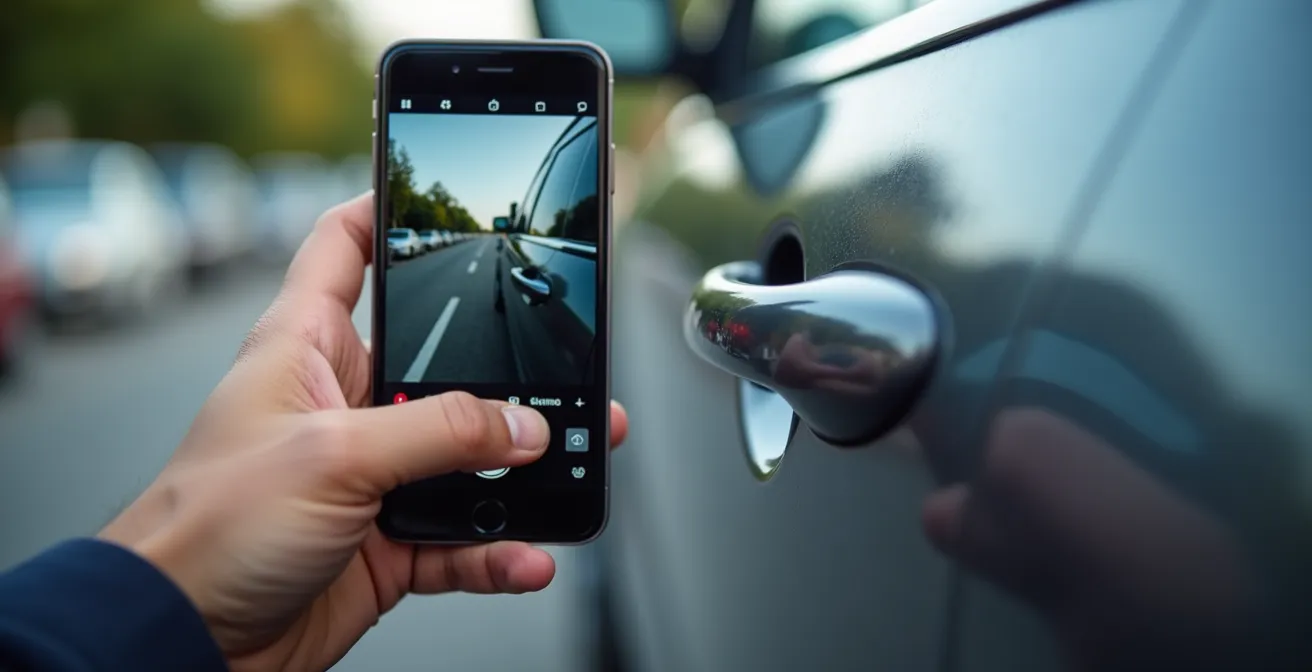
As the image demonstrates, a close, detailed inspection is paramount. You are not just looking for major dents; you are cataloging every imperfection that could be used against you later. This meticulous approach may take five extra minutes, but it can save you hundreds, or even thousands, of dollars in false damage claims.
Your Action Plan: Forensic Rental Car Inspection
- Video Walk-Around: Take a slow, continuous video of the entire car with GPS geotagging enabled, narrating your observations.
- Detail High-Risk Zones: Focus specifically on the windshield for chips, wheel rims for curb rash, and the underside of bumpers for scrapes.
- Agent Sign-Off: Insist the rental agent notes every scratch you find on the official Vehicle Inspection Form before you sign.
- Create a Record: If the agent refuses, write “See video documentation for all pre-existing damage” on the form yourself and take a clear photo of it.
- Preserve Evidence: Keep the video file, the photo of the form, and all rental paperwork until your final credit card statement is clear of any extra charges.
This process isn’t about being difficult; it’s about being precise. It’s the professional way to protect yourself in a system where you are held responsible for the asset’s condition.
Unlimited or 200 km/Day: Which Plan to Choose for an Interprovincial Road Trip?
The “Unlimited Kilometres” offer looks like the obvious choice for a Canadian road trip, but it’s often a marketing tactic that masks other, more significant costs. This is the Mileage Mirage. Agencies know that for true cross-country or interprovincial trips, the real killer isn’t the per-kilometre charge; it’s the one-way drop-off fee. Before you even look at the mileage, ask about the cost to return the car in a different province. This fee can be substantial.
For example, a limited plan of 200 km/day might seem restrictive for a Toronto-to-Halifax trip. Over a 10-day rental, that’s a 2,000 km allowance. If the trip is 2,500 km, you’re 500 km over. At a typical overage rate of $0.25/km, that’s an extra $125. However, the agency might charge a $200 to $500 one-way drop-off fee regardless of your mileage plan. In this scenario, finding a company with a lower one-way fee is far more important than getting “unlimited” kilometres.
The calculation changes for round trips. If you’re exploring a single region, like the Cabot Trail in Nova Scotia from Halifax and back, a limited plan can be a trap. Do the math before you book. Map out your intended route and add a 20% buffer for detours. Compare the total cost of the limited plan (daily rate + expected overage) versus the unlimited plan. Also, consider fuel costs in your planning. A larger SUV might offer more comfort, but the fuel cost difference on a long trip can be significant, often more than the savings from a limited mileage plan. Don’t let the allure of “unlimited” distract you from the total cost of your journey. The real savings are found in analyzing the entire cost structure, not just one attractive feature.
The smart choice depends entirely on your itinerary. A one-way interprovincial journey demands scrutiny of drop-off fees, while a regional round trip requires a realistic estimate of your total distance.
The Exorbitant Cost of Agency Gasoline: How to Avoid It
This is the ultimate last-minute trap, and it’s brilliantly simple. Agencies offer you three fuel options: prepay for a full tank, bring it back full, or let them refill it for you. The third option is financial suicide. They know you’ll be rushing to catch a flight, won’t have time to find a gas station, and will just return the car with the tank half-empty. For this convenience, they will charge you a punitive, per-litre rate that can be double or even triple the local price.
How high can it go? While local prices fluctuate, it’s not uncommon for agencies to charge the equivalent of what a US-based analysis found, where rental companies can charge up to $9 per gallon when the local average is $3.50. In Canada, that translates to over $2.35 per litre when stations nearby are charging under a dollar. The prepaid option isn’t much better. It’s a bet you’ll use the entire tank. If you return with a quarter tank left, you’ve just donated that fuel to the agency. You never get a refund for unused prepaid fuel.
The only winning move is the “Return Full” policy. Your mission is simple: return the car with the fuel needle on ‘F’. The trick is doing this cost-effectively. Don’t use the gas station right at the airport exit; it’s always the most expensive. Use an app like GasBuddy to find the cheapest station within 10 kilometres of the airport (this applies to major hubs like Toronto’s YYZ, Montreal’s YUL, and Vancouver’s YVR). Fill up there, and—this is crucial—always get a receipt. Some agencies have tried to claim the car wasn’t full, even when it was. A time-stamped receipt showing you refueled minutes before returning the car is your undeniable proof against this tactic.
This isn’t about saving a few cents on gas; it’s about refusing to pay a 100% or 200% markup for a service you can easily perform yourself with five minutes of planning.
What Documents to Ask the Agency to Avoid Customs Issues?
Planning to take your Canadian rental car across the border for a day of shopping in the US? This is a common plan, but it can turn into a nightmare at the border if you’re not prepared. US Customs and Border Protection (CBP) officers need to verify that you have permission from the vehicle’s owner—the rental company—to take their property out of the country. Simply having the keys is not enough.
Before you even leave the rental lot, you must inform the agent of your plans to cross into the United States. First, confirm that the specific vehicle you’ve been assigned is permitted to cross the border. Many Canadian rental companies prohibit certain models, such as 12-passenger vans, cargo vans, and some luxury vehicles, from entering the US. This must be confirmed in writing. Second, you need two key documents in the glove box: the original rental agreement and the Canadian Non-Resident Inter-province Motor Vehicle Liability Insurance Card (the “pink card”), which serves as proof of insurance.
To ensure there is no ambiguity, you should be direct and proactive. When you are at the counter, use a clear and specific script. As one major car rental guide suggests, stating your intention clearly can prevent significant problems later. The following statement leaves no room for error:
I am planning a trip to the United States. Please confirm this vehicle is permitted to cross the border and provide me with all necessary insurance and ownership documentation for US CBP.
– Recommended script for renters, KAYAK Car Rental Guide
Ask the agent to show you the clause in the rental agreement that permits border crossing. Having this verbal and written confirmation, along with the correct insurance card, will make your interaction with CBP smooth and efficient. Without it, you risk being turned away at the border, ruining your plans and wasting valuable time.
A few moments of clear communication at the rental counter can save you hours of frustration and potential refusal of entry at a land border.
Why Does Insuring a Car in Toronto Cost 50% More Than in Montreal?
If you’ve ever rented a car in both Toronto and Montreal, you may have noticed a significant price difference, even with the same company and for the same car class. The base rental rate might be similar, but the mandatory insurance costs can make the final bill in Toronto substantially higher. This isn’t arbitrary pricing; it’s a direct result of Canada’s complex Provincial Insurance Maze. The core difference lies in their auto insurance systems: Ontario uses a private system, while Quebec uses a public/private hybrid model.
In Quebec, the public insurer (the SAAQ) covers bodily injury for all parties in an accident, regardless of fault. This significantly reduces the liability risk for rental companies, so the mandatory insurance they sell you is cheaper because it primarily needs to cover property damage. In Ontario’s private system, the potential for multi-million dollar lawsuits for injury is much higher, so the third-party liability insurance that rental companies are required to sell to customers without their own policy is far more expensive to cover that risk. This fundamental difference is the main driver of the cost disparity.
Furthermore, airports in cities like Toronto often add hefty “airport concession fees” or “premium location surcharges” directly to the rental cost, which can add a significant percentage to your bill before you’ve even considered insurance. This combination of a high-risk private insurance market and additional location-based fees creates a perfect storm for expensive rentals in Toronto compared to the more regulated environment in Montreal.

The visual difference between the cities’ skylines is symbolic of their different insurance landscapes. The system in place directly dictates the risk, and therefore the cost, that gets passed on to you, the renter. The following table, based on information from expert analysis of Canadian insurance, breaks down the core differences.
| Province | System Type | Impact on Rental Cost | What Renters Must Buy |
|---|---|---|---|
| Ontario | Private | High – must buy liability | CDW + Third-Party Liability |
| Quebec | Public/Private Hybrid | Lower – SAAQ covers bodily injury | CDW only |
| British Columbia | Public | Moderate | Varies by coverage |
| Manitoba | Public | Moderate | Varies by coverage |
When planning your travel, be aware that the city you fly into can have a bigger impact on your total rental cost than the company you choose.
Wired to Wireless Adapter: Is It Reliable or Does It Constantly Cut Out?
Rental agencies love to upsell you on their built-in navigation systems, often at an outrageous daily rate. A savvy alternative is to use Apple CarPlay or Android Auto. But what if the rental car only has a wired connection and you want the convenience of wireless? A wired-to-wireless adapter, a small dongle you plug into the car’s USB port, seems like the perfect solution. But is it a reliable tool for a long Canadian road trip or a frustrating gadget that constantly disconnects?
The answer is: it depends on your route. These adapters generally work well in urban areas and along major corridors like the 401 between Toronto and Montreal. However, their reliability can waver on long, remote stretches of highway. Real-world tests on routes like the Trans-Canada Highway through the vast forests of Northern Ontario or the mountain passes of the Rockies show that performance can be mixed. The issue isn’t always the adapter itself, but the intermittent cell service that your phone relies on for data. The adapter can also experience temporary disconnections when your phone switches between cell towers from different national carriers like Bell, Rogers, and Telus during a multi-province journey.
Case Study: Adapter Performance on the Trans-Canada Highway
Testing various wireless CarPlay adapters on a drive from Calgary to Vancouver revealed that while 95% of the journey was seamless, brief but frustrating dropouts occurred in areas with poor cellular reception, particularly through Glacier National Park. The connection would re-establish automatically within a minute or two, but it highlighted that the technology is only as good as the cellular network it depends on. Despite these minor issues, the one-time cost of the adapter was still a fraction of the rental agency’s GPS fee for the week-long trip, making it the clear winner for value.
Despite the potential for occasional cutouts, these adapters offer tremendous value. When a rental agency is charging upwards of $15-$20 CAD per day for their outdated, clunky GPS, a wireless adapter that you own and can use in any rental becomes a very smart investment. For a one-week rental, the adapter often pays for itself. The key is to have a backup: download offline maps for your entire route on Google Maps or Apple Maps before you leave. That way, if the connection does drop, your navigation continues uninterrupted.
It’s a classic case of a small investment in your own tech providing a better, cheaper experience than the overpriced, built-in alternative.
Key Takeaways
- Your credit card likely covers collision damage (CDW) but not third-party liability, a critical and mandatory gap in provinces like Ontario.
- A continuous, narrated video is the only foolproof method for documenting pre-existing damage and winning disputes.
- For interprovincial trips, steep one-way drop-off fees often outweigh any savings from a limited mileage plan.
Why Standard HD Isn’t Enough to Read a License Plate in Motion
Using your own dash cam is a great way to protect yourself in case of an accident, providing an unbiased record of events. However, not all dash cams are created equal, and having a recording that doesn’t capture the most critical detail—the other car’s license plate—is almost as bad as having no recording at all. On high-speed Canadian highways, like Ontario’s 400-series, a standard 1080p HD camera often fails to produce a clear, legible image of a license plate on a moving vehicle.
The challenge is a combination of factors. First is motion blur. At highway speeds, a camera with a lower frame rate (like 30fps) will produce a blurry image of a fast-moving object. Second is the huge variance in lighting conditions. Driving into direct sunlight or dealing with the intense glare of headlights at night requires a camera with excellent Wide Dynamic Range (WDR). Without WDR, the plate will either be washed out by light or lost in shadow. Finally, the diverse and often intricate designs of Canadian provincial license plates—from Ontario’s “Yours to Discover” to Quebec’s “Je me souviens”—use different fonts and reflective coatings that can be difficult for a standard camera to resolve clearly from a distance.
For a dash cam to be a truly effective tool in Canada, it needs specific features. A minimum resolution of 2K (1440p), or preferably 4K, is essential for the necessary detail. A frame rate of 60 frames per second (fps) is crucial to minimize motion blur at speed. Superior WDR technology is non-negotiable for handling Canada’s extreme lighting conditions, from bright summer days to the long, dark winters. You should also verify the camera’s cold-weather operating rating, as cheap models can fail in the -30°C temperatures common in many parts of the country. Before recording audio, it’s also wise to check provincial privacy laws, which can vary.
Ultimately, a high-quality dash cam isn’t a cost; it’s a form of personal insurance that ensures you have clear, undeniable proof when you need it most.
Frequently Asked Questions About Renting a Car in Canada
Can I use my own personal auto insurance for a rental car in Canada?
It depends on your policy and province. In private insurance provinces like Ontario, if your personal auto policy includes an endorsement for rental vehicles (often called an OPCF 27 or SEF 27), it may extend both collision and liability coverage to your rental. You must confirm this with your insurer. In public insurance provinces like B.C. or Quebec, the rules are different, so it’s best to clarify coverage before renting.
Is it cheaper to rent a car off-airport in Canada?
Generally, yes. Airport locations almost always include “premium location surcharges” or “airport concession fees” that can add 10-25% to your bill. Renting from a neighbourhood location in the city, even if it requires a short taxi or transit ride from the airport, can often result in significant savings, especially on longer rentals.
What is the minimum age to rent a car in Canada?
The minimum age is typically 21, but renters under the age of 25 are almost always subject to a hefty “young renter surcharge.” This daily fee can be $25-$35 or more, making the rental significantly more expensive. Some companies may also restrict the types of vehicles available to younger drivers.