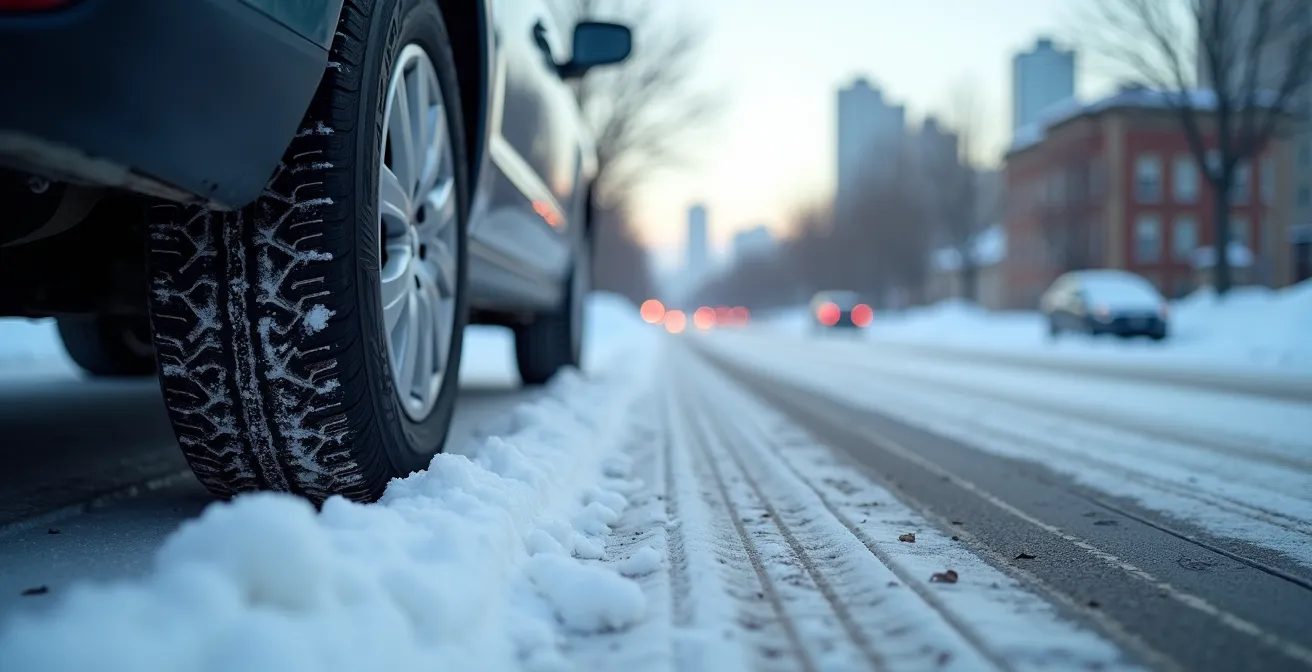
In summary:
- In Quebec, winter tires are mandatory on all four wheels from December 1st to March 15th.
- Tire performance degrades significantly below 7°C; the law is based on temperature science, not just snow.
- Use a 25-cent coin to check tread depth: if the caribou’s nose is visible, your tires are likely unsafe.
- All-Wheel Drive (AWD) does not replace the need for winter tires; grip comes from the rubber, not the drivetrain.
- Tires expire; a tire older than six years is unsafe, regardless of its tread depth.
For any driver in Quebec, the annual winter tire changeover is a familiar ritual. The province mandates their use from December 1st to March 15th, and failure to comply can result in fines ranging from $200 to $300, plus costs. This legislation requires that all four wheels of a passenger vehicle be equipped with tires bearing the Three-Peak Mountain Snowflake (3PMSF) pictogram. However, merely adhering to these dates is a critical misunderstanding of the law’s intent.
Many drivers believe the requirement is simply about navigating snow. They might delay installation until the first flakes fall or assume their All-Wheel Drive system provides sufficient safety. This perspective misses the core principle of winter driving safety: temperature. The legislation isn’t just about snow; it’s about the physical properties of rubber in the cold. True safety isn’t achieved by meeting the minimum legal standard, but by understanding the science and risks behind each regulation.
This guide moves beyond simple compliance. It decodes the legal and physical rationale behind Quebec’s winter tire requirements. We will explore why your tires lose effectiveness long before the first snowfall, how to verify their true condition beyond a superficial glance, and why even the most advanced vehicle is only as safe as its four hand-sized contact patches with the road. The goal is to transform you from a merely compliant driver into a genuinely prepared one, equipped with the knowledge to make informed safety decisions.
To navigate these critical topics, this guide is structured to address every key aspect of winter tire legality and performance. The following sections will provide detailed, evidence-based information to ensure your vehicle is not only legal but fundamentally safe for Canadian winters.
Summary: Quebec Winter Tire Guide: Decoding Legal Requirements for Safety
- Why Do Your Summer Tires Become ‘Hockey Pucks’ Below 7°C?
- How to Use a 25-Cent Coin to Know if Your Tires Are Still Legal?
- Winter-Approved vs. True Snow Tires: Which to Choose for Montreal vs. Vancouver?
- The Blowout Risk: Why Is It Dangerous to Finish Your Winter Tires in July?
- When to Buy Your Winter Tires to Have Choice and Avoid the October Rush?
- The Manufacturing Date Trap: Why Can Tires With Good Tread Be Refused?
- The Invincible 4×4/AWD Myth: Why Your SUV Still Slides Without Good Tires?
- Black Ice Driving Techniques: How to Regain Control on Frozen Roads
Why Do Your Summer Tires Become ‘Hockey Pucks’ Below 7°C?
The single most misunderstood aspect of winter tire legislation is the 7°C rule. The effectiveness of a tire is dictated by the chemical composition of its rubber, specifically its “glass transition temperature”—the point at which a flexible polymer becomes hard and brittle. Summer and all-season tires are designed with a harder rubber compound that provides excellent durability and grip in warm conditions. However, as the ambient temperature drops, this compound undergoes a fundamental change.
Below 7°C (45°F), the rubber in a summer or all-season tire begins to stiffen, losing its elasticity. This reduces its ability to conform to the micro-imperfections of the road surface, dramatically decreasing traction. On a cold, dry road, the tire behaves like a hockey puck on ice—it slides over the surface rather than gripping it. This is not a gradual decline; it is a critical state change that compromises braking distance and cornering stability, even in the complete absence of snow or ice.
Winter tires, by contrast, are engineered with a higher percentage of natural rubber and advanced silica compounds. This keeps them soft and pliable in freezing temperatures, allowing the tread to flex and maintain maximum contact with the road. The science is clear:
- At 7°C: All-season tire rubber begins to harden and lose its essential elasticity.
- At 0°C: Summer tires can lose up to 50% of their grip, even on perfectly dry pavement.
- At -15°C: The compound of a summer tire becomes rigid like hard plastic, offering minimal traction.
- Below -25°C: Only specialized winter tire compounds are able to maintain the flexibility required for safe grip.
Therefore, the December 1st deadline is a legal backstop. The true deadline for safety is dictated by the thermometer. Installing winter tires when temperatures consistently drop to 7°C or below ensures your vehicle maintains its designed braking and handling capabilities.
How to Use a 25-Cent Coin to Know if Your Tires Are Still Legal?
While the law in Quebec dictates a minimum tread depth, there is a significant difference between what is legally required and what is safe. According to provincial regulations, a winter tire is illegal if its tread is worn to a depth of 1.6 mm (2/32″) or less at any point. However, safety organizations and tire experts universally agree that a winter tire loses its effectiveness for snow and slush evacuation long before reaching this legal limit. The widely accepted safety minimum is 4.8 mm (6/32″).
A simple, distinctly Canadian method for checking this is the 25-cent coin test, which uses the caribou as a measuring gauge. This quick visual inspection provides an immediate assessment of your tire’s remaining safe lifespan. It is an essential skill for any driver responsible for vehicle maintenance.
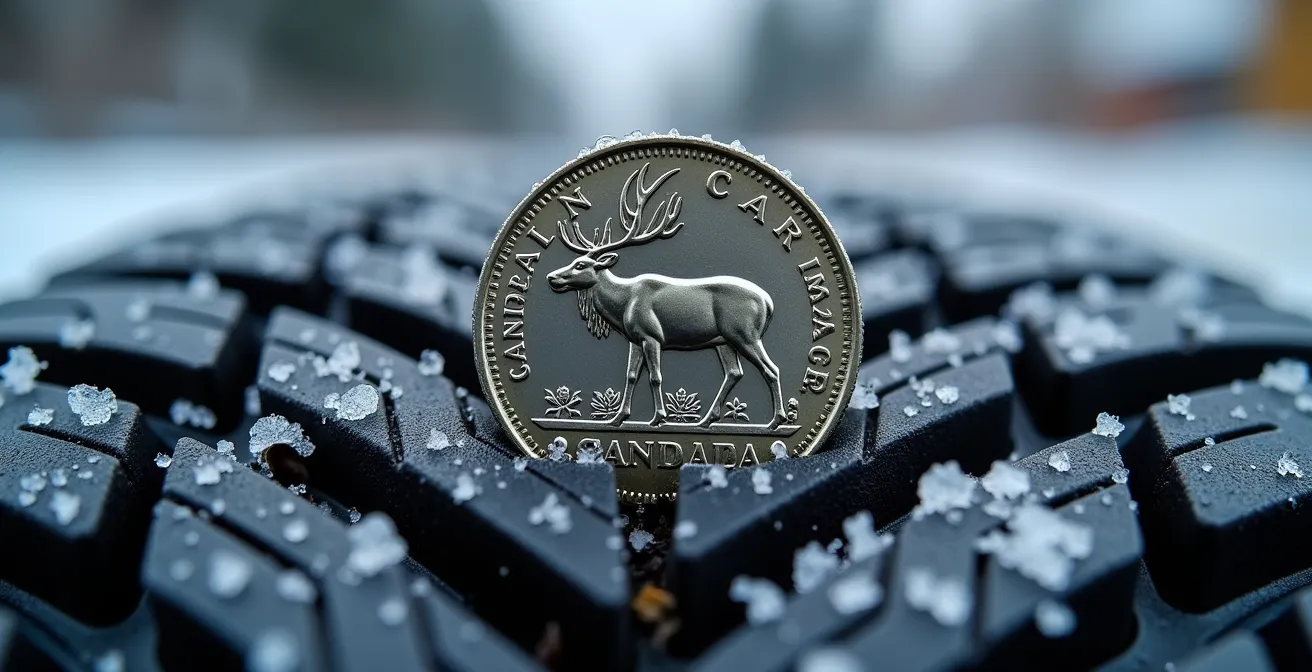
As this image demonstrates, the test is straightforward and requires no special tools. By inserting the coin into the tread, you can instantly determine if your tires meet the recommended safety standard, not just the bare legal minimum. This proactive check is a cornerstone of responsible winter driving.
Action Plan: Performing the Caribou Quarter Test
- Take a Canadian quarter and hold it so the caribou’s nose is pointing down into the tread.
- Insert the coin into one of the central grooves of the tire tread.
- If you can see the tip of the caribou’s snout, your tread depth is below the recommended 4.8 mm (6/32″).
- Check multiple locations across the tire’s width—the inside, center, and outside edges—as tires can wear unevenly.
- If any location shows the caribou’s snout, it is strongly recommended to replace your tires to ensure optimal safety and performance in winter conditions.
Winter-Approved vs. True Snow Tires: Which to Choose for Montreal vs. Vancouver?
The 3PMSF symbol legally defines a winter tire in Quebec, but not all tires bearing this symbol are created equal. This has led to a critical distinction between “All-Weather” tires (often marketed as a four-season solution) and dedicated “Winter” or “Snow” tires. While both are legally permissible in Quebec during the mandatory period, their performance characteristics are designed for vastly different Canadian winter climates.
All-Weather tires are a compromise. They offer better snow and ice performance than an All-Season tire but do not match the capabilities of a true winter tire in severe conditions. They are best suited for urban environments with milder winters and efficient snow-clearing services, like Vancouver. Dedicated Winter tires, however, are optimized for the harshest conditions: deep snow, ice, and extreme cold. They are the unequivocal choice for regions with severe winters like Montreal, Calgary, or rural Quebec.
The choice between them depends entirely on your geographical location and typical driving conditions. As a report from CAA-Quebec highlights, using all-weather tires in a region prone to heavy snowfall and ice can create a false sense of security. The following table breaks down the recommended choice for major Canadian regions:
| City/Region | Recommended Tire Type | Key Performance Factor | Temperature Range |
|---|---|---|---|
| Montreal | Dedicated Winter/Ice Tires | Ice traction for freeze-thaw cycles | -25°C to 5°C |
| Vancouver | All-Weather (3PMSF) | Wet traction with occasional snow | -5°C to 10°C |
| Calgary/Winnipeg | Severe Winter Tires | Extreme cold performance | -40°C to 0°C |
| Rural Quebec | Studded Winter Tires | Unplowed road grip | -30°C to 0°C |
Furthermore, for drivers in rural areas facing unplowed roads or frequent freezing rain, studded winter tires remain a critical safety tool. In designated parts of Quebec like the Laurentians and Gaspésie, where they are legal from October 15th to May 1st, drivers report significantly improved control on icy surfaces, which can be the difference between maintaining control and a total loss of traction.
The Blowout Risk: Why Is It Dangerous to Finish Your Winter Tires in July?
It can be tempting to “finish off” a set of worn winter tires during the summer months to extract maximum value. From a regulatory and safety standpoint, this is a hazardous practice. The soft, flexible rubber compound that makes winter tires effective in the cold becomes a dangerous liability in the heat. Warm pavement accelerates the degradation of the rubber, leading to rapid and unpredictable wear.
Official Quebec government safety data shows winter tires experience a 25-30% reduction in their expected lifespan when used through a single summer. This is not just a matter of accelerated wear; it poses a significant risk of catastrophic failure. The heat buildup within the tire can cause the internal structure to break down, dramatically increasing the risk of a blowout, especially at highway speeds. Beyond the blowout risk, performance is severely compromised. As the Government of Quebec officially states:
Winter tires do not evacuate water as efficiently as summer or all-season tires, decreasing aquaplaning resistance. The stopping distance for winter tires used in the summer may be greater than that of all-season tires, especially on wet pavement.
– Government of Quebec, Requirements for Winter Tires – Official Guidelines
This means that in a common summer rainstorm, a vehicle on winter tires will have a longer braking distance and be more susceptible to hydroplaning than a vehicle with appropriate all-season tires. The practice is both economically unsound due to rapid wear and dangerously unsafe due to compromised performance and failure risk.
When to Buy Your Winter Tires to Have Choice and Avoid the October Rush?
Strategic timing is essential when purchasing winter tires to secure the best selection, pricing, and installation availability. Waiting until the first snowfall or the late-November rush often results in limited choices, higher prices, and long waits at installation centers. A proactive approach, aligned with the industry’s retail cycle, ensures you are prepared well in advance of the legal deadline.
The ideal time to begin shopping is late September to early October. This is when manufacturers typically roll out their seasonal rebates and retailers have the best inventory of new models and popular sizes. Booking an installation appointment at this time guarantees you can have your tires changed before the chaotic period begins. However, other windows of opportunity exist for savvy buyers.
For those looking for the best possible price, end-of-season clearance sales in April and May can offer significant discounts on the previous season’s stock. Planning your purchase allows you to take control of the process, rather than being forced into a hurried decision by weather or deadlines. The optimal timeline is as follows:
- Late September: Manufacturer rebates begin, offering the best combination of savings and selection.
- Early October: Pre-season promotions are common, and it’s the ideal time to book an installation appointment to avoid the rush.
- Black Friday/Cyber Monday: This period in November can be an overlooked opportunity for hidden discounts from major retailers.
- April/May: End-of-season clearance sales often feature discounts of 20-30% on remaining inventory.
- Year-Round Strategy: Consider purchasing a dedicated set of steel rims for your winter tires. While an upfront cost, this saves on mounting and balancing fees each season and can pay for itself within 3-4 years.
The Manufacturing Date Trap: Why Can Tires With Good Tread Be Refused?
Tread depth is not the only factor determining a tire’s safety and legality. A tire’s age is equally critical. The rubber compounds in tires degrade over time due to exposure to oxygen, UV light, and temperature fluctuations, a process known as oxidation. This causes the rubber to become hard and brittle, reducing grip and increasing the risk of cracking or delamination, even if the tire has never been used and has full tread depth.
Because of this, many Canadian insurers and garages enforce a 6-year maximum age rule for tires. A garage can refuse to install a tire that is older than six years from its manufacturing date, and an insurance company may deny a claim if it is found that aged tires contributed to an accident. This makes checking the manufacturing date an essential step when buying new or used tires, or when assessing your current set.
This information is encoded on the tire’s sidewall in what is known as the DOT (Department of Transportation) code. While the full code contains manufacturer information, the last four digits reveal the week and year of production. Being able to decode this is a crucial skill for every car owner.
- Locate the DOT code: Find the series of letters and numbers on the tire’s sidewall that begins with “DOT”.
- Find the last four digits: At the end of this code, there will be a four-digit number (e.g., 3521).
- Decode the date: The first two digits represent the week of manufacture (e.g., 35 = the 35th week of the year). The last two digits represent the year of manufacture (e.g., 21 = the year 2021).
- Calculate the age: Compare the manufacturing date to the current date.
- Take action: If a tire is more than six years old, it should be replaced, regardless of how much tread remains.
This rule prevents the use of “new old stock” tires that have been sitting in a warehouse for years and protects drivers from the hidden danger of aged, brittle rubber. Always verify the date code before purchasing or installing tires.
The Invincible 4×4/AWD Myth: Why Your SUV Still Slides Without Good Tires?
One of the most persistent and dangerous misconceptions in winter driving is that an All-Wheel Drive (AWD) or 4×4 system is a substitute for winter tires. This belief is fundamentally incorrect. A vehicle’s drivetrain can only distribute power; it cannot create grip. The only thing connecting your vehicle to the road are four contact patches, each roughly the size of your hand. If those contact patches have no traction, the vehicle’s powertrain is irrelevant.
An AWD system is effective at preventing you from getting stuck in deep snow by sending power to the wheels that have traction. However, it does nothing to improve your ability to stop or turn on a slippery surface. Braking and steering are entirely dependent on the grip provided by your tires. On ice, an SUV with all-season tires will slide just as easily as a two-wheel-drive car. As Sylvain Légaré, a research analyst at CAA-Quebec, aptly puts it:
AWD can send power to all four wheels, but it can’t create grip where there is none. Only the four contact patches, the size of your hand, can do that. On ice, all-seasons are like dress shoes; winter tires are like crampons.
– Sylvain Légaré, CAA-Quebec Research Analyst, Mobility
This isn’t just an opinion; it’s a fact proven by controlled testing. An official government study provides definitive evidence.
Case Study: Transport Canada AWD Performance Testing
In a formal evaluation, Transport Canada tested a 21-passenger minibus with AWD on a snow-covered course. When equipped with all-season tires on the front axle, the vehicle experienced severe understeer (failure to turn) and was unable to safely navigate a slalom course at 80 km/h. However, when the exact same vehicle was equipped with proper winter tires on all four wheels, it successfully and safely completed the course. The conclusion was unequivocal: tire quality is the primary factor for vehicle control in winter, superseding the drivetrain configuration.
Key Takeaways
- Winter tires are a legal requirement based on temperature science, not just snow; they are essential for grip below 7°C.
- The 1.6 mm legal tread minimum is not a safe benchmark; use the 25-cent test to ensure your tires exceed the 4.8 mm safety recommendation.
- AWD/4×4 systems do not help with braking or steering on ice. Tire grip is the only factor that provides control.
Black Ice Driving Techniques: How to Regain Control on Frozen Roads
Black ice is one of the most treacherous conditions a driver can face. It is a thin, transparent layer of ice that forms on the road surface, making it appear merely wet. It frequently occurs on bridges, overpasses, and shaded areas, as these surfaces freeze faster than the ground. Data from CAA-Quebec reveals that over 65% of winter accidents involving loss of control happen on these specific structures, highlighting them as high-risk zones requiring extreme caution.
Encountering black ice often results in an instantaneous and total loss of traction. Panic reactions, such as slamming on the brakes or jerking the steering wheel, are the worst possible response and will almost certainly induce an uncontrollable spin. The key to survival is to remain calm and execute a precise set of corrective actions designed to help the tires regain grip. Every driver should memorize these steps, as there is no time to think when a slide occurs.
Your vehicle’s response and your inputs will differ depending on whether the front wheels (understeer) or rear wheels (oversteer) lose traction. Knowing the correct, counter-intuitive response for each scenario is a life-saving skill.
- Detect the Hazard: Be vigilant for glossy or dark-looking pavement, especially on bridges, in tunnels, and in shaded spots, particularly around dawn or dusk.
- Initial Response: The moment you feel the vehicle begin to slip, ease your foot completely off the accelerator and the brake. Do not make any sudden movements.
- If Sliding Straight: Apply firm, steady, and continuous pressure to the brake pedal. If your vehicle has an Anti-lock Braking System (ABS), do not pump the brakes. The system will do it for you, and you will feel it pulsing under your foot.
- Correcting Oversteer (Rear-end slide): Gently and smoothly steer the wheel in the same direction that the rear of the car is sliding. This is known as “steering into the skid.”
- Correcting Understeer (Front-end slide): If the front of the car is not turning, release the brake pedal for a moment to allow the front tires to regain grip, then reapply braking and steering inputs more gently.
- Maintain Visual Focus: Your hands will follow your eyes. Look and focus on where you want the car to go, not at the obstacle or ditch you are trying to avoid.
- Recovering Grip: Once you feel the tires start to grip the road again, make smooth and gradual steering and acceleration adjustments to fully regain control.
To ensure your vehicle is fully prepared, perform a complete inspection of your tires using these guidelines well before the mandatory December 1st deadline. Your safety, and the safety of others, depends on it.