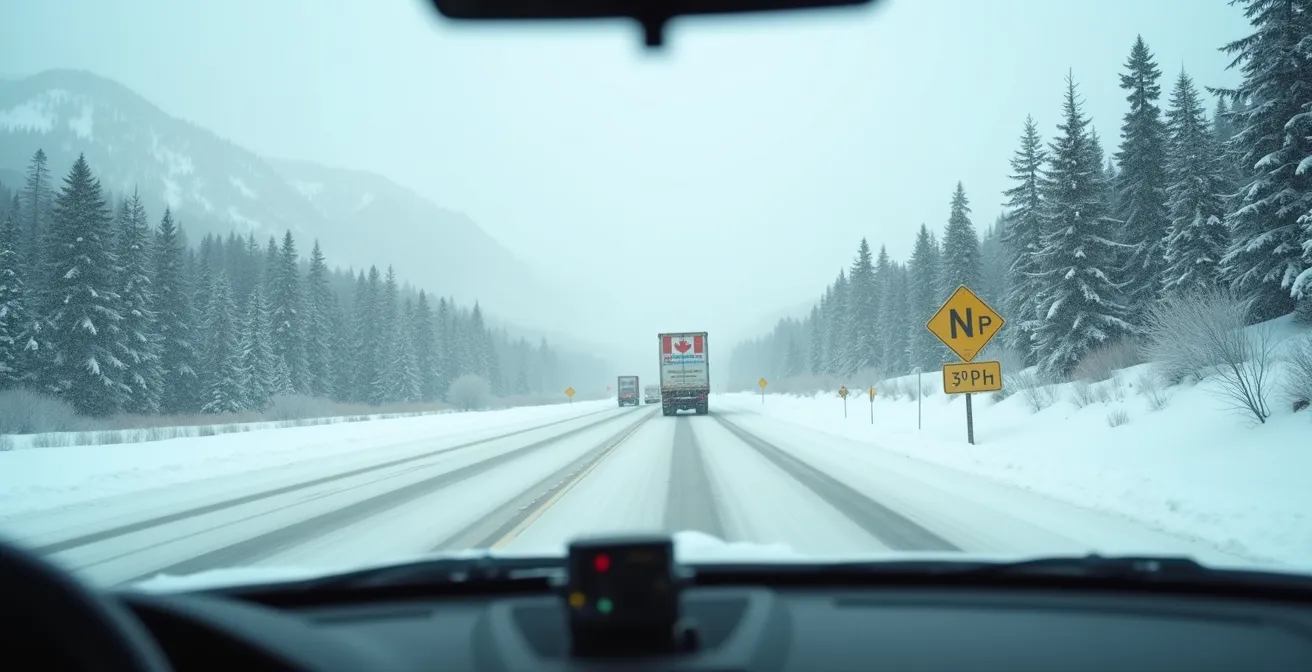
The key to preventing winter collisions isn’t just leaving more space; it’s adopting a proactive space management system that anticipates hazards before they happen.
- Your reaction time and your vehicle’s stopping distance are drastically compromised on snow and ice, making a 6-8 second following gap non-negotiable.
- Shifting your vision from the bumper ahead to the distant horizon gives you the critical “visual lead time” needed to react smoothly and safely.
- Recognizing the subtle signs of a distracted driver and understanding your own vehicle’s handling limits are as important as watching the road.
Recommendation: Instead of just reacting to traffic, actively control the space around your vehicle by managing your speed, vision, and anticipation of other drivers’ actions.
That familiar crunch of a minor fender bender is a sound no Canadian driver wants to hear, especially during the treacherous winter months. We’re all taught the basics: slow down, have good winter tires, and leave more space. But despite this, rear-end collisions remain one of the most common types of crashes on snowy and icy highways. The conventional wisdom of “just add a few seconds” often fails in the chaos of dense traffic, sudden whiteouts, and the unpredictable actions of other drivers.
The problem is that we often think about following distance as a passive measurement, a rule to follow. But what if the true key to winter safety isn’t just about distance, but about active and total space management? What if it’s a skill based on re-engineering how you see the road and predict danger? This guide moves beyond the generic advice. We’ll dismantle the physics of a winter stop, teach you how to read the “behavioural telegraphing” of other drivers, and show you how to use your vision as your most powerful safety tool.
We will explore the precise reasons behind the 6-to-8-second rule, identify the critical driving errors that lead to accidents, and provide a complete framework for defensive driving. This is about transforming you from a reactive driver, vulnerable to the mistakes of others, into a proactive pilot of your vehicle, in full control of your safety bubble, no matter what the Canadian winter throws at you.
This article provides a comprehensive look at the proactive behaviours and defensive principles required to navigate snowy highways safely. Below is a summary of the key areas we will cover to help you master the art of winter driving and collision prevention.
Summary: A Proactive Approach to Winter Driving Safety
- Why should you leave a 6-8 second gap on a snowy road?
- How to spot a distracted driver in front of you before they slam on the brakes?
- Looking at the bumper or the horizon: how does your vision influence your reaction time?
- The lane change error that causes 30% of side-swipe accidents on highways
- What to do when a driver is tailgating you on a slippery road?
- Why a sedan holds the road better than an SUV in an avoidance maneuver?
- Why you lose 30 meters before even touching the brake pedal at 100 km/h?
- Defensive Driving Principles: The Smith System and Anticipating Hazards
Why should you leave a 6-8 second gap on a snowy road?
The standard two-second rule taught for dry conditions becomes dangerously inadequate the moment snowflakes start to fall. On a snowy or icy road, the laws of physics work against you. The friction between your tires and the road surface is drastically reduced, which means your ability to slow down or stop is severely compromised. A 6 to 8-second gap isn’t an arbitrary number; it’s a carefully calculated buffer designed to give you back the time that winter weather steals.
This extended time accounts for three critical factors: your own perception and reaction time, the delayed response of your vehicle’s braking system on a low-traction surface, and the sheer increase in physical distance required to come to a halt. As a driving instructor, I tell my students to pick a fixed object ahead, like a sign or a bridge. When the car in front of you passes it, start counting: “one-thousand-one, one-thousand-two…” You should reach at least “one-thousand-six” before your vehicle passes that same object. This method turns an abstract concept into a concrete, repeatable practice.
Remember, even with the best winter tires, you need significantly more room. According to safety experts, your vehicle may need three to 12 times the amount of space to stop on snow or ice compared to dry pavement. The 6-8 second gap is your primary line of defense. It’s the single most important factor you can control to prevent a rear-end collision when the driver ahead makes a sudden, unexpected stop.
How to spot a distracted driver in front of you before they slam on the brakes?
In winter driving, your best defense is a good offense, and that means identifying a potential hazard before it fully materializes. A distracted driver is one of the greatest threats, as their actions are unpredictable and sudden. Instead of just staring at their tail lights, you need to become an expert in reading “behavioural telegraphing”—the subtle cues that broadcast a driver’s lack of attention.
Look for these tell-tale signs:
- Inconsistent Speed: A driver who speeds up, then slows down for no apparent reason, is likely not paying attention to their speedometer or the flow of traffic.
- Lane Drifting: Weaving within their lane or drifting towards the shoulder or centre line is a classic sign of visual or cognitive distraction. Their tires might touch the lines repeatedly.
- Delayed Reactions: When traffic begins to move after a stop, does the driver in front hesitate for several seconds? When the traffic ahead slows, are their brake lights the very last to come on? This indicates a significant perception delay.
- The “Glow” of a Screen: At night or in low light, you can often see the distinct blueish glow of a smartphone screen illuminating the driver’s face or the cabin.
These behaviours are alarmingly common. A 2024 survey by CAA revealed that 66% of Ontario drivers have witnessed a close call or traffic violation caused by distracted driving. When you spot a driver exhibiting these signs, your immediate action should be to increase your following distance even further. Give them extra space, because their next move is likely to be an erratic one, like slamming on the brakes for a hazard they only noticed at the last second. Your observation skills are what will prevent their bad habit from becoming your accident.
Looking at the bumper or the horizon: how does your vision influence your reaction time?
Where you look while driving directly dictates your ability to react. Many drivers fall into the trap of “target fixation,” focusing only on the bumper of the car directly in front of them. This is one of the most dangerous habits in winter driving. It shrinks your world to a tiny, reactive space, leaving you with zero time to plan or respond smoothly. The key to unlocking more reaction time is to lift your gaze and practice horizon scanning.
This technique involves aiming your central vision far down the road, 12 to 15 seconds ahead of your vehicle. You’re looking for the “big picture”: brake lights two or three cars ahead, a transport truck preparing to change lanes, or a cloud of snow kicked up by a developing hazard. By seeing problems early, you can react with gentle adjustments to your speed or position, rather than sudden, panic-induced movements that can easily cause a skid on a slippery surface.
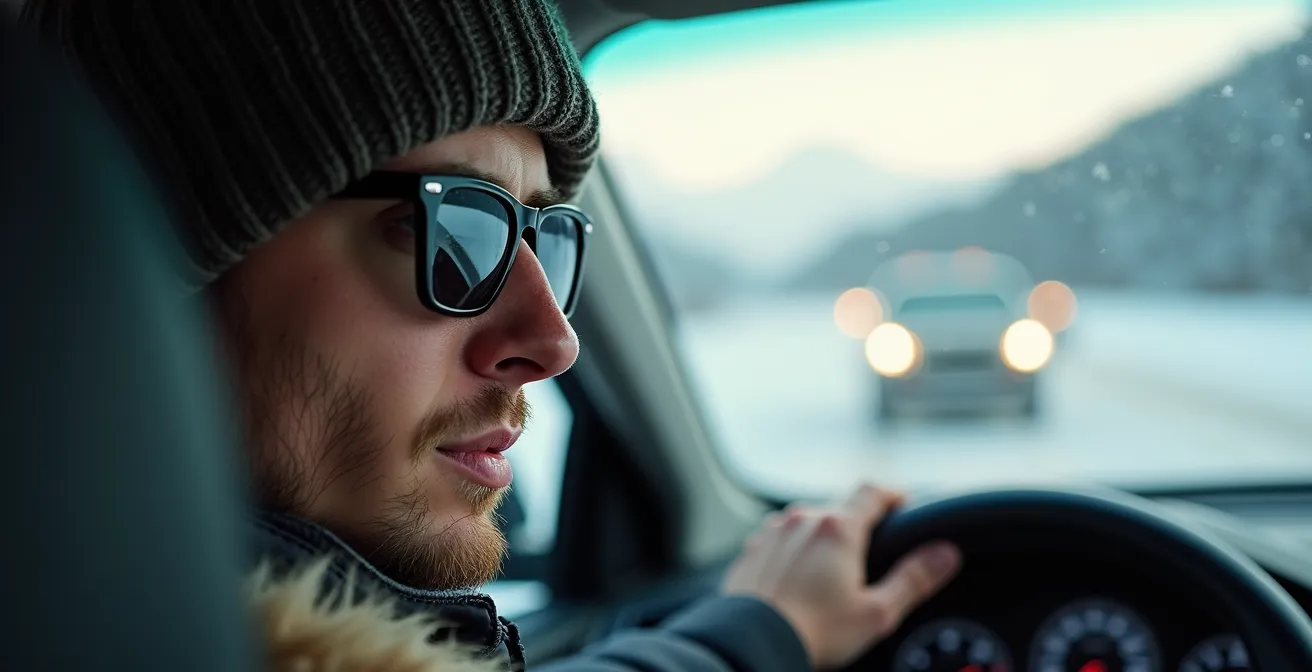
As the illustration shows, a focused driver scans the far distance, using their peripheral vision to monitor the immediate surroundings. When you see brake lights far ahead, you can ease off the accelerator immediately, long before the driver in front of you even thinks about braking. This creates a “domino effect” of safety in reverse. If you do find your car beginning to skid, the rule is absolute: look where you want to go, not at the object you’re trying to avoid. Your hands will naturally follow your eyes. Let your peripheral vision track the hazard while your central vision guides you to safety. This is a technique that racing drivers master, and it is just as critical on a snowy Highway 401.
The lane change error that causes 30% of side-swipe accidents on highways
While rear-end collisions are a primary concern, the risk of a side-swipe accident skyrockets during Canadian winters due to one common error: misjudging the conditions between lanes. On a seemingly clear highway, the space between the driven tracks can hide treacherous ridges of packed snow, ice, or deep slush. Attempting a lane change over these ridges without proper care can violently pull your vehicle in an unexpected direction, leading to a loss of control.
The risk is compounded by poor visibility. In conditions of blowing snow, sight lines can be reduced to near zero in an instant, completely hiding a vehicle in your blind spot. Official guidance from sources like the Ontario Ministry of Transportation is clear: avoid passing or changing lanes when weather and road conditions are poor. A critical mistake is following a snowplow too closely and then trying to pass it. The plow creates a “plow windrow”—a ridge of snow and slush beside it—that can be extremely hazardous to cross, not to mention the severely reduced visibility from the spray of snow.
To execute a lane change safely in winter, you must assume the space between lanes is compromised. The following table breaks down the specific risks and necessary safety measures.
| Condition | Risk Factor | Safety Measure |
|---|---|---|
| Blowing Snow | Sight lines significantly reduced | Avoid lane changes when visibility is compromised. |
| Snow Ridges Between Lanes | Vehicle can be pulled violently when crossing the ridge. | Slow down significantly and make the maneuver as gently as possible. |
| Following a Snowplow | The ridge of snow created by the plow reduces visibility and stability. | Never pass a working snowplow; maintain a safe distance behind it. |
The fundamental rule is to reduce speed before initiating the lane change. A slower speed reduces the force with which your tires hit the ridge, giving you more control. Always signal your intention well in advance, check your blind spots multiple times, and execute the maneuver smoothly and gradually. A hurried lane change on a snowy highway is an invitation for disaster.
What to do when a driver is tailgating you on a slippery road?
Few situations are more stressful than seeing a pair of headlights filling your rearview mirror on an icy road. A tailgater has given up their own safety margin, and in doing so, they have stolen yours. Your instinct might be to tap your brakes to warn them off, but this is the most dangerous thing you can do. A sudden brake check can easily cause them to slide directly into your rear bumper, making a bad situation much worse.
The correct response is counter-intuitive but profoundly effective: you must take responsibility for the space in front of your own vehicle. Your goal is to create a bigger buffer ahead of you, which will in turn become the tailgater’s buffer. To do this, gradually and smoothly ease your foot off the accelerator. Don’t touch the brakes. As your car slows, the gap between you and the car in front of you will increase. You are effectively creating the stopping distance that the driver behind you has failed to establish for themselves. This proactive “space management” gives you the ability to brake more gently and gradually if the traffic ahead slows, reducing the risk of the tailgater colliding with you.
As George Ljubicic, an Agency Manager for Allstate Canada, points out, the danger is real and multi-faceted.
Rear-end crashes can stem from following too closely, busy urban traffic, sudden slowdowns, poor weather conditions. Drivers should be aware of the risks of slippery roads and maintain more space around their vehicle to safely brake.
– George Ljubicic, Allstate Canada Agency Manager
If possible, and only when it is safe to do so, signal and move into another lane to let the tailgater pass. Do not speed up to create distance; this only encourages them and increases your own risk. Stay calm, control the space you can control—the space in front—and let their impatience become their problem, not yours.
Why a sedan holds the road better than an SUV in an avoidance maneuver?
In the popular imagination, the size and weight of an SUV often equate to a feeling of safety in winter. While a higher driving position and four-wheel drive can be advantageous in deep snow, when it comes to emergency avoidance maneuvers on a slippery highway, a sedan often has a significant, physics-based advantage: a lower center of gravity.
An SUV’s height means its center of gravity is much higher off the ground. During a sudden swerve—to avoid a piece of tire debris or a spinning car—this higher mass creates more body roll. This shifting weight can overwhelm the tires’ limited grip on an icy surface, making the vehicle more susceptible to tipping or rolling over. In contrast, a sedan’s weight is concentrated closer to the road. This inherent stability allows it to change direction with more agility and control, keeping the vehicle’s body flat and all four tires pressed firmly to the pavement.
Case Study: Agility and Control in Emergency Maneuvers
Vehicle dynamics analyses consistently show that sedans tend to outperform SUVs in handling tests. Their lower profile improves braking, turning, and overall stability. This superior control can be the decisive factor in preventing a crash in the first place. In an emergency swerve, a sedan is more likely to follow the driver’s intended path, whereas an SUV’s momentum and higher center of gravity can lead to a dangerous skid or a complete loss of control. The sedan’s agility allows the driver to avoid a collision, while the SUV’s bulk can sometimes be a liability.
This doesn’t mean SUVs are unsafe, but it does mean their drivers must be even more committed to the principles of defensive driving. Because an SUV is less nimble, its driver must rely more heavily on anticipation and early detection of hazards. You must use the techniques of horizon scanning and maintaining a large following distance to ensure you never have to ask your vehicle for a sudden, high-speed maneuver that its physics are not designed to handle on a low-friction surface.
Why you lose 30 meters before even touching the brake pedal at 100 km/h?
This is a statistic that shocks most drivers, but the math is undeniable. The process of stopping a vehicle is not instantaneous; it happens in two distinct phases: perception-reaction distance and braking distance. On a winter road, both are extended to terrifying lengths. At 100 km/h, your vehicle is travelling at approximately 28 meters every single second.
First, there is the perception-reaction distance. This is the distance your car travels from the moment you spot a hazard to the moment your foot physically applies pressure to the brake pedal. For an alert driver, this takes about 1.5 seconds. In that time, before you’ve even begun to slow down, your car has already travelled 42 meters—far more than the 30 meters in the title. Now, factor in winter conditions. The cognitive load of driving in blowing snow or the glare from a wet road can easily increase that reaction time to 2 or even 2.5 seconds. At 2.5 seconds, you’ve travelled 70 meters before the brakes are even engaged.
Second, there is the braking distance itself. This is where the physics of friction truly come into play. On dry pavement, you might stop in another 50-60 meters. But on a compromised surface, that distance explodes. According to data from Manitoba Public Insurance, your stopping distance is up to 10 times longer on an icy road. That 50-meter stop can become a 500-meter slide. A distraction, even for a moment, has catastrophic consequences. As Transport Canada warns, the risk of a collision goes up when a driver’s eyes are taken off the road even for a second, making them slower to notice and less able to respond. That single second at 100 km/h costs you 28 meters of priceless reaction space.
Key Takeaways
- Your total stopping distance is a combination of reaction time and braking capability, both of which are severely degraded in winter.
- Proactively managing the space around your vehicle is more effective than reacting to immediate threats.
- Lifting your vision to scan the horizon, 12-15 seconds ahead, is the single best technique to increase your effective reaction time.
Defensive Driving Principles: The Smith System and Anticipating Hazards
Everything we have discussed—managing following distance, scanning the horizon, and identifying erratic drivers—can be unified into a cohesive strategy known as defensive driving. It’s a mindset that shifts from simply operating a vehicle to actively managing risk. One of the most effective frameworks for this is the Smith System, which is built on five core principles designed to improve your awareness and give you more time to react.
This system provides a structured way to practice the proactive control we’ve been exploring. It’s about seeing everything and creating a “space cushion” around your vehicle. If your vehicle is equipped with Electronic Stability Control (ESC), it can be a valuable safety net. When the ESC light flashes, it means the system is actively working to prevent a skid by applying individual brakes or reducing engine power. This is your car’s way of telling you that you’ve reached the limits of traction. You must heed this warning, slow down, and drive more cautiously.
Ultimately, defensive driving is a behavioural choice, one that prioritizes safety over speed. As the Infrastructure Health & Safety Association (IHSA) wisely puts it:
‘Patience is a virtue’ doesn’t go far enough when it comes to winter driving. Behind the wheel, patience is a must. Risky behaviours like driving too fast and following too closely become even more dangerous on slippery roads.
– IHSA, Infrastructure Health & Safety Association
Your 5-Point Defensive Driving Audit: Applying the Smith System
- Aim High in Steering: Are you looking far down the road (15+ seconds ahead) or are you fixated on the car in front? Consciously lift your gaze to the horizon to anticipate hazards early.
- Get the Big Picture: Are you actively scanning your mirrors and the entire environment around you, or just looking forward? Check your mirrors every 5-8 seconds to maintain a 360-degree awareness.
- Keep Your Eyes Moving: Avoid a fixed, blank stare. Are you constantly moving your eyes, scanning from your mirrors to the road ahead, to the side roads, and back? This prevents highway hypnosis and keeps you alert.
- Leave Yourself an Out: Have you created a “space cushion”? Always maintain open space to at least one side of your vehicle so you have an escape route if the car ahead stops suddenly.
- Make Sure They See You: Are you communicating your intentions clearly? Use your signals early, tap your brakes to flash your lights if you see a slowdown ahead, and make brief eye contact with other drivers or pedestrians when possible.
By integrating these defensive driving principles into every trip, you are no longer at the mercy of the weather or other drivers. You are taking definitive control of your own safety, ensuring you and your family arrive at your destination, no matter the conditions on the road.