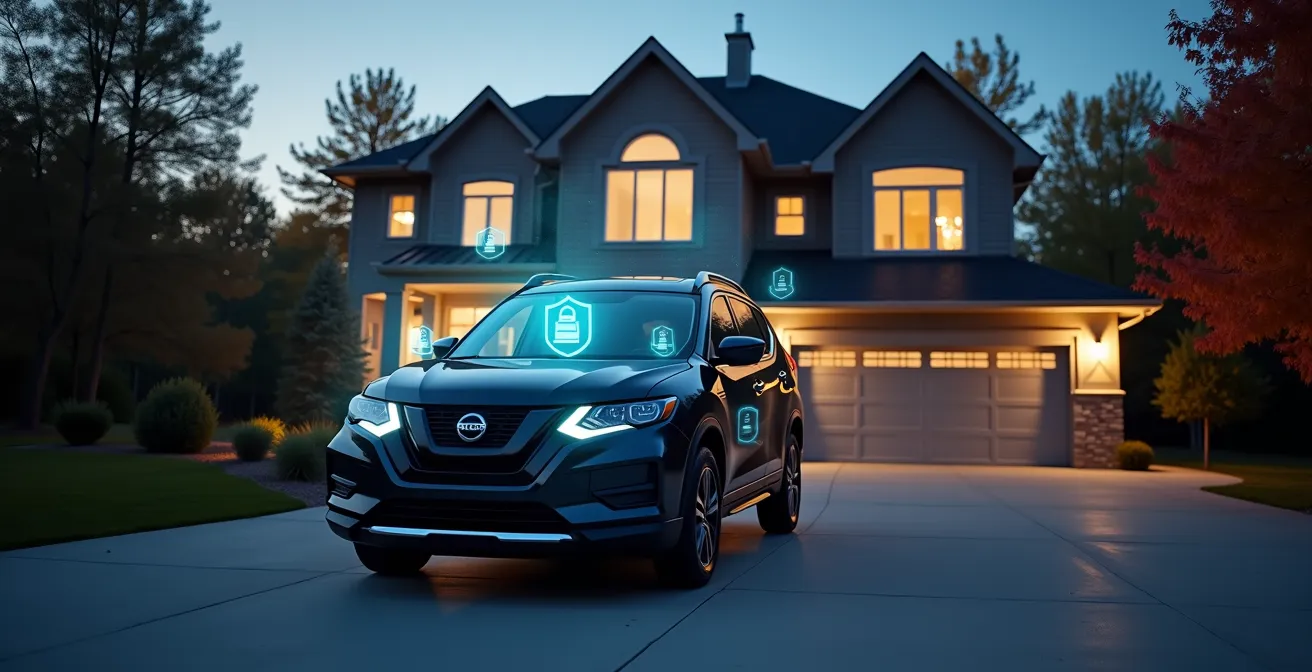
Contrary to popular belief, a simple Faraday pouch is a dangerously incomplete solution to modern vehicle theft in Canada.
- Thieves bypass simple blockers by directly accessing your car’s internal computer (OBD port) or resorting to violence.
- True protection lies in a “defense-in-depth” strategy that combines signal blocking, physical hardening, and advanced tracking.
Recommendation: Stop thinking about a single magic bullet and start building multiple layers of security to make your vehicle a difficult and unattractive target.
The feeling is a cold knot in the pit of your stomach. You look out your window at your driveway, where your Toyota Highlander or Lexus RX was parked just hours ago, and see nothing but empty space. In Canada, this is no longer a rare occurrence; it’s a nightly crisis. Organized crime syndicates are targeting desirable SUVs and trucks with a level of sophistication that renders old security advice obsolete. You’ve probably been told to get a Faraday pouch, lock your doors, and park in a well-lit area. This is dangerously simplistic advice.
While these basic precautions have their place, they create a false sense of security against professional thieves who operate with chilling speed and technical prowess. They aren’t opportunists checking for unlocked doors; they are specialists who can clone your key signal from outside your home, create a new key in under a minute by hacking your car’s computer, or simply break into your home to get the keys. The fight against modern vehicle theft isn’t about one trick; it’s about building a fortress around your asset.
So, if the common solutions are failing, what actually works? The answer lies in a strategic, multi-layered defense system. This approach forces thieves to overcome multiple obstacles, each one increasing their risk and the time it takes to steal the vehicle. This guide will dismantle the thieves’ process step-by-step and provide concrete, expert-level countermeasures for each stage of the attack—from digital breaches to physical security and post-theft recovery. We will go beyond the pouch to explore the real-world strategies that secure your vehicle against Canada’s auto theft epidemic.
This article provides a comprehensive look at the modern threats and the layered security solutions required to protect your vehicle. Explore the sections below to understand each attack vector and its corresponding defense.
Summary: A Multi-Layered Strategy to Combat Modern Vehicle Theft
- How do thieves copy your key without entering the house?
- Is a Faraday pouch or box enough to stop electronic theft?
- Why do insurance companies require the TAG system and how does it help recover the car?
- How to prevent thieves from programming a new key by blocking the diagnostic port?
- The risk of ‘Home Jacking’: how to secure also the physical access to your keys?
- Why is it simpler to steal a car from 2020 than one from 2000?
- Why does insuring a car in Toronto cost 50% more than in Montreal?
- How to film when the car is parked without draining your battery at -20°C?
How do thieves copy your key without entering the house?
The most terrifyingly efficient method of modern car theft is the “relay attack.” It requires no forced entry, no broken glass, and happens in complete silence. Thieves work in pairs using specialized electronic devices. One thief stands near your home with a signal amplifier, which is powerful enough to detect the weak signal from your key fob, even through doors and walls. This captured signal is then relayed to an accomplice standing next to your vehicle with a transmitter. The transmitter mimics your key, tricking the car’s computer into thinking the authentic key is present. The doors unlock, the ignition starts, and your car is driven away.
The speed of this attack is what makes it so devastating. There is no time to react. In many documented cases, the entire process—from signal capture to driving off—is completed in under a minute. York Regional Police reports that in some instances, thieves can steal a vehicle in as little as 22 seconds. This is not a crime of opportunity; it is a meticulously planned and executed electronic heist.
The vulnerability lies in the very convenience of keyless entry and start systems. The constant, low-power signal your key fob emits for proximity detection is the exact weakness that thieves exploit. Unless that signal is completely blocked, your car is perpetually broadcasting a “welcome” message to anyone with the right equipment. This initial digital breach is the first link in the theft chain, and understanding it is the first step toward building an effective defense.
Is a Faraday pouch or box enough to stop electronic theft?
The most common piece of advice for preventing a relay attack is to store your keys in a Radio Frequency (RF) shielding container, commonly known as a Faraday pouch or box. These containers are lined with a metallic mesh that blocks electromagnetic signals, effectively making your key fob invisible to thieves’ amplifiers. In theory, this is a perfect countermeasure to the relay attack. If the thief cannot capture the key’s signal, they cannot relay it to the vehicle. This is an essential first layer of defense and should be considered mandatory for any owner of a vehicle with a keyless system.
However, relying on a Faraday pouch as your *only* line of defense is a critical mistake that creates a dangerous false sense of security. As Detective Doug Belanger of the Ottawa Police Central Criminal Investigation Unit warns, thieves have multiple attack vectors. He states:
In most cases, the driver-side door is mechanically breached – at which point thieves access the vehicle’s Engine Control Module (ECM) port to reprogram a new key. This remains the most common type of vehicle theft and it is not deterred using a Radio Frequency Shield (known as a ‘Faraday bag/box’).
– Detective Doug Belanger, Ottawa Police Central Criminal Investigation Unit
This expert testimony highlights a crucial point: professional thieves are not deterred by a single obstacle. If the relay attack fails, they will simply shift to a more direct method, like breaking a window and plugging into your car’s brain. A true security strategy must anticipate this escalation. The Faraday pouch is a vital but incomplete solution. It protects against one specific type of attack, but leaves you exposed to others.

As this visualization suggests, effective protection is about creating multiple, overlapping layers of security. The Faraday pouch is the outer perimeter, but you must also harden the vehicle itself and have a plan for recovery if all else fails. Each layer adds time and complexity for the thief, making your car a less attractive target.
Why do insurance companies require the TAG system and how does it help recover the car?
As theft rates spiral out of control, insurance companies are no longer just passive participants; they are actively mandating specific security measures for high-risk vehicles. In Canada, one of the most frequently required systems is TAG Tracking. This isn’t just another GPS dot on a map. Insurers demand it because it represents a fundamentally different and more robust approach to vehicle recovery, built specifically to counter the tactics of organized crime.
The reason for its effectiveness lies in its multi-layered tracking technology. Unlike standard GPS trackers that are easily jammed and often wired into the car’s battery (making them easy for thieves to locate and disable), the TAG system uses a combination of self-powered wireless beacons. These tiny devices are hidden in multiple, undisclosed locations throughout the vehicle by certified technicians. They use a combination of radio frequency (RF), cellular, and GPS signals, making the system incredibly difficult to jam or defeat. According to insurance industry statistics, this approach works: vehicles protected by Tag Tracking’s system experience a 90% lower theft incidence, as thieves know the vehicle is likely to be recovered.
The differences between TAG and a standard GPS tracker are stark, highlighting why one is an insurer-mandated tool and the other is often just a consumer gadget. The following table breaks down the key distinctions:
| Feature | TAG System | Standard GPS |
|---|---|---|
| Power Source | Self-sufficient, wireless | Vehicle battery dependent |
| Jamming Resistance | Anti-jamming RF technology | Can be jammed |
| Installation Cost | ~$400-595 CAD | $100-300 CAD |
| Tracking Period | 5 years included | Monthly fees |
| Recovery Team | 24/7 dedicated team | Self-monitoring |
| Port Access | CBSA special passports | No port access |
The final point is perhaps the most critical. TAG maintains a dedicated 24/7 recovery team that works directly with law enforcement and has special access credentials with the Canada Border Services Agency (CBSA). This means they can help locate and identify stolen vehicles even after they’ve been packed into shipping containers at ports like Montreal, which is a primary exit point for stolen Canadian cars. This recovery layer is the ultimate safety net in a defense-in-depth strategy.
How to prevent thieves from programming a new key by blocking the diagnostic port?
When a relay attack is thwarted by a Faraday pouch, a professional thief’s next move is often a direct assault on the vehicle’s brain: the On-Board Diagnostics (OBD-II) port. As noted by the Ottawa Police, this is an extremely common theft method. Thieves gain mechanical entry (often by breaking a small window to minimize noise), then plug a specialized device into the OBD port, which is usually located under the dashboard. This device allows them to bypass the factory immobilizer and program a new, blank key fob in under 60 seconds. At that point, they have a fully functional key, and they can simply drive your car away.
Stopping this requires “hardening” the OBD port itself, creating a physical or electronic barrier that prevents unauthorized access. This is a critical internal layer of your security system, designed to frustrate and delay the thief once they are inside your vehicle. Fortunately, several effective methods are available to vehicle owners in Canada:
- Physical OBD Port Locks: These are robust metal casings that are installed over the port and locked with a unique key. They physically prevent a thief from plugging their programming device in. This is a simple, highly effective deterrent.
- OBD Port Relocation: A more involved but clever solution is to have a mechanic move the OBD port to a hidden location within the vehicle. A thief expects the port to be in its standard location; if it’s not there, they lose precious time searching for it, increasing their risk of being caught.
- Aftermarket Immobilizers: Advanced systems like the CAN-phantom or IGLA add a secondary, invisible layer of authorization. Even if a thief programs a new key via the OBD port, the vehicle will not start until a unique PIN code is entered using existing buttons on the steering wheel or dashboard.
- Kill Switches: A classic but effective method is to install a hidden switch that disables a critical component like the fuel pump or ignition system. Unless the thief knows where the switch is, the car will not start, regardless of what they do with the OBD port.
Each of these solutions adds another significant obstacle. A thief’s business model relies on speed and efficiency. By blocking or complicating access to the OBD port, you turn a 60-second job into a 10-minute nightmare, dramatically increasing the odds they will abandon the attempt and move on to an easier target.
The risk of ‘Home Jacking’: how to secure also the physical access to your keys?
As vehicles become more fortified with electronic defenses, desperate and violent criminals are reverting to a terrifyingly low-tech method: “home jacking.” Instead of trying to bypass your car’s security, they bypass you. This involves breaking into your home, often while you are there, with the sole purpose of demanding your car keys through intimidation or force. Canadian police forces have reported a significant increase in home invasions and violent attacks to obtain vehicles. This trend underscores a grim reality: if your security strategy only focuses on the car, you’ve overlooked the most vulnerable entry point—your home.
Protecting the physical keys is the final, and perhaps most important, layer of your vehicle security plan. It’s about turning your home into a less appealing target and ensuring your keys are never an easy prize. This involves both common-sense habits and physical security upgrades. It is no longer sufficient to just toss your keys on the kitchen counter. You must treat them with the same security considerations as cash or jewelry.
Adopting a multi-layered home security approach is essential. The goal is to create deterrents that make a potential home invader think twice and move on to a softer target. This means securing entry points, using surveillance as a deterrent, and being smart about key storage. Every obstacle you create buys you time and increases your safety.
Action plan: Securing your home against key theft
- Key Storage Protocol: Immediately designate a secure, hidden location for your keys away from all doors and windows. Store them inside a Faraday pouch to block signals, and then place that pouch inside a locked drawer or a small home safe. Never leave them visible.
- Entry Point Hardening: Inspect all ground-floor doors and windows. Install reinforced strike plates on door frames, use longer screws for hinges, and consider applying security film to glass panes to make them shatter-resistant and harder to break through quickly.
- Surveillance and Lighting Audit: Walk the perimeter of your property at night. Identify and eliminate dark spots around your driveway and entrances by installing high-quality, motion-activated security lighting. Ensure video surveillance cameras are visible and cover all approaches to your home.
- Vehicle Identification Tactic: As a simple but clever aid for police, drop a business card or a piece of paper with your name and number inside your vehicle’s door panels. If the car is stolen and recovered, this can help law enforcement quickly confirm you as the rightful owner.
- Security System Integration: Ensure your home alarm system is always armed, especially at night. Modern systems can provide instant alerts to your phone for any breach, giving you and the authorities a critical head-start.
Why is it simpler to steal a car from 2020 than one from 2000?
It seems counterintuitive. A modern car, packed with advanced computers, sensors, and factory alarms, should be more secure than a 20-year-old vehicle. Yet, for organized crime syndicates, the opposite is often true. The very technology that makes modern cars convenient and connected is the same technology that provides thieves with new, more efficient digital backdoors. A car from the year 2000 was primarily a mechanical object; a car from 2020 is a rolling network of computers, and any network can be hacked.
There was a time when auto theft was on a steady decline in Canada. As Bryan Gast of Équité Association, an organization that investigates insurance fraud, explains, a combination of technology and enforcement made a huge difference.
In the early 2000s, car manufacturers were consistently outfitting their vehicles with anti-theft devices, and engine immobilizers were mandated by the federal government. A number of provinces had dedicated auto-theft teams, so we saw a precipitous decline in the amount of cars stolen.
– Bryan Gast, Équité Association Interview with Macleans
The original engine immobilizers worked. They used a physical chip in the key that had to be authenticated, a system that was difficult to bypass without the original key. However, the shift to keyless entry and push-button start systems created new vulnerabilities like the relay attack. Furthermore, the universal adoption of the OBD-II port created a standardized entry point for thieves to hack the car’s software. They no longer had to defeat complex mechanical locks; they just had to exploit software vulnerabilities. The situation has become a national crisis, reflected in the staggering financial impact. According to the Insurance Bureau of Canada (IBC), the value of auto theft claims has skyrocketed by 442% over the past decade.
In essence, the industry won the battle against mechanical theft but is now losing the war against electronic theft. The convenience features demanded by consumers have inadvertently become powerful tools for criminals, turning modern, high-tech vehicles into surprisingly soft targets.
Why does insuring a car in Toronto cost 50% more than in Montreal?
The price of your auto insurance premium is a direct reflection of risk, and in Canada, nowhere is the risk of theft more pronounced than in Ontario. While the headline might seem like an exaggeration, the underlying data shows a dramatic geographic disparity in the auto theft crisis, which directly impacts the wallets of drivers. Insuring a car in the Greater Toronto Area (GTA) can indeed be significantly more expensive than in Montreal, and the reason is simple: a car in a Toronto driveway is far more likely to be stolen.
The numbers from the Insurance Bureau of Canada (IBC) are alarming. The auto theft crisis has hit Ontario with the force of a tidal wave. IBC data confirms that since 2017, Ontario’s auto theft insurance claim costs are up a staggering 538%. This explosion in claims, driven by organized crime rings operating with impunity across the GTA, is passed directly on to consumers through higher premiums. An insurer for a Lexus RX in Brampton has to price in a much higher probability of a total loss payout than an insurer for the same vehicle in Laval.
The Port of Montreal Paradox
The geography of organized crime explains the rest of the story. While Toronto and its surrounding regions are the primary hunting grounds for thieves, the Port of Montreal is the primary export hub for shipping those stolen vehicles overseas. A Statistics Canada report identified the highest rates of vehicle theft in the urban centres of Quebec and Ontario, linking the proximity to major ports with the higher theft rates. Cars stolen from driveways in the GTA are often loaded onto trucks and driven down Highway 401 directly to Montreal, where they are loaded into containers and disappear onto the global black market. This makes the entire Southern Ontario-Quebec corridor a hotbed for auto theft activity, with Ontario bearing the brunt of the thefts and Quebec’s main port serving as the getaway route.
This logistical reality creates a financial imbalance. Toronto drivers pay for the high frequency of thefts occurring at their doorsteps, while the entire country deals with the downstream effects of this highly organized criminal enterprise. Your postal code has become one of the single biggest factors in determining your risk profile, and therefore, your insurance cost.
Key takeaways
- A single security measure like a Faraday pouch offers a false sense of security; a multi-layered approach is essential.
- Thieves have multiple attack vectors, including relay attacks, OBD port hacking, and physical home invasions.
- Effective defense involves signal blocking, physical vehicle hardening, advanced tracking, and securing your home.
How to film when the car is parked without draining your battery at -20°C?
A dashcam with “parking mode” is a powerful layer of security. It can capture video of a thief tampering with your vehicle, providing crucial evidence for police and insurance. However, for a Canadian car owner, this feature presents a significant technical challenge: how do you keep the camera running overnight in a -20°C winter without waking up to a dead battery? Standard car batteries lose significant power in extreme cold, and a dashcam can easily drain the remaining charge needed to start your engine.
The solution lies in a smart power management strategy specifically designed for cold climates. Simply plugging your dashcam into a “live” fuse is a recipe for disaster in winter. You need a setup that monitors your car’s battery voltage and intelligently cuts power to the camera before the battery is depleted to a critical level. This ensures you get the surveillance you need without being stranded.
Here are the essential components and settings for a reliable Canadian winter dashcam setup:
- Use a Hardwiring Kit with Voltage Cutoff: This is non-negotiable. A hardwiring kit connects the dashcam directly to your car’s fuse box and includes a module that constantly monitors battery voltage. When the voltage drops to a pre-set level, it automatically shuts off the camera.
- Set a Higher Winter Voltage Cutoff: Most hardwiring kits have adjustable voltage settings. In summer, a cutoff of 12.0V is fine. In winter, you must set it higher—typically to 12.2V or even 12.4V. This provides a larger safety margin to compensate for the cold’s effect on battery performance.
- Choose a Capacitor-Based Dashcam: Dashcams use either small lithium-ion batteries or capacitors. For extreme cold and heat, capacitors are far more reliable and safer. Lithium-ion batteries can fail or swell in extreme temperatures.
- Consider a Dedicated Battery Pack: For the ultimate peace of mind, an external dashcam battery pack (like a BlackVue B-130X or Cellink NEO) is the best solution. This pack charges while you drive and then powers the dashcam independently when the car is parked. It completely isolates your car’s main battery from any drain, ensuring reliable starting even on the coldest mornings.
By implementing this cold-weather strategy, your dashcam becomes a reliable 24/7 sentinel instead of a liability. It’s a perfect example of how a “defense-in-depth” mindset applies not just to choosing devices, but to implementing them correctly for your specific environment.
Now that you have a comprehensive understanding of the threats and the layers of defense, the next step is to conduct a personalized security audit of your own vehicle and home to identify and fortify your weakest points.
Frequently Asked Questions about Preventing Car Theft in Canada
Will a dashcam drain my battery in winter?
With a proper hardwiring kit and a high voltage cutoff setting (12.2V or higher in winter), the dashcam’s parking mode will shut down automatically before it can affect your car’s ability to start. This is a critical safety feature.
Do I need a separate battery pack?
While not strictly necessary with a good hardwiring kit, a dedicated external battery pack like a Cellink NEO is the most robust solution. It completely eliminates any drain on your car’s main battery and is designed to work reliably even at temperatures of -20°C.
Can dashcams capture theft attempts?
Yes. Modern dashcams equipped with motion detection and impact sensors in parking mode can automatically record and save footage when they detect suspicious activity or a physical jolt to your vehicle, providing valuable evidence 24/7.