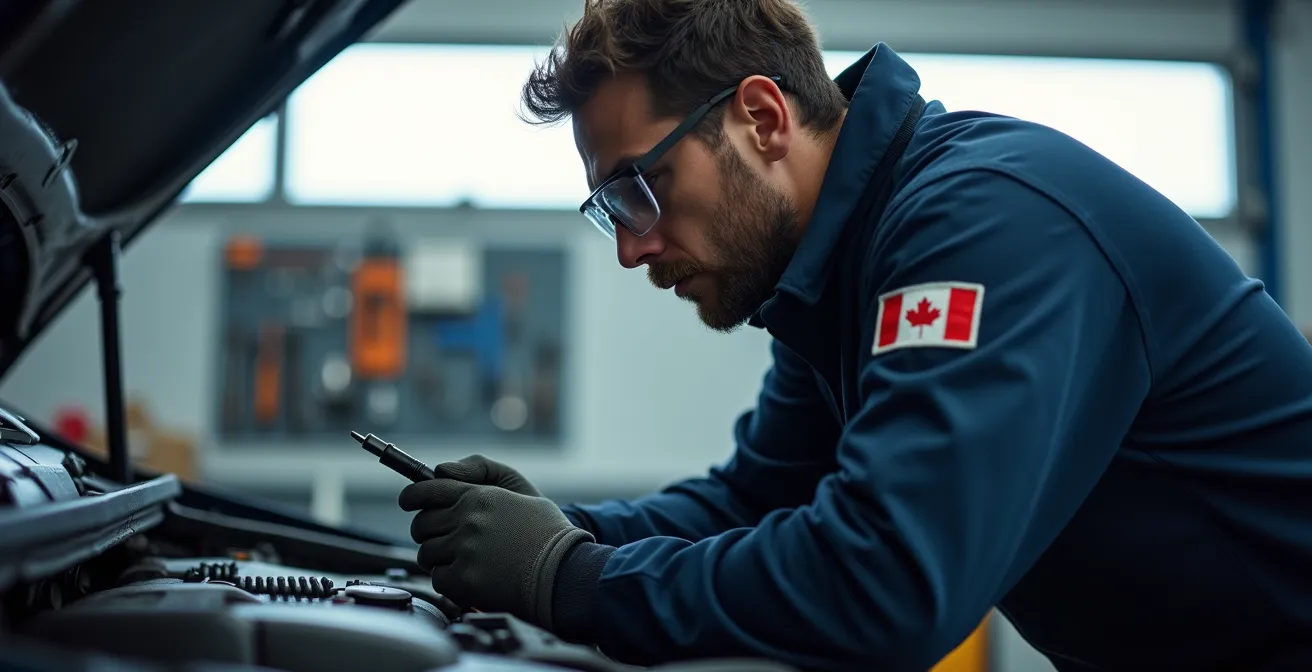
Contrary to what a clean exterior suggests, a used car’s biggest and most expensive problems are almost always invisible.
- A $150 independent inspection is not a cost; it’s financial leverage to negotiate a lower price or avoid a catastrophic repair bill.
- Sellers (and their mechanics) have a conflict of interest. Only an independent report gives you the unbiased truth about the vehicle’s health.
Recommendation: Never skip a Pre-Purchase Inspection (PPI). Use the findings to demand a price reduction that more than covers the inspection cost, or walk away from a bad deal with confidence.
You’ve found it. The perfect used car. It’s the right colour, the mileage seems reasonable, and the seller assures you it’s been “babied.” It shines under the sun, the interior is spotless, and you’re already picturing the road trips. The thought of spending an extra $150 to $200 on a pre-purchase inspection (PPI) feels like an unnecessary expense, a waste of money on a car that already looks pristine. This is the most common, and most costly, mistake a buyer can make.
Let’s be blunt. As a mechanic, I’ve seen this story play out hundreds of times in my garage. A hopeful buyer brings in their “new” car a month after purchase with a check engine light, a strange noise, or a leak. The diagnosis is almost always a pre-existing condition that a basic inspection would have caught. That “saved” $150 quickly turns into a $2,000 repair bill for a transmission, a head gasket, or a rusted-out subframe. The clean paint and shiny tires mean nothing when the mechanical heart of the car is failing.
This guide isn’t about giving you “peace of mind.” It’s about giving you financial leverage. We’re going to put on the diagnostic goggles and look at a used car the way a professional does. We’ll uncover the specific, expensive problems that a seller might not even know about (or worse, might be actively hiding). We’ll show you how an inspector can find issues that don’t trigger a warning light and how to use their report to either save thousands or dodge a financial bullet. This is your playbook for turning a simple inspection into the smartest investment you can make.
For those who prefer a visual walkthrough, the following video provides an excellent overview of the key areas to check during a used car inspection, complementing the deep-dive analysis in this guide.
This article will break down the critical inspection points that separate a good-looking car from a genuinely good car. Follow along to understand the specific tests a mechanic performs and why they are non-negotiable for any Canadian car buyer.
Summary: A Mechanic’s Guide to Smart Used Car Buying
- Why a ‘Check Engine’ light off doesn’t mean the engine is healthy?
- How does a mechanic check the engine compression in 1 hour?
- Inspection on place or on pont élévateur : laquelle révèle les fuites d’huile ?
- The conflict of d’intérêts caché : pourquoi ne jamais se fier au mécanicien du concessionnaire vendeur ?
- How to use the list of required repairs to lower the price by $500?
- How to test the automatic transmission in 10 minutes of urban driving?
- Le piège de la peinture neuve : pourquoi une belle apparence ne garantit pas un moteur jeune ?
- Spotting Hidden Rust on Used Cars: The Rocker Panel Test
Why a ‘Check Engine’ light off doesn’t mean the engine is healthy?
The most dangerous assumption a buyer can make is that a dark dashboard is a clean bill of health. The “Check Engine” light is not a comprehensive health monitor; it’s a warning for a specific set of emissions-related or critical sensor failures. Many serious mechanical issues, like low engine compression, failing timing belts, or internal coolant leaks, can develop without ever triggering a code. A car can feel fine on a 10-minute test drive while hiding a problem that will cost thousands to fix.
Furthermore, a common and deceptive tactic is to clear the diagnostic trouble codes (DTCs) right before a buyer arrives. A cheap OBD2 scanner can erase the codes, turning off the light temporarily. However, the car’s computer needs to complete a series of drive cycles to run its internal tests, known as I/M Readiness Monitors. A mechanic can plug in a professional scanner and see if these monitors are “Not Ready.” If multiple monitors show this status, it’s a huge red flag that the battery was recently disconnected or, more likely, the codes were just cleared to hide a problem.
A proper inspection goes far beyond the lights on the dash. A mechanic performs a cold start to listen for piston slap or timing chain rattle that often vanishes when the engine warms up. They check the battery and alternator under load, critical for surviving a Canadian winter but issues that won’t trigger a Check Engine light. They look for non-OEM parts that might indicate a history of problems and shoddy repairs. The absence of a light is just the first, most superficial layer of the investigation.
How does a mechanic check the engine compression in 1 hour?
A compression test is the engine’s EKG. It’s a non-negotiable step that reveals the mechanical health of the cylinders, pistons, and valves—the very core of the engine. A “clean-looking” car with poor compression is a ticking time bomb. The process is methodical and takes about an hour. First, the mechanic disables the fuel and ignition systems for safety. Then, they remove all spark plugs, which also gives them a chance to “read” the plugs for signs of oil burning or lean/rich conditions.
Next, a special pressure gauge is threaded into each spark plug hole one by one. The engine is cranked over several times, and the gauge measures the maximum pressure each cylinder can build. What the mechanic is looking for are two things: the absolute pressure reading in PSI (pounds per square inch) and, more importantly, the consistency between cylinders. A healthy engine will have strong and even compression across all cylinders. A low reading in one cylinder could point to a bad valve, while low readings in two adjacent cylinders could signal a blown head gasket—a very expensive repair.
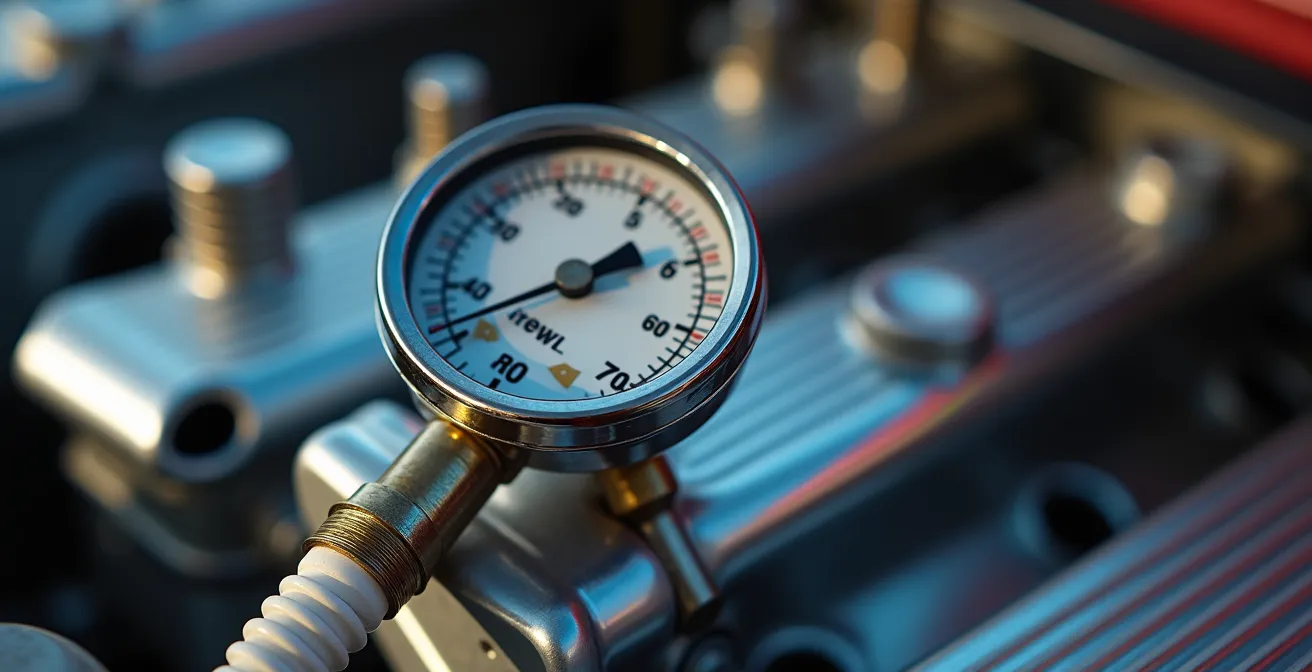
The expected PSI values vary by make and model, but an experienced mechanic knows the acceptable range. A variance of more than 10-15% between the highest and lowest cylinder is a major red flag, even if the absolute numbers seem okay. This test provides a definitive answer about the engine’s internal wear and tear, something no visual inspection or short test drive could ever reveal.
To give you a concrete idea, a recent analysis provides typical compression values for popular vehicles in Canada. These numbers are a crucial baseline for any technician performing an inspection.
| Vehicle Model | 100,000 km | 150,000 km | 200,000 km | Max Variance |
|---|---|---|---|---|
| Honda Civic | 170-185 PSI | 165-180 PSI | 160-175 PSI | 10-15% |
| Ford F-150 | 175-190 PSI | 170-185 PSI | 165-180 PSI | 10-15% |
| Toyota RAV4 | 180-195 PSI | 175-190 PSI | 170-185 PSI | 10-15% |
| Mazda3 | 165-180 PSI | 160-175 PSI | 155-170 PSI | 10-15% |
Inspection on place or on pont élévateur : laquelle révèle les fuites d’huile ?
This isn’t even a fair fight. An on-site or “mobile” inspection where the mechanic meets you in a parking lot is better than nothing, but it cannot compare to an inspection on a hoist (pont élévateur). While mobile services are convenient, with some mobile vehicle inspection services covering major cities like Montreal since 2009, they have a critical blind spot: the undercarriage. Lying on the ground with a flashlight gives you only a fraction of the view. To properly diagnose leaks, check for frame rust, and inspect suspension components, the car needs to be in the air.
On a hoist, a mechanic can see the true story. An engine might be wiped clean on top, but the bottom will reveal the source of leaks. Oil and other fluids are pulled down by gravity and blown back by wind while driving, creating tell-tale patterns. A mechanic can differentiate between a minor “sweat” from a gasket, a more serious “seep,” and an “active drip” that requires immediate and costly attention. A valve cover gasket might be a $400 fix, but a rear main seal leak, only visible with the car lifted, can easily run over $2,000 as it requires removing the entire transmission.
Here’s a simple breakdown of what a mechanic looks for underneath:
- Sweating: A light film of oil on a gasket surface. This is common on higher-mileage cars and is something to monitor, but not an immediate crisis.
- Seeping: A wet appearance where oil has started to accumulate but isn’t dripping yet. This repair should be budgeted for within the next 6 months.
- Active Dripping: Oil drops are forming and falling. This requires immediate attention and can be a negotiation point or a reason to walk away.
- Salt Damage: Especially critical in Ontario, Quebec, and the Maritimes, a hoist allows for a thorough check of brake lines and fuel lines for the white, crusty deposits of severe salt corrosion, a major safety failure.
The conflict of d’intérêts caché : pourquoi ne jamais se fier au mécanicien du concessionnaire vendeur ?
This is the golden rule of buying a used car: never use the seller’s mechanic for the inspection. It doesn’t matter if it’s a large dealership or a small independent lot. The seller’s primary goal is to sell the car. The mechanic they recommend, or the one they have in-house, has a direct or indirect incentive to minimize problems and help their employer or partner make the sale. This is a massive conflict of interest.
I’ve heard it all: “Our 150-point inspection is done!” or “Our guy already checked it out, it’s perfect.” An in-house inspection report is a marketing document, not an unbiased technical assessment. They might catch bald tires or worn brakes, but will they tell you about the early signs of transmission failure or the subtle signs of a previous accident? It’s highly unlikely. You need an inspector who works for *you* and nobody else. Their only job is to protect your financial interests by giving you the unvarnished truth.
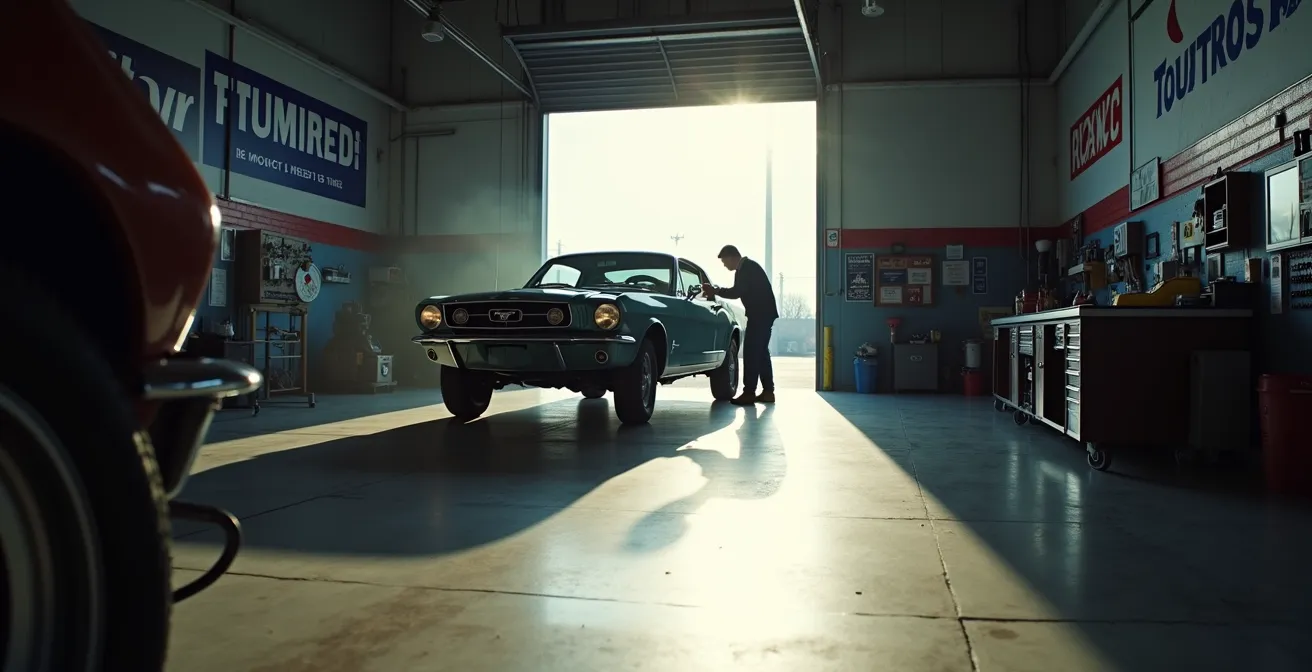
So, how do you find a truly independent inspector? Look for a well-reputed local garage that has no affiliation with the seller. In Canada, organizations like the CAA (Canadian Automobile Association) and the APA (Automobile Protection Agency) offer inspection services or have lists of approved, vetted facilities. These organizations exist to protect consumers, providing a crucial layer of trust and ensuring the assessment is unbiased. Paying for your own independent, licensed mechanic is the only way to get a report you can actually trust.
Action Plan: Vetting Your Independent Inspector
- Points of Contact: List all potential inspectors in your area—independent shops, mobile services with good reviews, and CAA/APA-approved centres.
- Information Gathering: Collect sample reports if they offer them, verify their provincial mechanic’s license, and meticulously read online reviews for mentions of thoroughness.
- Process Alignment: Confront their standard process with your goals. Do they use a hoist? Will they provide a detailed written report with repair estimates? This is crucial for negotiation.
- Trust Assessment: Speak with the mechanic or service manager. Do they communicate clearly and answer your questions without being dismissive? This “gut check” is an important part of the process.
- Integration Plan: Once you’ve chosen, book the appointment and clarify the deliverables—a PDF report, an in-person walkthrough, or both—to ensure you can effectively use the information.
How to use the list of required repairs to lower the price by $500?
The report from your independent mechanic isn’t just a pass/fail document; it’s a powerful negotiation tool. The goal isn’t to find a perfect car—no used car is perfect. The goal is to identify the car’s real-world costs and adjust the price accordingly. A report that comes back with a list of needed repairs is your opportunity to turn your $150 inspection fee into a $500, $1,000, or even greater price reduction.
The key is a professional, fact-based approach. Don’t just say “it needs work.” Present the seller with the professional inspection report. It’s best to also get two written quotes from local garages for the specific repairs noted. This moves the conversation from your opinion to documented, third-party facts. Separate the issues into two categories: safety-required repairs (e.g., brakes, tires, rusted brake lines needed for provincial safety certification) and general maintenance items (e.g., fluid changes, a seeping gasket).
Your negotiation script should be calm and direct. For example: “I’m still very interested in the vehicle. However, the independent inspection found that it requires $800 in repairs to pass a safety inspection—specifically, the front brakes and rotors. I am prepared to buy the car today if we can adjust the price to reflect this immediate cost.” By focusing on safety items, you make the request reasonable and hard to refuse. You’re not asking for a discount; you’re asking for the price to reflect the car’s actual condition. This data-driven approach removes emotion and positions you as a serious, informed buyer.
To negotiate effectively, you need realistic cost estimates. As a comparative analysis of Canadian repair costs shows, prices vary significantly by region and type of shop. Having these numbers in mind is critical.
| Repair Type | Rural Areas | Urban Centers | Dealership | Plus HST/GST |
|---|---|---|---|---|
| Front Brakes & Rotors | $450-550 | $550-700 | $700-900 | +13-15% |
| Valve Cover Gasket | $280-380 | $380-500 | $500-650 | +13-15% |
| Rear Main Seal | $900-1200 | $1200-1600 | $1600-2100 | +13-15% |
| Labour Rate/Hour | $90-110 | $120-150 | $170-200 | +13-15% |
How to test the automatic transmission in 10 minutes of urban driving?
The automatic transmission is one of the most complex and expensive components in a vehicle. A replacement can easily cost $3,000 to $5,000, making it a critical focus of any test drive. A simple drive around the block isn’t enough. You need a structured, 10-minute test that puts the transmission through its paces, both cold and warm.
Here is a systematic approach to follow during your test drive:
- Cold Start Shift Test (Minutes 1-2): Before you even start driving, with the engine just started, hold the brake firmly and shift from Park through all the gears (R, N, D). Pause for a second in each gear. Note any significant delay, hesitation, or loud clunking.
- Low-Speed Shifts (Minutes 3-4): Drive slowly through a residential area. The transmission should shift smoothly and almost imperceptibly from 1st to 2nd and 2nd to 3rd gear under light acceleration. Any harsh jerks or shuddering is a bad sign.
- Moderate Acceleration (Minutes 5-6): Find an on-ramp or an open road where you can accelerate moderately up to highway speed (80-100 km/h). The shifts should be crisp and timely. Any slipping, where the engine revs up but the car doesn’t accelerate accordingly, indicates worn clutches.
- Highway Cruise (Minutes 7-8): At a steady highway speed, listen carefully. For Continuously Variable Transmissions (CVTs), common in many modern cars, an excessive drone or a constant “hunting” for the right ratio can be a problem. In fact, transmission specialists warn that certain CVT transmissions can have high failure rates, with replacement costs running from $3,500 to $5,000.
- Warm Shift Test (Minutes 9-10): After the transmission has fully warmed up, come to a stop and repeat the initial test, shifting from Reverse to Drive. Sometimes problems only appear when the fluid is hot.
This short but structured test drive gives you valuable data. Any abnormality you notice should be pointed out to the inspecting mechanic, who can then perform more in-depth diagnostics, like checking the transmission fluid condition and scanning for transmission-specific trouble codes.
Le piège de la peinture neuve : pourquoi une belle apparence ne garantit pas un moteur jeune ?
A fresh, glossy coat of paint is one of the biggest traps for an unsuspecting buyer. It creates a powerful illusion of a well-cared-for, newish car. But in the used car world, shiny paint is often a mask, hiding a history of accidents, rust, or neglect. A “curbstoner”—an unlicensed dealer posing as a private seller—can spend a few hundred dollars on a cheap respray to hide thousands of dollars in underlying problems.
An inspector’s trained eye can spot a respray job from a mile away. They look for signs you might miss, such as paint overspray on rubber window seals, plastic trim, or even inside the door jambs. They compare the paint’s texture between different body panels; a factory paint job is perfectly smooth, while a cheap respray often has a slightly bumpy “orange peel” texture. Uneven gaps between the doors and fenders are another dead giveaway of a previous collision repair.
You don’t need professional tools to do a preliminary check. Use your phone’s flashlight and shine it at an angle along the body panels; this will reveal subtle waves and ripples that indicate body filler underneath. A professional will often use a paint depth gauge, but there’s a simpler trick you can use.
Case Study: The Magnet Test for Hidden Bodywork
A common tactic to hide extensive damage, especially on former taxis or delivery vehicles common in major Canadian cities, is to use thick layers of plastic body filler (Bondo). A simple way to detect this is with a small magnet. A refrigerator magnet will do. Test it on a known metal surface like the roof, then carefully try it on lower door panels and rocker panels. If the magnet fails to stick in certain areas, it’s a clear sign that you’re not touching metal, but a thick layer of filler hiding whatever is underneath—be it a massive dent or a panel rotted out by rust.
Ultimately, a beautiful appearance is just that—an appearance. It tells you nothing about the health of the engine, the state of the transmission, or the integrity of the frame. In many cases, it’s a deliberate distraction from the real issues.
Key Takeaways
- A pre-purchase inspection is a financial tool, not an expense. Its findings are your leverage for negotiation.
- The most expensive used car problems (engine, transmission, rust) are rarely visible on the surface.
- Never trust a seller’s in-house inspection; the conflict of interest is too great. Always hire your own independent, licensed mechanic.
Spotting Hidden Rust on Used Cars: The Rocker Panel Test
In Canada, rust isn’t a cosmetic issue; it’s a car-killer. Thanks to road salt used heavily in the “salt belt” provinces like Ontario, Quebec, and the Maritimes, rust can silently eat away at a car’s structural integrity. A shiny exterior can easily hide a frame that’s about to fail a safety inspection. The most vulnerable areas are the ones you don’t normally see: the rocker panels (below the doors), the inner wheel wells, the strut towers under the hood, and the frame rails themselves.
A bubbling paint spot is a late-stage symptom. The real damage starts from the inside out. One of the most effective field tests is what I call the “Screwdriver Test.” Take the plastic handle of a screwdriver and firmly tap along the length of the rocker panels. A solid panel will produce a sharp “thud.” If you hear a crunchy, soft, or hollow sound, you’re tapping on rusted-out metal, likely hidden by a thin layer of paint or filler. This is an instant deal-breaker, as rocker panel replacement is a major, expensive job.
A thorough rust inspection protocol includes:
- Wheel Well Inspection: Turn the steering wheel to full lock and use a flashlight to inspect the inner fenders and the area behind the wheel. Look for flaking metal or bubbling paint.
- Strut Tower Check: Pop the hood and examine the metal towers where the top of the suspension struts mount to the body. Rust here is a critical structural failure.
- Trunk Floor Test: Lift the trunk carpet and the spare tire. Any signs of moisture, staining, or surface rust indicate a leaking trunk seal, which can lead to a rusted-out trunk floor.
- Frame Rail Examination: This is where a hoist is essential. A mechanic will inspect the main frame rails for scaling, flaking, or holes. Any compromise to the frame is an immediate safety failure.
Ignoring structural rust is not an option. It can make the car unsafe in a collision and lead to costly repairs. Furthermore, significant rust issues can impact a vehicle’s insurability, as structural integrity is a key factor in risk assessment. In fact, data on insurance premiums shows that factors affecting a vehicle’s safety and repair cost, like rust-related degradation common in salt belt provinces, contribute to the overall high cost of auto insurance.
Now that you’re armed with the knowledge of what to look for, the next logical step is to put it into practice. A pre-purchase inspection is the single best way to protect your investment and ensure you’re buying a reliable vehicle, not someone else’s problems. Find a trusted, independent mechanic in your area and book an inspection before you ever sign a bill of sale.