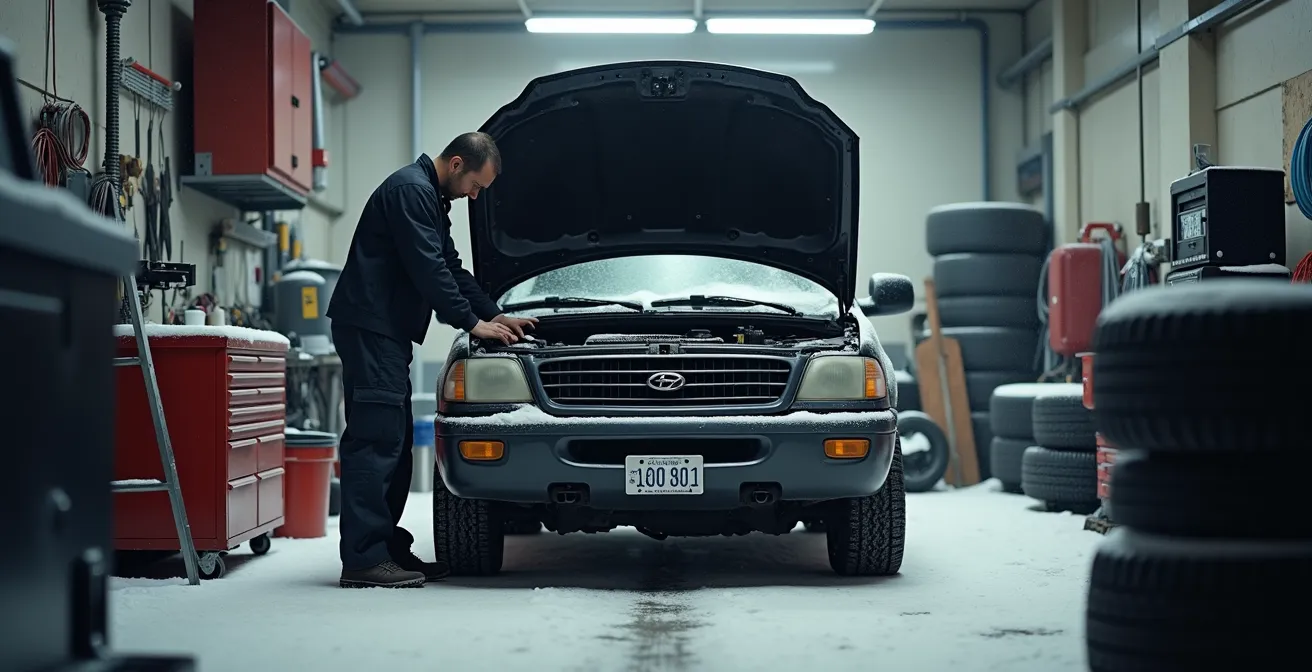
Contrary to popular belief, the number on a digital odometer is one of the least reliable indicators of a used car’s condition; its true history is written in electronic memory modules and physical wear patterns.
- Modern cars store mileage data in multiple modules (ECU, ABS, keys), making a simple dashboard rollback easy to detect with the right tools.
- Physical wear on pedals, seats, and steering wheels, especially patterns caused by Canadian road salt, tells a more honest story than the displayed mileage.
Recommendation: Always invest in a comprehensive pre-purchase inspection (PPI) that includes a full electronic module scan and a physical wear analysis before finalizing any used car purchase in Canada.
You’ve found it. The perfect used car, listed online at a great price with surprisingly low mileage. It seems too good to be true. As a vehicle electronics technician, I can tell you it often is. The digital dashboard, which many believe is a fortress of accuracy, is frequently the weakest link in a car’s history. Odometer fraud is a pervasive issue that costs unwary Canadian consumers dearly, with the Royal Canadian Mounted Police and insurers estimating losses in the millions of dollars annually. Most buyers are told to check the CARFAX report and look for obvious wear and tear, but this is surface-level advice.
The reality of modern vehicles is far more complex. Fraudsters have evolved, using cheap online tools to “correct” the mileage displayed on the instrument cluster. But they rarely erase all the digital footprints. The truth isn’t just in one place; it’s scattered across the vehicle’s electronic ecosystem and etched into its physical components. This guide moves beyond the basics. It’s about learning to read the contradictions—the mismatch between a pristine digital number and the tired reality of a transmission, the conflict between a shiny new paint job and the hidden corrosion beneath.
Forget the simple platitudes. We will delve into the technical vulnerabilities of modern odometers, decipher the physical language of wear and tear specific to Canadian conditions, and establish a hierarchy of evidence for vehicle records. This is your technical manual for unmasking a rollback, ensuring the car you buy has the life left in it that you’re paying for. We’ll explore why a car from 2020 can be easier to tamper with than one from 2000, how to conduct a 10-minute transmission stress test, and why a $150 inspection is the best defence against a multi-thousand-dollar mistake.
This article provides a structured approach to identifying potential odometer fraud. Each section is designed to give you the technical insight and practical steps needed to become a more informed and protected used car buyer in Canada.
Summary: A Technician’s Guide to Detecting Odometer Rollbacks in Canada
- Pourquoi est-il plus simple de trafiquer une voiture de 2020 qu’une de 2000 ?
- Comment le volant et les pédales trahissent-ils le vrai kilométrage d’une voiture ?
- Carnet d’entretien ou compteur : qui dit la vérité sur l’usage réel ?
- Le piège de la peinture neuve : pourquoi une belle apparence ne garantit pas un moteur jeune ?
- Que faire si vous découvrez le trafic de kilométrage 3 mois après l’achat ?
- Comment lire les codes moteur sur votre téléphone avec un dongle à 20 $ ?
- Comment tester la transmission automatique en 10 minutes de conduite urbaine ?
- Pre-Purchase Inspections: Why Saving $150 Can Cost You $2,000 Later
Pourquoi est-il plus simple de trafiquer une voiture de 2020 qu’une de 2000 ?
The transition from mechanical to digital odometers created a deceptive sense of security. In reality, it opened a new, more accessible frontier for fraud. A 2000s-era mechanical odometer required physical disassembly of the dashboard, a noisy and intricate process that left tell-tale signs. Tampering with a 2020 model, however, can be as simple as plugging a device into the vehicle’s On-Board Diagnostics (OBD-II) port. These rollback tools, readily available online, can rewrite the mileage value displayed on the instrument cluster in minutes.
The fraudster’s critical mistake, and your biggest advantage, is that modern cars are a network of computers. The mileage isn’t stored in just one place. Critical systems like the Engine Control Unit (ECU), the Transmission Control Module (TCM), the ABS controller, and even the key fob often record their own mileage or operational-hour data. As one automotive expert on Quora notes, this creates a system of checks and balances.
Mileage is logged in the ECU so with a scan tool, you can look at the actual mileage in the ECU. Even if one were to swap a different cluster in, most likely it won’t even work
– Automotive Expert, Quora Discussion on Odometer Fraud Detection
A lazy scammer will only alter the main display. A thorough pre-purchase inspection involves a “full module scan” using professional diagnostic tools. This scan interrogates every computer in the car and compares their stored mileage data. Any discrepancy is a massive red flag. For instance, the dashboard might read 80,000 km, but the TCM might have a stored record of 180,000 km. This is the electronic smoking gun of odometer fraud. The apparent simplicity of digital alteration is precisely what makes it detectable through a deeper, more technical investigation.
Comment le volant et les pédales trahissent-ils le vrai kilométrage d’une voiture ?
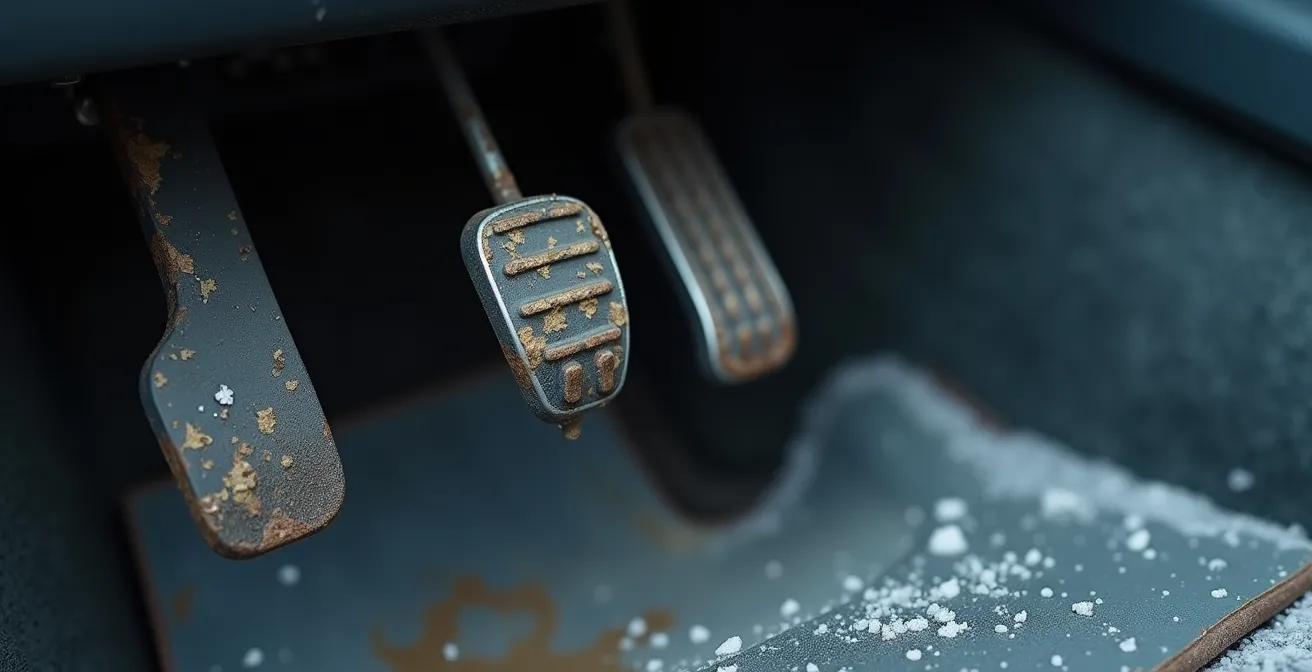
While scammers focus on digital deceit, they often overlook the undeniable story told by physical wear. The driver’s main points of contact—the steering wheel, pedals, and seat—are honest witnesses to a car’s life. A vehicle showing 50,000 km should not have a steering wheel worn smooth and shiny, or a brake pedal worn down to the metal. These are signs of high-mileage, stop-and-go city driving, no matter what the dashboard claims.
In Canada, this physical evidence takes on a unique character. Look closely at the pedals and the floor area. The corrosive effects of road salt used during harsh winters leave a distinct “Canadian wear signature.” You might see pitting on the metal pedal arms or salt stains bleached into the carpet edges that are inconsistent with a low-mileage vehicle. These details betray a car that has endured many winters on salted roads.
This method is not just theoretical; it’s a proven way to uncover fraud. Real-world cases confirm its effectiveness, showing how a quick physical inspection can trigger deeper investigation.
Case Study: Ontario Woman Uncovers 92,000 km Rollback Through Wear Analysis
An Ontario woman purchased a van showing low mileage for $2,700. However, the vehicle’s heavily worn pedals, seats, and steering wheel felt inconsistent with the number on the odometer. Prompted by these physical clues, she examined the Used Vehicle Information Package (UVIP) more closely and discovered the odometer had been rolled back by a staggering 92,000 kilometres. The director of OMVIC (Ontario’s vehicle sales regulator) confirmed that this is a common issue, particularly with digital odometers that can be easily altered.
Therefore, your first inspection should always be tactile. Run your hands over the steering wheel. Feel the texture of the pedals. Look at the wear on the driver’s side seat bolster. If the story these components tell doesn’t match the odometer, trust your senses and dig deeper.
Carnet d’entretien ou compteur : qui dit la vérité sur l’usage réel ?
When an odometer is suspect, buyers naturally turn to the service records. However, not all records are created equal. A stack of handwritten receipts from an unknown independent shop is far less reliable than a digital history from a certified dealership. Establishing a hierarchy of evidence is crucial. The most trustworthy data comes from sources that are difficult to forge and are recorded by third parties with established systems.
Official manufacturer dealership records are the gold standard. When a car is serviced at a dealership, the date and mileage are entered into a nationwide, and sometimes international, database. This creates a time-stamped, verifiable history that is extremely difficult to alter. Provincial government records, like Ontario’s Used Vehicle Information Package (UVIP), provide another layer of data, but can be less reliable as sellers have been known to alter these documents. A vehicle history report like CARFAX Canada is an essential tool, as it aggregates data from multiple sources, including service shops, insurance companies, and government registries, making it excellent for spotting inconsistencies over time.
The following table, based on information from consumer protection bodies like the Vehicle Sales Authority of BC, breaks down the reliability of common sources for vehicle history in Canada.
| Report Source | Coverage | Reliability Level | Key Features |
|---|---|---|---|
| CARFAX Canada | Nationwide | High – includes dealer records | Multiple odometer readings, accident history, recall status |
| Provincial UVIP | Province-specific | Medium – unverified readings | Government records, but sellers can alter documents |
| Dealer Service Records | Brand-specific | Highest – manufacturer database | Complete maintenance history if serviced at dealerships |
| Independent Shop Records | Local only | Low – handwritten often | May lack consistency, harder to verify authenticity |
The key is to cross-reference. Compare the mileage on the CARFAX report with the seller’s service receipts and, if possible, call a dealership with the VIN to check their internal records. If a seller is hesitant to provide records or claims they are lost, consider it a major red flag.
Le piège de la peinture neuve : pourquoi une belle apparence ne garantit pas un moteur jeune ?
A fresh, glossy coat of paint can be a major warning sign. While it might suggest a well-cared-for car, it’s more often a mask for a troubled past. Sellers may repaint a vehicle to hide evidence of a major collision, cover up spreading rust, or simply make a high-mileage car look deceptively new. A shiny exterior has no correlation with the health of the engine, transmission, or the vehicle’s true mileage. In fact, it should increase your suspicion, not allay it.
One of the first red flags is an odometer reading that seems too low for the vehicle’s age. For instance, Alberta.ca identifies unusually low odometer readings as a key indicator of potential fraud, noting that the average Canadian drives around 20,000 km per year. A ten-year-old car with only 50,000 km on the clock warrants extreme skepticism, especially if it also sports a perfect paint job. This combination often points to a “curbsider”—an unlicensed, illegal dealer who flips damaged or rolled-back cars for a quick profit.
A professional paint job is rarely perfect. Telltale signs of a repaint are often found in the details. Look for overspray on non-metal parts that shouldn’t be painted, such as window seals, black plastic trim, or under-the-hood components. Inconsistent gaps between body panels (like the hood and fenders) are a classic sign of collision repair. In Canada, another giveaway is premature bubbling under the paint, especially around wheel wells, where road salt accelerates corrosion on poorly prepped bodywork.
Your Paint Job Inspection Checklist
- Overspray Check: Inspect black plastic trim, window seals, and engine bay components for any paint overspray. These areas are never painted at the factory.
- Panel Gap Test: Use a credit card to measure the consistency of gaps between the hood, fenders, and doors. Uneven gaps suggest major collision repair.
- Corrosion Watch: Look for premature bubbling under the paint, especially near wheel wells, a sign of rust repair accelerated by Canadian road salt.
- Paint Thickness Verification: During a pre-purchase inspection, ask the mechanic to use a paint thickness gauge. Factory paint is typically under 120 microns; readings over 150 often indicate a repaint.
Ultimately, a flawless finish on an older car should be seen not as an asset, but as a question that needs answering. What is it hiding?
Que faire si vous découvrez le trafic de kilométrage 3 mois après l’achat ?
Discovering you’ve been a victim of odometer fraud after the sale is a stressful and disheartening experience. However, you are not without options. In Canada, consumer protection laws and motor vehicle dealer regulations provide avenues for recourse, but acting quickly and methodically is key. Your first step is to gather irrefutable proof of the rollback. This isn’t just your suspicion; it’s hard evidence.
This evidence typically comes from a certified dealership for the vehicle’s brand. Provide them with the Vehicle Identification Number (VIN) and ask for the vehicle’s complete service history from their internal database. If their records show a higher mileage at a past service date than what is currently on your odometer, you have your smoking gun. For example, if dealership records show the car had 150,000 km in 2022, and you bought it in 2024 showing 95,000 km, the fraud is undeniable. Get this information in writing from the dealership.

With this proof in hand, your next step is to contact the seller. If you bought from a registered dealership, present your evidence and demand a resolution, which could be a full refund or compensation for the diminished value of the vehicle. If they are uncooperative, immediately file a complaint with your provincial motor vehicle sales regulator, such as OMVIC in Ontario or the VSA in British Columbia. These bodies have the power to investigate and mediate disputes. If you bought from a private seller or a suspected curbsider, the path is more difficult and may require pursuing the matter in small claims court.
Case Study: B.C. Buyer’s Success Story Highlights the Path to a Refund
Steve Andrews purchased a Subaru from a registered dealership in Burnaby, B.C., with 98,000 km on the odometer. Weeks later, mechanical issues arose. A visit to a Subaru dealership revealed service records showing the car had over 112,000 km four years prior, proving a rollback of at least 50,000 km. Armed with this official documentation from Subaru, Andrews confronted the selling dealership. As reported by CBC News, he successfully secured a full refund of his $13,000 purchase price. This case demonstrates the power of manufacturer service records as evidence and the potential for recourse, even with registered dealers.
The key takeaway is that discovery is not defeat. By systematically gathering evidence and engaging the correct regulatory bodies, you have a fighting chance to right the wrong.
Comment lire les codes moteur sur votre téléphone avec un dongle à 20 $ ?
Empowering yourself as a buyer doesn’t require a full mechanic’s toolkit. One of the most accessible and powerful tools you can own is a simple OBD-II scanner dongle. These inexpensive devices, often costing as little as $20, plug directly into the car’s diagnostic port (usually located under the dashboard on the driver’s side). Using a Bluetooth connection, they send a wealth of data directly to an application on your smartphone.
While a basic dongle and a free app won’t perform the same deep module scan as a professional tool, they can provide crucial initial clues. Their primary function is to read Diagnostic Trouble Codes (DTCs), more commonly known as “check engine” codes. A seller may have recently cleared the codes to hide a problem, but some apps can tell you how long it has been since the codes were last reset. If they were cleared just before you arrived for the test drive, it’s a major red flag that the seller is hiding an issue.
Beyond trouble codes, some more advanced (but still affordable) apps paired with these dongles can access “Mode $09” data. This can include the vehicle’s VIN as stored in the ECU, and sometimes, operational hour counters for certain components. Here’s how to leverage this simple tool:
- Verify the VIN: Use the app to read the VIN from the ECU. Compare it to the VIN on the dashboard, door jamb sticker, and ownership documents. Any mismatch is a sign of major, fraudulent tampering.
- Check for Recently Cleared Codes: Look for the “I/M Readiness” status in the app. If many of the monitors show “Not Ready” or “Incomplete,” it’s highly likely the trouble codes were just erased to hide a problem.
- Look for Inconsistencies: A car with supposedly low mileage shouldn’t have a history of recurring trouble codes related to high-wear components like oxygen sensors or catalytic converters.
This $20 investment won’t uncover every rollback, but it’s a powerful first-pass screening tool. It can instantly reveal attempts to hide mechanical problems and provides a data-driven reason to walk away from a deal that feels off. It’s the first step in moving from a gut feeling to a fact-based assessment.
Comment tester la transmission automatique en 10 minutes de conduite urbaine ?
The engine isn’t the only component that tells the story of a car’s life; the automatic transmission is an equally eloquent, and often more honest, narrator. Transmission wear is directly proportional to mileage and driving conditions. A low-mileage car that has been driven gently should have smooth, almost imperceptible gear shifts. A high-mileage vehicle, especially one used for extensive city commuting in Canada, will inevitably show signs of wear in its transmission.
Analysis from vehicle history companies has shown that during a simple 10-minute city drive, a high-mileage transmission will betray itself. This “Stop-and-Go Stress Test” is something any buyer can perform. According to research, many modern cars start developing transmission issues around the 193,000 km (120,000-mile) mark. A car claiming to have only 70,000 km should not exhibit any of these symptoms.
Case Study: Transmission Wear Reveals True Mileage in City Driving
Analysis shows that vehicles with genuinely low mileage (e.g., under 60,000 km) should have flawless transmission performance. However, cars with actual mileage exceeding 140,000 km often exhibit clear symptoms during city driving. These include hesitation when shifting from 1st to 2nd gear, a noticeable shudder under light acceleration, and “clunking” sounds during stop-and-go traffic. These symptoms are pronounced in Canadian urban environments, where heavy traffic and harsh winters accelerate wear on transmission components. A test drive that specifically includes these conditions can quickly reveal a transmission whose condition is inconsistent with a low mileage claim.
To perform your own stress test, find a safe road with stop signs or traffic lights. During your test drive, pay close attention to the following:
- From a full stop: Accelerate gently. Is the shift from first to second gear perfectly smooth, or is there a hesitation or a noticeable “lurch”?
- Under light acceleration: As the car shifts through the lower gears (2nd to 3rd, 3rd to 4th), do you feel a shudder or vibration through the vehicle?
- Coming to a stop: As you brake and the car downshifts, do you hear or feel any clunking or harsh engagement?
- Reverse Gear: When shifting from Park to Reverse, or from Drive to Reverse, is the engagement instant and smooth, or is there a long delay followed by a hard jolt?
If the transmission is performing poorly, it’s a strong indication that the car has lived a much harder life than the odometer suggests.
Key Takeaways
- Odometer rollbacks are increasingly digital; fraud detection requires scanning all vehicle electronic modules, not just trusting the dashboard display.
- Physical wear, particularly salt-related corrosion on pedals and undercarriage specific to Canada, provides more reliable clues than a digital mileage number.
- A Pre-Purchase Inspection (PPI) is not an expense but a critical investment that can save thousands by uncovering hidden wear and electronic discrepancies.
Pre-Purchase Inspections: Why Saving $150 Can Cost You $2,000 Later
After reviewing all the methods of detection, one truth becomes clear: the single most effective safeguard against odometer fraud is a comprehensive, independent Pre-Purchase Inspection (PPI). Many buyers, in an attempt to save money, will skip this step, viewing the $150-$200 fee as an unnecessary expense. This is a catastrophic financial error. A PPI is not a cost; it is an investment in certainty that can prevent thousands of dollars in future repairs and overpayment.
Odometer fraud is not a static problem; it’s a growing one. Recent data indicates that odometer fraud saw a 14 percent increase, making third-party verification more critical than ever. A proper PPI by a trusted mechanic goes beyond a simple visual check. It includes placing the car on a lift to inspect for hidden rust and collision damage, a full electronic module scan to check for mileage discrepancies, and a technical assessment of the engine and transmission. This is the only way to get a complete picture of the vehicle’s true condition.
The financial logic is undeniable. Paying $200 to discover a 100,000 km rollback on a car saves you from overpaying by thousands and inheriting the imminent costs of replacing a worn-out transmission or engine. As the following cost-benefit analysis shows, in every scenario, the PPI is the wisest financial move.
| Scenario | Initial Cost | Potential Loss/Savings | Risk Level |
|---|---|---|---|
| Skip PPI, Buy with Rollback | $0 | -$3,300 average value loss + unexpected repairs | High |
| Get PPI, Detect Rollback | $150-200 | Save $7,000+ on 2018 Honda Civic example | None – fraud detected |
| Get PPI, Car is Clean | $150-200 | Peace of mind + maintenance planning | Low – verified condition |
| Seller Refuses PPI | $0 | Walk away – major red flag | Extreme – likely fraud |
Furthermore, the legal implications of a PPI are significant. According to guidance from the Ontario Motor Vehicle Industry Council (OMVIC), the PPI serves as a crucial piece of evidence.
If a mechanic documents evidence of a rollback before the sale, and the buyer proceeds, they have no recourse. If the PPI misses it, they may have recourse with the inspection shop
If a seller refuses to allow an independent PPI, you should walk away from the deal immediately, no matter how good it seems. It is the biggest red flag of all, and it is a clear signal they have something to hide.
The most effective action you can take to protect yourself is to insist on an independent pre-purchase inspection before any money changes hands. It’s the definitive step to transform suspicion into certainty and ensure your investment is sound.