
The secret to a great car deal in Canada isn’t just knowing the price; it’s understanding the dealership’s entire playbook and using their own tactics against them.
- Dealers create a $5,000+ gap between your trade-in’s value and their offer by inflating “reconditioning” costs and adding hidden fees.
- Focusing on the “out-the-door” price neutralizes the “low monthly payment” trap, which hides thousands in extra costs over long loan terms.
Recommendation: Shift your focus from the sticker price to deconstructing their offer. Question every line item, leverage timing, and turn vehicle imperfections into documented, non-negotiable discounts.
You’ve spent weeks researching, you know your trade-in’s Canadian Black Book value down to the dollar, and you walk into the dealership ready for a fair deal. Then comes the offer, and it’s thousands less than you expected. The frustration is real, and it’s a universal part of the car-buying experience in Canada. Most advice tells you to “be prepared to walk away” or “negotiate the trade-in separately,” but this is surface-level stuff. It’s like telling a hockey player to “skate fast.” It doesn’t teach them the plays.
As someone who spent years on the other side of the desk, let me pull back the curtain. The dealership isn’t just a store; it’s a finely tuned machine designed to maximize profit on every transaction. They have a script, a process, and a set of psychological triggers they use all day, every day. They count on you negotiating the sticker price while they make their real money on the trade-in, financing, and back-end products.
But what if you could dismantle that machine? The true key to saving thousands isn’t just knowing your car’s value; it’s knowing their math. It’s about understanding concepts like the “dealer’s spread,” “payment packing,” and “quota leverage.” This guide isn’t about generic tips. It’s an insider’s playbook. We’re going to dissect the dealership’s most common strategies, from the initial lowball offer to the final-hour financing pitch, and give you the specific numbers and scripts to counter them effectively.
This article provides a structured approach to master every stage of the negotiation. By understanding how the dealership thinks, you can anticipate their moves and turn every part of the deal to your advantage, ensuring you walk out with the keys and without a dollar of regret.
Summary: Your Complete Canadian Car Negotiation Playbook
- Why is the dealer offering you $5,000 less than the online listed price?
- How to turn a bumper scratch into a $300 discount?
- 8% financing or a cash rebate: which option costs less in the end?
- The ‘how much do you want to pay per month’ trap: how to avoid paying for too long?
- When to visit the dealership to take advantage of sales quotas?
- When to sell your SUV to maximize its value on the used market?
- How to use the list of required repairs to lower the price by $500?
- Private Car Sales in BC: Transfer Forms and Tax Implications
Why is the dealer offering you $5,000 less than the online listed price?
That gut-punch offer isn’t personal; it’s a calculated business strategy built on a concept we call the “dealer’s spread.” They aren’t just looking at the Canadian Black Book (CBB) value. They’re looking at that number and immediately subtracting a series of internal costs and profit goals. Your $20,000 trade-in becomes a $15,000 offer because they’ve already mentally deducted everything it will take to flip your car for a profit on their used lot.
Here’s the typical math they do in their head, which they will never show you. They start with the CBB value and subtract:
- Reconditioning Costs: This is for new tires, brake pads, professional detailing, and fixing any dings. They often budget a generous $1,500 or more for this, even if the car needs less.
- Market Risk & Pack Fee: This is a slush fund. The “pack fee” is a non-negotiable internal charge (e.g., $500) added to every used car’s cost to cover overhead. The “market risk” is another buffer (e.g., $1,000) in case the market for your specific model softens.
- Desired Profit: Finally, they subtract their minimum target profit. On a desirable used car, they want to make at least $2,000.
When you add it all up ($1,500 + $500 + $1,000 + $2,000), you get the $5,000 gap between what your car is worth and what they offer. Your first counter-move is to acknowledge their need for profit but question the costs. A great line is, “I understand you need to recondition it, but a $5,000 spread on a CBB value of $20,000 seems high. Let’s look at the real numbers.” Also, remind them of the tax savings you provide them in provinces like Ontario. Trading in reduces the taxable amount of your new purchase, a real-dollar advantage you bring to the table.
How to turn a bumper scratch into a $300 discount?
The secret is to transform from a buyer into a professional inspector before you ever talk price. Every minor imperfection, missing item, or sign of wear is not just a flaw; it’s a quantifiable bargaining chip. A single scratch isn’t about aesthetics; it’s about the real-world cost to repair it, and that cost comes directly off their bottom line or yours. You must document these issues to build a case for a discount.
This process, which I call condition arbitrage, involves meticulously inspecting the vehicle and getting local repair estimates *before* you negotiate. That way, you’re not arguing opinions; you’re presenting facts. A missing second key fob isn’t a minor inconvenience; it’s a $300 to $600+ replacement cost at a Canadian dealership. Worn-out all-season tires aren’t just used; they’re a $1,000+ expense looming before the next safety inspection. By presenting a list of legitimate, cost-assessed issues, you force them to concede on price or fix the problems themselves.
This paragraph introduces a complex concept. To well understand it, it is useful to visualize its main components. The illustration below decomposes this process.
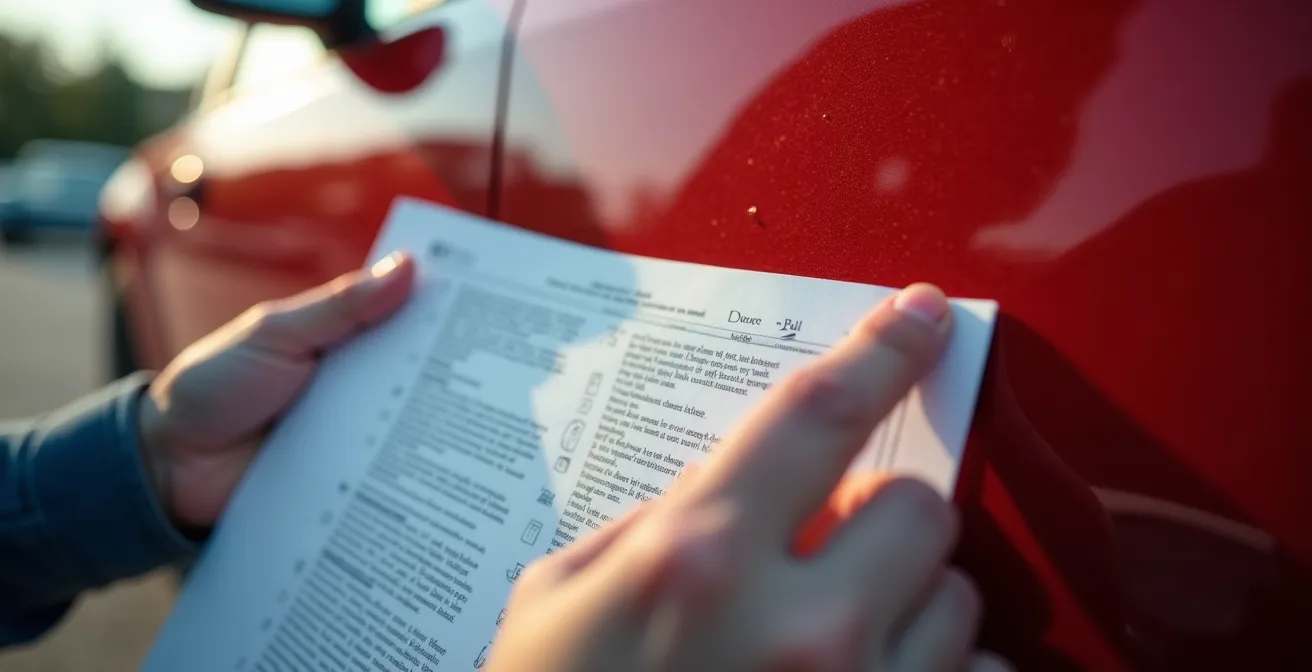
As this image suggests, a detailed, methodical inspection is your most powerful tool. Don’t just glance; scrutinize. Run your hands along panels, check every button, and listen for every noise. These details are the foundation of a successful negotiation, allowing you to chip away at the asking price with undeniable evidence.
Your Pre-Negotiation Inspection Checklist: Finding a Discount
- Exterior Walk-around: Document every scratch, dent, and paint chip. Check for uneven panel gaps that could indicate a past accident. Don’t forget the windshield for any chips or cracks.
- Tires and Brakes: Check tread depth on all four tires. Are they the same brand? Mismatched tires suggest corner-cutting. Look at the brake rotors through the wheels for rust or scoring.
- Interior and Electronics: Test every single button, switch, and function. Check for missing items like the owner’s manual, floor mats, or that second key fob. A single missing fob is a significant cost.
- Get Local Quotes: Before negotiating, get quick quotes from Canadian chains like CARSTAR or Maaco for the cosmetic repairs you’ve noted. This gives you a real dollar amount to negotiate with.
- Present Systematically: Don’t just say “it’s scratched.” Say, “I have a quote to repaint this bumper for $450. I’m willing to accept a $300 discount to save us both the hassle of getting it fixed.”
8% financing or a cash rebate: which option costs less in the end?
This choice is one of the biggest shell games on the showroom floor, and the right answer depends entirely on your access to third-party financing. Dealers often present a choice between a low manufacturer-subsidized interest rate (like 0.99%) or a large cash rebate (e.g., $3,000) if you use their standard, higher-rate financing. The cash rebate feels like an instant win, but it’s designed to lock you into a more profitable loan for the dealership.
The dealership’s finance office is a massive profit center. They make very little on the new car itself but earn significant commissions on the loans they arrange. Offering a cash rebate is a small price to pay for getting you into an 8% loan where they make thousands over the term. The only way to know the true cost is to calculate the total amount paid for each option. You must ignore the monthly payment and focus on the final number. The best-case scenario is often taking the cash rebate and securing your own, better-rate loan from a bank or credit union before you even walk into the dealership.
This table breaks down the real cost of a $40,000 vehicle under different financing scenarios, as shown by a recent comparative analysis of Canadian car deals.
| Option | Interest Rate | Rebate | Monthly Payment (60 months) | Total Cost |
|---|---|---|---|---|
| Dealer Financing | 8% | $0 | $811 | $48,660 |
| Cash Rebate + Bank Loan | 5.5% | $3,000 | $707 | $45,420 |
| Manufacturer 0.99% Special | 0.99% | $0 | $684 | $41,040 |
As the data clearly shows, the manufacturer’s special low rate is often the cheapest overall option. However, if you can secure a good rate from your bank (like the 5.5% example), taking the cash rebate can be a superior choice to the dealer’s standard high-rate financing. Always run the numbers.
The ‘how much do you want to pay per month’ trap: how to avoid paying for too long?
This question is the single most effective trap in a salesperson’s arsenal, and you must never answer it directly. The moment you give a monthly payment number, you lose control of the negotiation. This tactic, known as “payment packing,” allows the salesperson to shift your focus from the vehicle’s total price to a seemingly affordable monthly figure. It’s a psychological sleight of hand that lets them load the deal with high-profit add-ons without you noticing the overall cost skyrocketing.
Here’s how it works: you say you can afford “$500 a month.” The salesperson goes to their manager, and they structure a deal that hits your number, but they do it by stretching the loan term to 84 or even 96 months. Then, they start adding extras. “For just $35 more a month, we can add a premium extended warranty.” What they don’t tell you is that this “small” addition just added $3,000 to your total debt, as a breakdown of common car loan pitfalls shows. They can “pack” thousands in warranties, rust proofing, and fees into the loan, and as long as the monthly payment stays near your target, many buyers don’t question the total price.
The only way to win this game is to refuse to play. Your pivot script should be firm and immediate.
- Salesperson: “So, what are you hoping to be around for a monthly payment?”
- You: “I appreciate you working with my budget, but I prefer to focus on the total ‘out-the-door’ price of the vehicle first. Once we agree on that final number, we can discuss financing options.”
This response re-establishes your control. Always negotiate the total purchase price, get it itemized in writing, and only then discuss loan terms. This prevents any hidden costs from being packed into your payments.
When to visit the dealership to take advantage of sales quotas?
The best time to buy a car is when the dealership is most desperate to sell one, and that desperation is driven by monthly, quarterly, and annual sales quotas. Hitting these targets unlocks significant manufacturer bonuses for the dealership, meaning they’re often willing to take a small loss on your specific car to secure a much larger payout. Your goal is to time your visit to coincide with this peak desperation.
Forget leisurely Saturday afternoon shopping; that’s when they’re busiest and least flexible. The real opportunities are at the end of the month (the last two days) and, even better, the end of a quarter (March, June, September, December). A salesperson who is one car away from a big bonus on December 30th is your new best friend. Furthermore, a detailed analysis suggests that in Canada, dealerships clear inventory for new models during late summer around August/September, creating another window of opportunity. Keep an eye out for model redesign announcements; dealers will offer steep discounts on outgoing models to clear the lot.
Don’t underestimate environmental factors either. A heavy snowstorm in a Canadian winter or a torrential downpour means an empty showroom. A bored salesperson is a motivated salesperson. Being one of the few customers in the building gives you immense leverage, as the quiet atmosphere itself puts pressure on them to make a deal happen.

This scene of a quiet, snow-covered dealership represents your golden opportunity. When the showroom is empty and the sales team is idle, you hold the power. Plan your visit for a weekday evening or during miserable weather to maximize your advantage and find a salesperson eager to meet their quota with your purchase.
When to sell your SUV to maximize its value on the used market?
The key to maximizing your SUV’s resale value in Canada is to sell when demand is highest and supply is tightest, which means thinking seasonally. While the overall used car market is stabilizing, with a recent analysis showing that the Canadian used car market shows that prices have dropped about 15% from their pandemic-era peaks, seasonal trends remain a powerful force. You need to align your sale with the natural buying cycles of Canadian consumers.
For SUVs, especially those with All-Wheel Drive (AWD) or 4×4 capabilities, the peak selling season is undoubtedly the fall. From September to October, families and commuters start preparing for winter, and the demand for safe, capable vehicles skyrockets. This is when you’ll get the most inquiries and the highest offers. Listing your SUV as the first snowflakes are predicted is a classic and effective strategy. Conversely, trying to sell a large SUV in December or January is often a mistake, as that’s when the market is flooded with post-holiday trade-ins and prices tend to dip.
There’s a secondary peak in the spring, around April and May. This demand is driven by a different need: summer road trips. Larger, three-row SUVs become particularly attractive to families planning vacations. If you miss the fall window, preparing your vehicle for a spring sale is your next best bet. The absolute worst time to sell is typically mid-summer (July/August), when vacations are already underway and the market is at its quietest. By timing your listing to these two key seasons, you ensure you’re selling into a wave of demand, not a trough of indifference.
How to use the list of required repairs to lower the price by $500?
The most powerful negotiation tool you can have is not an opinion, but a professional, written estimate. After you’ve test-driven a used car you like, the single most important step is to invest in a pre-purchase inspection (PPI) with a trusted independent mechanic. This step is non-negotiable. As insiders know, it is wise to spend $100-$200 to have any used vehicle professionally inspected prior to purchase in Canada. This inspection report becomes your roadmap for a price reduction.
Your mechanic will provide a list of issues, which you should then categorize. Separate “nice-to-have” fixes from “must-have” repairs required to pass a provincial safety certification (like Ontario’s Safety Standards Certificate or BC’s inspection program). The safety issues are your leverage. For example, if the mechanic states the car needs new brake pads and rotors to pass safety and quotes you $600 for the job, you now have a non-negotiable talking point. Your script isn’t a request; it’s a statement of fact.
You approach the salesperson and say, “My mechanic’s inspection shows the car won’t pass a safety without new brakes. The written quote for the repair is $600. So, you can either have your service department complete the work before I purchase, or you can deduct that amount from the agreed-upon price. Which do you prefer?” This frames it as a choice between two acceptable outcomes for you. By combining several of these safety-related items (e.g., brakes, tires, a cracked windshield), you can easily build a case for a $500 to $1,000 price reduction based on concrete evidence, as recommended by a guide on using inspections in negotiations. If they agree to do the repairs, always get it in writing on a “We Owe” slip signed by the manager.
Key Takeaways
- Deconstruct the Offer: Always ask for an itemized price. Challenge the “reconditioning” and “admin” fees, as this is where hidden profits lie.
- Control the Conversation: Never answer the “what’s your monthly payment” question. Pivot to the “out-the-door” price to neutralize their most common trap.
- Leverage Time and Condition: Shop at the end of the month or quarter, and use a professional inspection report to turn necessary repairs into concrete discounts.
Private Car Sales in BC: Transfer Forms and Tax Implications
Navigating a private vehicle sale in British Columbia involves specific paperwork and a unique tax situation that differs from dealership purchases. While it can save you money, it’s crucial to understand the process and the tax rules to avoid costly surprises at the ICBC Autoplan broker’s office. This section focuses specifically on the rules within British Columbia.
The most common questions revolve around taxes. When you buy a vehicle in a private sale in Canada, the federal GST/HST does not generally apply. This is a key advantage over buying from a dealer. However, you will have to pay Provincial Sales Tax (PST) when you register the vehicle. According to the Canada Revenue Agency, the GST/HST does not generally apply to private sales, but provincial tax is a separate matter administered by the province.
Here are the answers to the most frequent questions for a BC private sale:
- What tax do I pay? You will pay PST when you register the car. Since 2022, BC has a new rule to prevent tax avoidance. You’ll pay PST on the *greater* of either the price you paid or the vehicle’s “specified value” (its average wholesale value). Declaring an artificially low price on the transfer form no longer works.
- What is the transfer process? It’s a three-step dance. First, you and the seller must complete the APV9T Transfer/Tax Form together. Second, the seller signs over the original Certificate of Registration. Third, you, the buyer, take both of these signed documents, along with your driver’s license and proof of insurance, to an Autoplan broker to complete the registration and pay the PST.
Payment should be handled securely. Avoid carrying large amounts of cash. A bank draft is the safest method. Alternatively, multiple Interac e-Transfers can work, but be mindful of daily sending limits. Completing the paperwork correctly and understanding the tax implications upfront will ensure a smooth transfer of ownership.
Now, armed with an insider’s understanding of the dealership’s math, timing, and tactics, you are no longer just a customer; you are a prepared negotiator. Walk into that dealership with the data, the scripts, and the confidence to control the conversation and secure the deal you deserve.