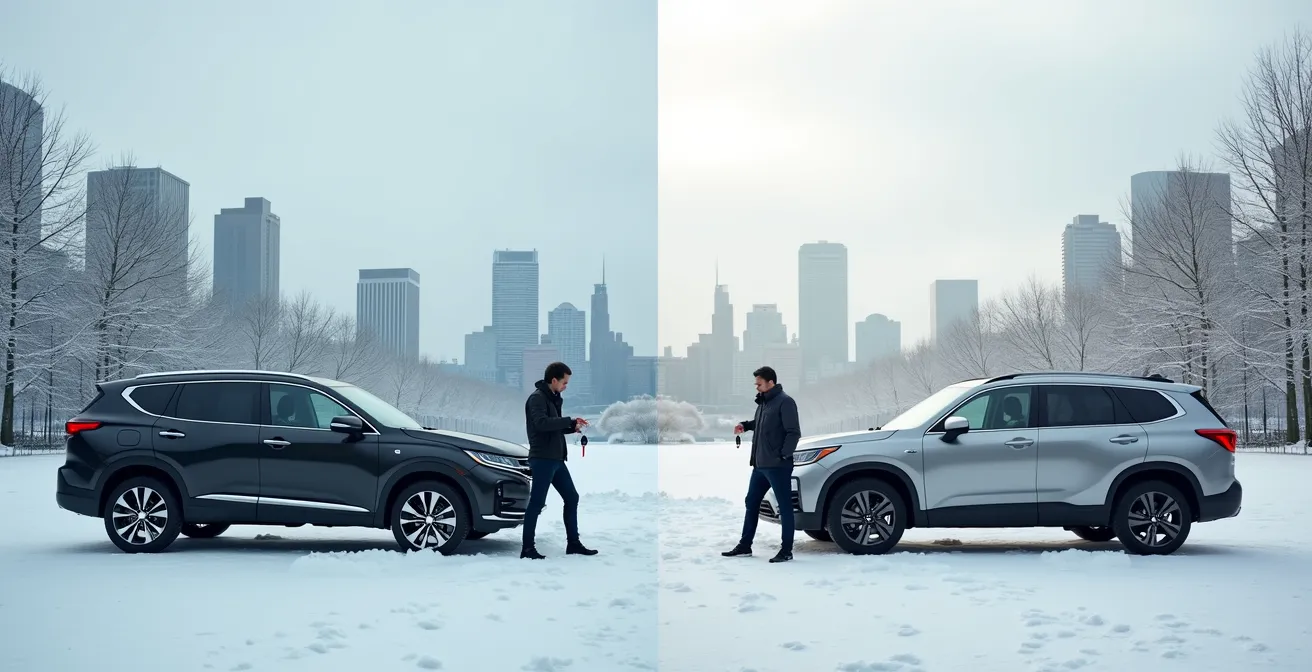
For a 12-month term in Canada, a lease takeover is almost always financially superior to a long-term rental, but only if you analyze it like a broker: by focusing on the total, risk-adjusted cost, not just the monthly payment.
- Cash incentives are a key financial lever, often reducing your effective monthly cost significantly, but their real value depends on provincial taxes.
- Hidden liabilities like inherited wear-and-tear fees from harsh Canadian winters or non-transferable warranties can quickly erase any savings.
Recommendation: Your primary task is a financial due diligence and risk assessment. Treat the vehicle inspection and lease agreement review with the same seriousness as a home purchase.
For professionals on temporary assignment or newcomers navigating their first year in Canada, securing a vehicle for a 12 to 24-month period presents a classic dilemma. The traditional long-term rental offers flexibility but often comes with a premium price tag that feels like a poor investment. On the other side, a lease takeover, or “lease transfer,” beckons with the promise of lower monthly payments, effectively letting you step into the desirable middle part of someone else’s car lease.
The surface-level analysis is simple: lease takeovers appear cheaper. However, this perspective often overlooks a landscape of hidden variables, financial risks, and uniquely Canadian challenges. The real cost isn’t just the advertised payment. It’s a complex equation involving cash incentives, administrative fees, credit approvals, and the significant impact of “severe usage” conditions dictated by Canadian winters and dense urban driving. A cheap monthly payment can quickly become an expensive mistake if you inherit a vehicle on the verge of needing costly repairs or facing end-of-lease penalties.
This guide moves beyond the simplistic “cheaper vs. flexible” debate. Acting as your financial broker, we will dissect the true, risk-adjusted cost of both options. We will not just tell you what to look for; we will explain the financial mechanics behind each component, from leveraging cash incentives to identifying the legal traps of an improper transfer. The goal is to equip you with a professional framework to assess these opportunities, ensuring your final decision is based on a complete financial picture, not just an attractive monthly number.
To make the most informed choice, it’s essential to understand the specific financial levers and potential pitfalls associated with each option. The following sections break down the critical factors that determine the true cost and value of a lease takeover compared to its alternatives.
Summary: Lease Takeover vs. Long-Term Rental: A Financial Breakdown
- Why cash incentives make lease takeovers so attractive
- How to avoid inheriting the previous lessee’s wear and tear fees
- All-inclusive subscription services: a good option to avoid commitment?
- Who pays the $500 administrative fee for the file transfer?
- What credit score is needed for the manufacturer to approve the transfer?
- Why can the bank repossess your new car if the ex-seller stops paying?
- Why is driving in Montreal considered ‘severe use’ by all manufacturers?
- How to Buy a Used Car in Ontario Without Getting Scammed
Why cash incentives make lease takeovers so attractive
The single most powerful financial advantage of a lease takeover is the cash incentive. This is a direct payment from the original lessee to you, the new buyer, to make their lease more appealing. Why would someone pay you to take their car? The answer lies in urgency. The original lessee may be moving, changing family needs, or facing financial hardship, and breaking a lease agreement with the manufacturer is incredibly expensive. Offering an incentive is often the cheaper way out for them. For the buyer, this translates into a significant reduction in the total cost of ownership.
These incentives are not trivial amounts. Data from Canadian marketplaces shows they commonly range from $1,000 to much higher sums for luxury vehicles. The seller’s urgency creates powerful leverage for the buyer. With an estimated 80 per cent of lease takeover listings resolved within 60 days, many sellers are highly motivated to close a deal quickly, opening the door for you to negotiate a larger incentive. This cash can be used to cover initial fees, buy winter tires, or simply lower your effective monthly payment over the term of the lease.
However, it’s crucial to remember that a cash incentive is treated as a rebate on the vehicle’s value, which has tax implications. The net value you receive depends on the provincial sales tax (HST/GST/QST) where the transfer occurs. A $2,000 incentive in Alberta is worth more in your pocket than the same incentive in Quebec.
| Province | Tax Type | Tax Rate | Net Value After Tax |
|---|---|---|---|
| Ontario | HST | 13% | $1,770 |
| Quebec | GST+QST | 14.975% | $1,700 |
| Alberta | GST | 5% | $1,900 |
| British Columbia | GST+PST | 12% | $1,786 |
How to avoid inheriting the previous lessee’s wear and tear fees
The greatest financial risk in a lease takeover is inheriting liability for the previous owner’s neglect. At the end of the lease term, the manufacturer will perform a detailed inspection, and any “excess wear and tear” will be billed to you. This can include anything from significant scratches and curb-rashed wheels to stained interiors and tires with insufficient tread. In a country with harsh winters, this risk is amplified. Road salt accelerates underbody rust, and potholes can cause hidden suspension damage.
A generic walk-around is not enough. You must conduct a rigorous Canadian Condition Audit before signing any papers. This means scrutinizing the vehicle specifically for issues common in Canada. Pay close attention to tire tread depth, as minimums are legally mandated and winter performance is critical. Inspect the underbody and wheel wells for any signs of corrosion from road salt. A professional, third-party inspection by a trusted mechanic is a non-negotiable investment that can save you thousands in the long run. If the seller is hesitant to allow an inspection, consider it a major red flag.

As the image above highlights, the details matter immensely. You are not just buying the remaining months on a contract; you are assuming full responsibility for the vehicle’s physical condition. Your due diligence must be thorough, treating the inspection with the seriousness of a major financial transaction. This is the single most important step in mitigating your risk and protecting your investment.
Your Canadian Winter Condition Inspection Checklist
- Check underbody for rust damage from road salt exposure.
- Test battery cold-cranking amps (should be 600+ CCA for Canadian winters).
- Measure tire tread depth (minimum 2/32 inch in Ontario, but 4/32 is recommended for safe winter driving).
- Inspect the windshield for pitting from road salt and any stone chips that could crack in the cold.
- Review the maintenance history to ensure compliance with the manufacturer’s severe usage schedule.
All-inclusive subscription services: a good option to avoid commitment?
For those prioritizing ultimate flexibility and simplicity over lowest cost, car subscription services like Roam have emerged as a compelling alternative in Canada. These services operate like a Netflix for cars: you pay a single monthly fee that typically bundles the vehicle, insurance, routine maintenance, and roadside assistance. There’s no long-term lease agreement, and you can often swap cars or cancel the service with relatively short notice.
This model directly addresses the pain points of traditional ownership and leasing. As Apoorv Gupta, Founder and CEO of Roam, states:
In addition to flexibility, consumers want the car ownership experience to be simple and convenient. A Roam car subscription comes with insurance, routine maintenance, and roadside assistance bundled in.
– Apoorv Gupta, Roam Founder and CEO
This convenience, however, comes at a significant premium. The cost is substantially higher than a typical lease takeover. For example, Roam’s monthly costs can range from $771 to $2,469 plus taxes, depending on the vehicle. When you compare a potential $800+ monthly fee for a subscription service to a $400 monthly payment on an incentivized lease takeover, the financial trade-off becomes stark. You are paying a high price for the absence of commitment and the luxury of an all-in-one package. For a 12-month period, this cost difference can easily amount to several thousand dollars.
Who pays the $500 administrative fee for the file transfer?
The lease transfer is not a private transaction; it is a formal process administered by the manufacturer’s financing arm (e.g., Honda Canada Finance, Ford Credit Canada). For this service, they charge a non-negotiable administrative transfer fee. This fee covers the cost of running a credit check on the new lessee and processing the legal paperwork to transfer rights and obligations. While often quoted as a single “transfer fee,” the total cost can sometimes include additional dealer-specific charges.
So, who pays this fee, which can range from $450 to over $950? There is no set rule; it is a point of negotiation between the buyer and the seller. This is another opportunity for you to exercise financial leverage. If the seller is highly motivated, you can often negotiate for them to cover the entire fee. A common compromise is to split the cost 50/50. This negotiation should be finalized before you agree to proceed with the credit application. Your negotiation stance can be influenced by other factors, such as whether a cash incentive is being offered or if the car will soon need new tires or brakes.
It is critical to know the specific fees for the vehicle you are considering, as they vary significantly by manufacturer. Below is a breakdown of typical costs from major brands in Canada.
| Manufacturer | Transfer Fee | Additional Dealer Fees | Total Typical Cost |
|---|---|---|---|
| Honda Canada Finance | $450 + tax | $300-500 | $750-950 |
| Toyota Credit Canada | $399 + tax | $200-400 | $600-800 |
| Ford Credit Canada | $450 + tax | Varies by dealer | $450-900 |
| GM Financial | $595 + tax | $0-300 | $595-895 |
| Note: The transfer fee is commonly negotiated between the buyer and the seller, averaging about $600 CAD, and is subject to sales tax. | |||
What credit score is needed for the manufacturer to approve the transfer?
A lease takeover is not an automatic right; it is a privilege that must be earned through a formal credit approval process. The manufacturer’s finance company is taking a significant risk by transferring a multi-thousand-dollar asset to a new person. Their primary goal is to ensure you are financially capable of making the remaining payments. Therefore, your credit history and score are the most critical factors in the approval process.
While the exact requirements vary slightly between lenders, a general benchmark exists for the Canadian market. To be considered a strong candidate, you should aim for a credit score of 720 or higher. While some manufacturers may approve applications with scores in the high 600s, a score below 680 is very likely to be rejected. Based on typical Canadian lender requirements, a minimum score of 680 is often cited, with 720+ being the recommended threshold for a smooth approval.

For newcomers to Canada, this can be a significant hurdle. Without a Canadian credit history, manufacturers have no way to assess your financial reliability, and applications are often denied. In such cases, a co-signer with a strong Canadian credit file may be required. Before paying for a vehicle inspection or committing time to the process, it is wise to have a clear and recent understanding of your own credit score. Services like Borrowell or Credit Karma offer free access to your score in Canada, allowing you to assess your eligibility upfront.
Why can the bank repossess your new car if the ex-seller stops paying?
This scenario represents the single greatest legal and financial catastrophe in a lease transfer, known as the “Sublet Trap.” It occurs when a buyer and seller agree to a private, off-the-books arrangement to “take over payments” without going through the official manufacturer process. This is often seen in online ads on platforms like Kijiji or Facebook Marketplace, and it is an illegal sublet of the vehicle, not a legal transfer.
In this dangerous situation, the original lessee remains the only person legally tied to the car and the loan. Even if you make every payment to them on time, you have no legal rights to the vehicle. If the original lessee stops forwarding your payments to the finance company, the bank will declare the loan in default. Since the car is the collateral for that loan, the finance company has the legal right to repossess it—from you. You will lose the car, all the money you have paid, and have no legal recourse.
A legitimate transfer is the only way to protect yourself. As Square One Insurance clearly states in their guide:
The transfer must be approved and processed by the manufacturer’s financial services arm, which legally transfers all rights and obligations to the new lessee.
– Square One Insurance, Car Lease Takeover Guide
This official process is your only shield. Once the paperwork is signed with the manufacturer’s representative, the original lessee is removed from the agreement entirely, and you become the sole legal party responsible for the vehicle. Any offer that suggests bypassing this formal step is not a shortcut; it is a trap.
Why is driving in Montreal considered ‘severe use’ by all manufacturers?
Every vehicle manufacturer provides two maintenance schedules: “normal” and “severe.” The “severe use” schedule requires more frequent and often more expensive maintenance, such as oil changes, fluid flushes, and inspections. What many drivers in Canada don’t realize is that their daily driving habits likely fall under the severe category, and dense urban environments like Montreal are the textbook example.
Driving in Montreal—or any major Canadian city—is considered severe for several reasons:
- Stop-and-Go Traffic: Constant acceleration and braking put significant strain on the engine, transmission, and brakes.
- Short Trips: Frequent short drives, especially in the cold, prevent the engine from reaching its optimal operating temperature, leading to moisture buildup in the oil and exhaust systems.
- Extreme Temperatures & Road Salt: The brutal cold of winter reduces battery capacity and thickens fluids, while road salt aggressively corrodes the underbody, brake lines, and exhaust components.
Ignoring the severe service schedule is a costly mistake. It not only voids certain aspects of the manufacturer’s warranty but also leads to premature failure of key components. For someone taking over a lease, this is a hidden financial risk. If the previous owner followed the “normal” schedule in a “severe” environment, you could be inheriting a vehicle on the brink of needing expensive service, such as the typical $400+ cost for an unexpected transmission fluid change required under severe conditions. During your pre-purchase inspection, you and your mechanic must review the service records to ensure they align with the manufacturer’s severe use requirements for Canadian conditions.
Key Takeaways
- The true cost of a lease takeover is the monthly payment minus the cash incentive, plus transfer fees and a risk-premium for potential wear-and-tear charges.
- A third-party mechanical inspection focused on Canadian “severe use” conditions (salt, cold, city traffic) is your most important risk mitigation tool.
- Never engage in a private “take over my payments” deal. The only safe transfer is one officially processed and approved by the manufacturer’s finance company.
A Strategic Framework for Avoiding Lease Takeover Scams
Now that we’ve broken down the individual financial components, the final step is to assemble them into a strategic framework for making a decision. The lease takeover market is active but competitive; while about 20% of new cars are leased in Canada, only about a third of those listed for takeover succeed in finding a new owner. This means you can be selective, but you must also be prepared.
Your approach should not be that of a casual car shopper, but that of a financial analyst conducting due diligence. Every step is about verifying information and mitigating risk. The most common scams and bad deals prey on buyers who are rushed, uninformed, or willing to cut corners. The most dangerous of these is the illegal sublet, but other red flags include sellers misrepresenting the vehicle’s condition, hiding remaining payments, or not disclosing that taxes are extra on the monthly payment.
To protect yourself, you need a clear checklist of legitimate practices versus warning signs. A trustworthy seller will be transparent, patient, and will insist on following the official manufacturer process. A scammer or a desperate seller will pressure you, avoid inspections, and suggest private arrangements.
The following table provides a clear, actionable guide to help you distinguish a legitimate opportunity from a potential disaster.
| Red Flags (Avoid) | Legitimate Signs (Proceed) |
|---|---|
| Demands deposit before credit approval | Payment only after manufacturer approval |
| Refuses third-party inspection | Welcomes professional inspection |
| Monthly payment doesn’t include taxes | Clear breakdown of all costs |
| Private ‘take over payments’ arrangement | Official transfer through manufacturer |
| No access to original lease agreement | Provides full lease documentation |
| Pressures for immediate decision | Allows time for due diligence |
Now that you have the strategic framework of a professional broker, your next step is to confidently begin assessing lease takeover opportunities. Focus not just on the advertised price, but on the total, risk-adjusted cost to ensure you secure a deal that is not only cheap but also safe.
Frequently Asked Questions about Lease Takeovers in Canada
What’s the difference between a legal transfer and an illegal sublet?
In a legal transfer, you connect with the finance company that holds the lease. They will run a credit check to ensure you can responsibly take it over. Official paperwork is signed and transferred, legally making you the new owner responsible for the vehicle and payments. An illegal sublet is a private arrangement with the original owner, which offers you no legal protection.
Can I trust ‘take over my payments’ ads on Kijiji?
No. These ads almost always refer to an illegal sublet. They are designed to bypass the official manufacturer approval process, which leaves you legally unprotected. In these arrangements, the original lessee remains the legal owner, and you are simply giving them money with no rights to the car.
What happens if no official transfer is completed?
The vehicle and the loan remain in the original lessee’s name. If they stop making payments to the finance company (even if you are paying them), the loan will go into default and the car will be repossessed from you, regardless of the payments you have made. You will lose the vehicle and all your money.