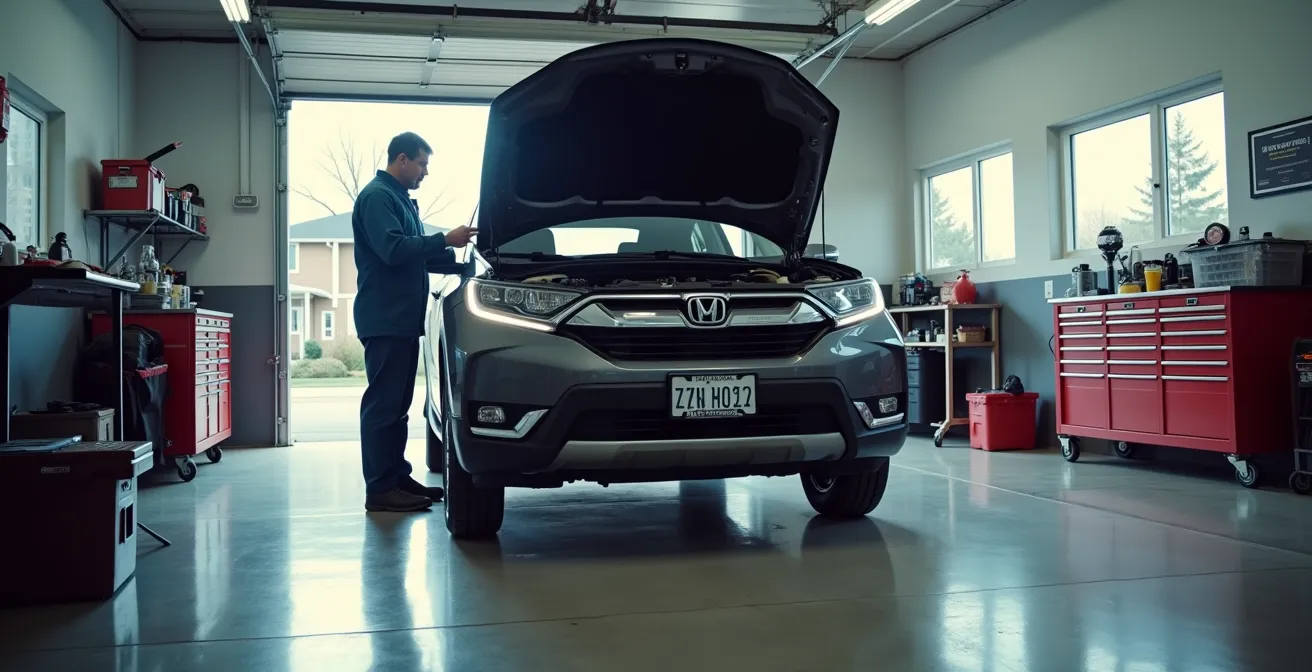
To buy a used car safely in Ontario, you must shift from a buyer’s mindset to a defensive investigator’s, proactively identifying and neutralizing common scams at every step.
- Curbsiders and private sellers exploit specific “transactional vulnerabilities,” such as public meeting spots and verbal deposit agreements, to sell problematic vehicles.
- Official, non-negotiable checks like the Used Vehicle Information Package (UVIP) and a Personal Property Security Act (PPSA) search are your only real protection against hidden liens and fraudulent histories.
Recommendation: Never hand over a deposit without a signed, written agreement detailing the VIN, price, and “subject-to-inspection” clauses. This single document is your most critical piece of legal armour.
The endless scroll through Kijiji, Autotrader, and Facebook Marketplace feels like a hunt for treasure. Hidden among the overpriced and the outlandish is that perfect used car: the right model, the right mileage, the right price. But for an inexperienced buyer in Ontario, this hunt is fraught with risk. The fear isn’t just about paying too much; it’s the chilling possibility of buying a polished-up lemon, a vehicle with a hidden past, or falling for a scam that leaves you with an empty bank account and no car at all.
Standard advice is everywhere: “get a CARFAX report,” “take it for a test drive,” “have a mechanic inspect it.” While essential, this checklist is merely the first line of defence. It’s what you do *in between* those steps that truly determines whether you get a great deal or get taken. Fraudsters, especially illegal dealers known as “curbsiders,” don’t just hope you’re uninformed; they have a playbook designed to exploit your trust and rush you through critical checkpoints.
This guide flips the script. Instead of just giving you a to-do list, we’re handing you the scammer’s playbook. We will dissect the most common transactional vulnerabilities from the initial inspection to the final signature. The key isn’t just to inspect the car, but to control the environment of the transaction itself. By understanding the specific traps laid by sellers—from temporary digital fixes for engine problems to the precise wording on transfer documents—you can build a fortress of legal and procedural protection around your purchase.
This article provides a step-by-step investigative methodology. We will explore the critical differences in legal protection between dealers and private sellers, outline the exact procedures for testing key components, and provide the non-negotiable checklists for handling deposits and transfer paperwork. Consider this your briefing on how to navigate the private used car market in Ontario not as a hopeful buyer, but as a savvy, protected consumer.
Summary: Your Defensive Guide to Buying a Used Car in Ontario
- Why you should never inspect a car in a shopping mall parking lot?
- How to test the automatic transmission in 10 minutes of city driving?
- Dealership vs. Private Seller: Who Offers the Best Legal Protection?
- The fatal mistake of giving a deposit without a written contract
- In what order to sign the transfer papers to avoid fines?
- Why a ‘Check Engine’ light turned off doesn’t mean the engine is healthy?
- How do thieves copy your key without entering your house?
- Ensuring a Lien-Free Car Purchase: The Step-by-Step Security Guide
Why you should never inspect a car in a shopping mall parking lot?
A seller suggesting you meet in a busy, neutral location like a shopping mall or coffee shop parking lot might seem reasonable, even safer. This is a classic red flag and a preferred tactic of “curbsiders”—unlicensed, illegal dealers who pose as private sellers. They operate in these environments precisely because it puts you, the buyer, at a significant disadvantage. These locations are designed for quick, superficial inspections where serious issues can be easily missed or concealed.
The scale of this problem in Ontario is significant. According to industry watchdogs, it’s a pervasive issue in online marketplaces. In fact, OMVIC estimates reveal that as many as 30% of vehicles listed online ‘for sale by owner’ are actually placed by these illegal dealers. Curbsiders often sell vehicles that are misrepresented, previously written-off, or have had their odometers tampered with. They thrive in anonymity; a public parking lot offers no history, no accountability, and an easy escape route.
Insisting on inspecting the vehicle at the seller’s registered address (the one on their driver’s license and vehicle ownership) is a powerful screening tool. It confirms you are dealing with a legitimate private individual and not an illegal business. It also provides a more controlled environment to perform a thorough cold start test, check for fluid leaks on the ground, and conduct your inspection without feeling rushed by the public setting. If a seller vehemently refuses this request without a very compelling reason, you should consider it a major warning sign and be prepared to walk away.
How to test the automatic transmission in 10 minutes of city driving?
The transmission is one of the most complex and expensive components to repair in a vehicle. A standard test drive around the block is often not enough to reveal underlying problems, especially if the seller has warmed up the car to hide cold-start issues. As an investigator, you need a specific, repeatable testing protocol to probe for weaknesses. This routine should be performed in a mix of city driving conditions and can reveal problems the seller hopes you’ll miss.
A healthy automatic transmission should shift smoothly and predictably, without any harsh clunks, hesitation, or shuddering. Any deviation from this is a sign of potential trouble, from low fluid levels to failing solenoids or a worn-out torque converter. The following sequence is designed to put the transmission through its paces in a short amount of time, simulating various loads and conditions to expose hidden faults.
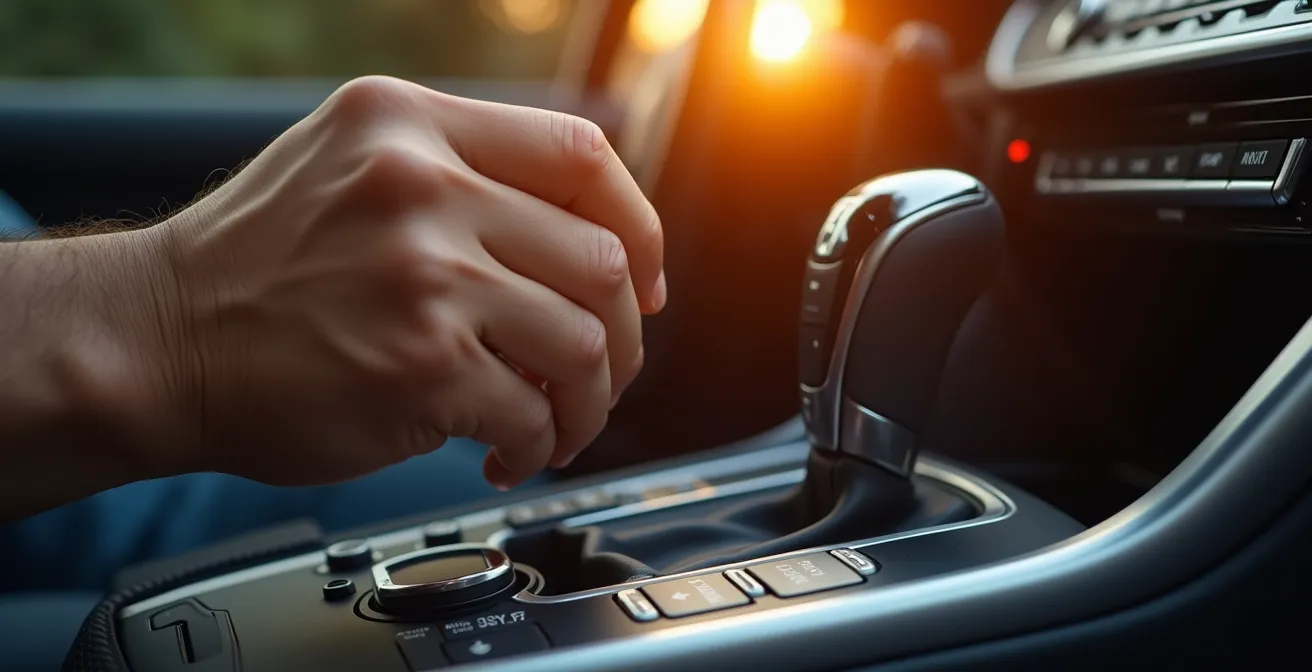
As you can see, the test involves more than just driving forward. You must systematically engage different functions to get a complete picture. Pay close attention not just to what you feel, but also what you hear. Here is a tactical sequence for your test drive:
- The Cold Start & Initial Check: Insist the car has not been driven for at least an hour. This is crucial for detecting issues that vanish once the transmission fluid is warm. Before starting, check the transmission fluid (if a dipstick is available); it should be pinkish-red and not smell burnt.
- The “401 Stop-and-Go” Simulation: In a safe area, gently accelerate to about 40-50 km/h and then brake smoothly to a stop. Repeat this several times. You are feeling for any shuddering or hesitation during acceleration or deceleration, which can indicate torque converter problems.
- The Incline Test: Find a moderate hill. As you drive up, the transmission should hold gear steadily. If it “hunts” or shifts up and down unnecessarily, it could signal failing sensors or worn clutch packs.
- The “Reverse-to-Drive Clunk” Test: With your foot firmly on the brake, shift from Park to Reverse, wait a second, then to Drive. A loud “clunk” or a significant jolt can point to worn U-joints or transmission mounts, not just an internal transmission issue, but a problem nonetheless.
- Manual Mode Engagement: If the vehicle has a sport or manual shifting mode, use it to shift up and down through all the gears. Any sluggish response or refusal to shift is a direct indicator of a potential solenoid or electronic control failure.
Dealership vs. Private Seller: Who Offers the Best Legal Protection?
When you’re buying a used car in Ontario, understanding who you’re buying from is just as important as the car itself. The legal landscape and consumer protections are drastically different depending on whether you purchase from an OMVIC-registered dealer or a private individual. This isn’t a matter of opinion; it’s a matter of law. Choosing a private seller on Kijiji for a lower price means you are voluntarily stepping away from a significant layer of government-mandated protection. You are entering a world of “caveat emptor,” or “let the buyer beware.”
An OMVIC-registered dealer is bound by the Motor Vehicle Dealers Act (MVDA), a robust piece of consumer protection legislation. This act enforces mandatory disclosures, all-in pricing, and provides access to a compensation fund. A private seller is governed only by the much looser Sale of Goods Act, which offers very little recourse if the car turns out to be a dud. Proving misrepresentation in Small Claims Court against a private individual is a difficult, expensive, and often fruitless endeavour.
This point is so critical it bears repeating. As the Ontario Motor Vehicle Industry Council (OMVIC) frequently warns consumers:
In Ontario, there’s no cooling-off period when it comes to vehicle purchases. Once you’ve signed the contract, the deal is final.
– Ontario Motor Vehicle Industry Council, Global Heroes – Consumer Protection Report
This applies to both dealer and private sales, but with a dealer, you have a regulated entity to hold accountable. The following table breaks down the fundamental differences in your legal armour, based on information provided by the official OMVIC website.
| Protection Type | OMVIC-Registered Dealer | Private Seller |
|---|---|---|
| Governing Law | Motor Vehicle Dealers Act (MVDA) | Sale of Goods Act – Caveat Emptor |
| Mandatory Disclosures | 22 specific disclosures including accident history over $3,000 | No disclosure requirements |
| Compensation Fund | Access to MVDCF up to $45,000 | No compensation available |
| All-in Pricing | Required by law since 2010 | Not applicable |
| Cooling-off Period | None (unless specifically offered) | None |
| Post-sale Recourse | OMVIC complaints process available | Small Claims Court only (difficult to prove) |
The fatal mistake of giving a deposit without a written contract
You’ve found the car, the test drive went well, and you’ve agreed on a price. The seller asks for a deposit to “hold the vehicle.” This is the single most dangerous moment in a private transaction—a major transactional vulnerability. Handing over cash or sending an e-Transfer based on a verbal agreement is a recipe for disaster. Without a written contract, your deposit has no legal protection and can vanish along with the seller.
This isn’t a hypothetical risk; it’s an active and common scam across Canada, particularly on platforms like Facebook Marketplace where anonymity is high. A cautionary tale from a consumer protection blog highlights the danger:
A common Facebook Marketplace scam in Canada involves sellers taking e-Transfer deposits from buyers, then immediately deleting the ad and blocking the buyer. Without a written contract tying the payment to a specific VIN and seller identity, the money is often unrecoverable through banks or law enforcement.
– HelloMotors.ca Blog
A deposit agreement doesn’t need to be a complex legal document, but it must be in writing and contain specific, non-negotiable elements to serve as your legal armour. It transforms a handshake deal into an enforceable contract. It protects both you and the honest seller by clearly defining the terms of the agreement before any money changes hands. Refusing to sign such a document is the biggest red flag a seller can wave.
Action Plan: Your Vehicle Deposit Agreement Checklist
- Full Legal Names: List the full legal names and addresses of both the buyer and seller, exactly as they appear on their government-issued ID.
- Vehicle Identification: Document the complete 17-character Vehicle Identification Number (VIN) and the year, make, and model of the car.
- Financial Terms: Specify the exact total purchase price and the exact deposit amount in Canadian dollars.
- Contingency Clauses: Add “subject-to” clauses. The most critical are “subject to a satisfactory pre-purchase inspection by a mechanic of the buyer’s choice” and “subject to a clean lien search (PPSA).”
- Refund Conditions: Clearly state the conditions under which the deposit is refundable (e.g., if the inspection reveals major issues, or a lien is found) or if it is non-refundable.
In what order to sign the transfer papers to avoid fines?
Completing the purchase of a used car in Ontario involves a precise sequence of paperwork. Getting this “paper trail protocol” wrong can lead to fines, registration headaches, and even put you in a position of uninsured liability. The process is straightforward, but every step must be done in the correct order to ensure a clean and legal transfer of ownership. The most critical thing to remember is that in Ontario, the licence plates belong to the owner, not the car. The seller will remove their plates, and you are responsible for registering the vehicle with your own.
Before any money changes hands, the buyer’s first responsibility is to secure insurance. Driving an uninsured vehicle, even for a moment, is illegal. Once you have a policy in place, you can proceed with the seller to complete the transfer. The two key documents are the seller’s green ownership permit (the “Application for Transfer” is on the back) and the Bill of Sale, which is part of the Used Vehicle Information Package (UVIP) that the seller is legally required to provide you in a private sale.
The final step for the buyer is to visit a ServiceOntario centre within six days of the sale. Here, you will officially register the vehicle in your name and pay the required tax. According to provincial law, Ontario law requires buyers to pay 13% RST charged on the greater of the purchase price or the vehicle’s official wholesale (Red Book) value. Declaring a falsely low price on the Bill of Sale to save on tax is illegal and can lead to significant penalties if discovered.
Follow this sequence exactly to ensure a smooth transfer:
- Buyer Secures Insurance: Before the final meeting, the buyer must contact their insurance company and arrange coverage for the new vehicle, meeting Ontario’s minimum liability requirements.
- Complete Application for Transfer: At the final meeting, the buyer and seller together fill out and sign the Application for Transfer on the back of the seller’s green ownership permit.
- Sign the Bill of Sale: Both parties sign and date the Bill of Sale (from the UVIP), ensuring the purchase price is clearly and accurately stated.
- Final Payment: The buyer completes the payment via a verifiable method like a certified cheque or bank draft. Document the payment method on the Bill of Sale.
- Buyer Takes Key Documents: The buyer leaves with the vehicle portion of the ownership permit and the completed Bill of Sale. The seller keeps the plate portion of their permit.
- Register at ServiceOntario: The buyer must go to a ServiceOntario location within 6 days to register the vehicle, pay the Retail Sales Tax (RST), and get their new plates and permit.
Why a ‘Check Engine’ light turned off doesn’t mean the engine is healthy?
The Check Engine Light (CEL) is a universal symbol for “potential trouble.” Seeing it illuminated during a test drive is an obvious deal-breaker. But what if the light is off? An inexperienced buyer might assume all is well. This assumption is a dangerous vulnerability that scammers are all too eager to exploit. A turned-off CEL is not proof of a healthy engine; it could be the sign of a very recent and deliberate deception.
The most common tactic is the OBD2 code clearing scam. Using an inexpensive On-Board Diagnostics (OBD2) scanner (readily available online in Canada), a seller can temporarily erase the fault codes that trigger the Check Engine Light. This turns the light off, but it does not fix the underlying problem. The light will remain off during a short test drive, but as soon as the car’s computer completes a new “drive cycle” (which can take anywhere from 20 to 200 kilometres), the original fault will be detected and the light will inevitably reappear—long after you’ve paid for the car.
Case Study: The OBD2 Readiness Monitor Trap
A seller in Mississauga was repeatedly clearing a P0420 code (Catalyst System Efficiency Below Threshold) on a used SUV just before potential buyers arrived. This code often indicates a failing catalytic converter, a repair costing over $1,500. A savvy buyer brought their own mechanic for a pre-purchase inspection. The mechanic, instead of just checking for codes (which showed none), checked the “I/M Readiness Monitors” status on his professional scanner. He found that multiple monitors—like the Catalyst, O2 Sensor, and EVAP System monitors—showed a status of “Not Ready” or “Incomplete.” This was definitive proof that the vehicle’s computer memory had been recently wiped, a massive red flag that exposed the scam and saved the buyer from a costly mistake.
This is why a professional pre-purchase inspection is non-negotiable. A qualified mechanic won’t just scan for active codes. They will check the readiness monitors. If several monitors are incomplete, it’s a clear sign of recent tampering. It’s the digital equivalent of finding fresh paint used to cover up rust. It proves a cover-up, and you should walk away immediately, no matter how good the deal seems.

How do thieves copy your key without entering your house?
While much of this guide focuses on transactional fraud, your role as a protective owner begins the moment you take possession. A significant and growing threat in Ontario, particularly in the Greater Toronto Area, involves thieves stealing your vehicle without ever breaking a window or even touching your house key. They exploit the very technology designed for your convenience: the keyless entry and start system.
This method is called a relay attack. It requires two thieves and two small electronic devices. One thief stands near your home’s front door or garage with a device that amplifies the signal from your key fob, which might be sitting on a hook just inside the door. This device captures the key’s signal—even through walls—and “relays” it to the second thief standing next to your car. Their device mimics your key fob, tricking the car’s computer into thinking the key is present. The doors unlock, the push-start ignition engages, and your car is driven away silently in under a minute.
This is not a sophisticated, high-tech heist from a movie; it’s a rampant form of theft in Canadian suburbs. The barrier to entry for criminals is low, and the success rate is high. However, the defence against it is remarkably simple and inexpensive. The key is to block your key fob’s signal when you are at home. You can do this by storing your keys in a Faraday pouch or box. These signal-blocking containers are widely available at stores like Canadian Tire or on Amazon.ca for a low cost. They create an electronic shield around your key fob, making it invisible to relay devices and rendering the attack useless.
Key Takeaways
- The location of an inspection is a test of the seller’s legitimacy; refusing a home inspection in favour of a public lot is a major red flag for a “curbsider” scam.
- Never give a deposit without a written contract that includes the VIN, price, and “subject-to-inspection” and “subject-to-lien-search” clauses. This is your primary legal protection.
- Trusting a seller’s word or even a standard UVIP is not enough; a real-time Personal Property Security Act (PPSA) search is the only definitive way to ensure a vehicle is free of liens.
Ensuring a Lien-Free Car Purchase: The Step-by-Step Security Guide
Perhaps the most devastating financial trap in a private used car sale is the hidden lien. A lien is a legal claim on a property—in this case, the car—to secure a debt, most commonly an unpaid car loan. If you buy a vehicle with an active lien against it, you don’t just buy the car; you inherit the previous owner’s debt. The lending institution (like a bank) has the right to repossess the vehicle from you, leaving you with no car and no money. It is legal to sell a car with a lien, but it must be disclosed and settled before the ownership transfer is complete.
To combat this, the seller in Ontario must provide you with a Used Vehicle Information Package (UVIP). This package will state if a lien is registered against the vehicle *at the time the UVIP was printed*. Herein lies the trap: a lien can be registered *after* the UVIP is printed. Relying on the UVIP alone is not sufficient. Your only definitive protection is to conduct your own real-time search of the Personal Property Security Act (PPSA) registry. This can be done online through the ServiceOntario portal or a licensed third-party provider for a small fee. This search provides the most up-to-date information on any registered liens against the vehicle’s VIN.
Furthermore, a growing concern is “re-VIN” fraud, where thieves swap the Vehicle Identification Number (VIN) plate from a clean vehicle onto a stolen or written-off one. This makes lien searches and history reports seem clean. A thorough pre-purchase inspection by a mechanic should include verifying that the public VINs (on the dash and door jamb) match the hidden VINs stamped on the vehicle’s chassis. The rise in this type of fraud is alarming; according to one report, Aviva Canada reported a 338% increase in re-VIN investigations between 2022 and 2024, highlighting the need for vigilance.
Your security guide for a lien-free purchase is as follows:
- Request and Verify the UVIP: Always get the UVIP from the seller, but immediately check the print date. If it’s more than a few days old, be extra cautious.
- Conduct a Real-Time PPSA Search: Use the vehicle’s VIN to perform your own PPSA search through an official channel. This is your most crucial due diligence step.
- Demand a Discharge Statement: If a lien is found, you must not complete the purchase until the seller provides an official “Discharge Statement” or “Letter of Release” from the lender, confirming the loan is paid in full. Better yet, accompany the seller to their bank to pay it off as part of the transaction.
- Add a Warranty Clause: For added protection, add a clause to your Bill of Sale: “The seller warrants that the vehicle is free and clear of all liens and encumbrances.”
- Keep All Records: Retain copies of your PPSA search, the UVIP, and the Bill of Sale as proof of your thorough due diligence.
Armed with this investigative knowledge, you are now prepared to enter the private used car market not as a potential victim, but as a protected and informed buyer. The next logical step is to start your search, applying these defensive principles to every listing and every interaction to find a reliable vehicle at a fair price, securely.