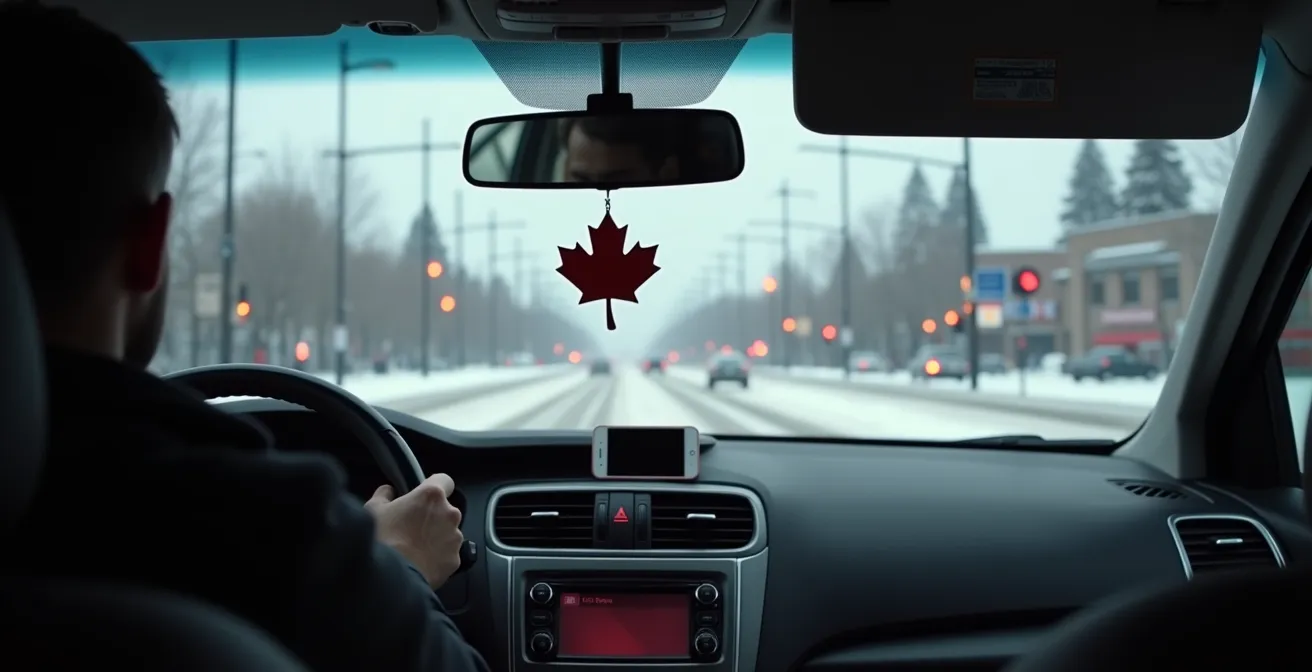
Contrary to popular belief, distracted driving laws in Canada are not just about texting; they penalize any activity that impairs your cognitive focus on the road, turning even a seemingly innocent act into a major conviction.
- Simply holding a phone at a red light is a fineable offense due to an “absolute prohibition” in many provinces.
- Activities like eating, drinking, or dealing with children can lead to “careless driving” charges if they affect your control of the vehicle.
Recommendation: Proactively manage your driving environment by configuring your phone’s driving mode and understanding that the law punishes mental distraction, not just physical action.
You’re stopped at a red light. The perfect moment to check that one text, type a quick address into your GPS, or even just take a sip of coffee. It feels harmless, efficient even. We’ve all been there. Most guides on distracted driving simply repeat the obvious: “don’t text and drive.” They list fines and demerit points, treating the issue as a simple matter of willpower. But this overlooks the real reason these laws exist and why they are so strict.
The core of the problem isn’t just about having your hands on the wheel or your eyes on the road. The true danger, and what Canadian law increasingly targets, is cognitive impairment. The mental load of a conversation, the decision-making of a GPS route, or the emotional reaction to a child’s tantrum in the back seat effectively hijacks the brainpower needed for driving safely. This is a critical distinction that many drivers miss, leading to expensive fines and tragic accidents.
So, what if the key to avoiding a conviction wasn’t just putting your phone down, but understanding the legal “grey zones” where everyday actions become offenses? This article moves beyond the platitudes to give you a clear, preventive understanding of the law. We will explore the science behind why multitasking is a myth, dissect when a snack becomes a criminal act, clarify the rules for being stopped at a light, and provide practical strategies to keep your focus—and your license—intact. We will break down what truly constitutes distracted driving in the eyes of the law, from the obvious to the surprisingly mundane.
To navigate these complex rules, this guide breaks down the most critical aspects of distracted driving in Canada. Discover the science behind the laws, the specific actions that can lead to a fine, and the proactive steps you can take to become a safer, more aware driver.
Summary: A Complete Guide to Canada’s Distracted Driving Rules and Penalties
- The multitasking myth: why talking on the phone reduces your visual field by 50%?
- Sandwich or coffee: when does a snack become a ‘careless driving’ offense?
- The mistake of typing an address at a red light: why is it fineable?
- Turning around to scold the children: a major, often ignored accident risk
- How to configure your phone to automatically block notifications while driving?
- Wired to wireless adapter: is it reliable or does it constantly disconnect?
- Why can Google Maps send you down a dangerous cul-de-sac in the forest?
- Defensive Driving Principles: The Smith System and Anticipating Hazards
The multitasking myth: why talking on the phone reduces your visual field by 50%?
The human brain is not wired for multitasking, especially when one of the tasks is as complex as driving. The belief that you can safely hold a conversation and operate a vehicle is a dangerous illusion known as “inattentional blindness.” When you’re mentally engaged in a phone call, even a hands-free one, your brain diverts significant resources away from processing your visual environment. You might be looking at the road, but you aren’t truly *seeing* it. Critical cues—a pedestrian stepping off the curb, a car braking suddenly, a changing traffic light—can fail to register in your consciousness.
This isn’t just a theory; it’s a proven cognitive impairment. Research has shown that a driver on a cell phone can miss up to 50% of the information in their driving environment. Your field of vision narrows, your reaction time slows to that of someone over the legal alcohol limit, and your ability to make sound judgments plummets. The Canadian Automobile Association underscores this risk, stating that you are 23 times more likely to be involved in a crash if you text while driving. This is because texting combines all three types of distraction: visual (eyes off the road), manual (hands off the wheel), and cognitive (mind off driving).
The consequences of this divided attention are stark. In Canada, the problem is growing, with Transport Canada’s National Collision Database reporting that 22.5% of fatal collisions in 2021 involved distracted driving. The law doesn’t just penalize you for holding a device; it recognizes the inherent danger of splitting your attention. Understanding this scientific basis is the first step toward appreciating why the rules are so uncompromising.
Sandwich or coffee: when does a snack become a ‘careless driving’ offense?
While no law in Canada explicitly forbids eating a sandwich or drinking coffee while driving, these actions can land you in serious legal trouble. The issue falls under the broader and more serious offense of “careless driving” or “driving without due care and attention.” This charge isn’t about a specific banned action, but rather the *consequence* of that action on your ability to control the vehicle safely. If a police officer observes you swerving, driving at inconsistent speeds, or failing to notice road hazards because you’re focused on your lunch, you can be pulled over and charged.
The legal test is whether your actions, whatever they may be, prevent you from exercising the level of caution that a reasonable and prudent driver would in the same situation. Spilling hot coffee on your lap, fumbling with a messy burger, or trying to unwrap a snack with one hand can all demonstrably reduce your control and attention. An officer doesn’t need to prove you were eating; they only need to prove your driving was erratic and dangerous to others. A conviction for careless driving often carries far more severe penalties than a standard distracted driving ticket, including higher fines, more demerit points, and a significant increase in your insurance premiums.
The penalties for distracted driving related to electronic devices are already severe and vary by province, demonstrating how seriously this category of distraction is treated. A conviction for careless driving due to other distractions like eating can be even more punitive, as it implies a higher degree of negligence.
This table, based on data from across the country, illustrates the steep penalties for a first offense of distracted driving with an electronic device, which serves as a baseline for how seriously all forms of driver inattention are viewed.
| Province | First Offense Fine | Demerit Points | License Suspension |
|---|---|---|---|
| Ontario | $615-$1,000 | 3 | 3 days |
| British Columbia | $368 | 4 | No |
| Quebec | $80-$100 | 5 | No |
| Alberta | $300 | 3 | No |
The mistake of typing an address at a red light: why is it fineable?
One of the most common and costly misunderstandings of distracted driving laws concerns what you can do while stopped at a red light. Many drivers assume that if the car isn’t moving, it’s safe—and legal—to pick up their phone. This is false. In most Canadian provinces, the law applies to any driver in care and control of a vehicle on a public road, which includes being temporarily stopped in traffic. The legal reasoning is rooted in a concept of absolute prohibition: the law forbids holding or using a device, period, without exception for being stopped.
This principle was cemented in landmark court cases like R. v. Kazemi in Ontario. The driver argued she merely picked up her phone from the floor while at a red light. The court, however, found that the simple act of “holding” the device was sufficient for a conviction. This strict interpretation is necessary for two reasons. First, it prevents drivers from trying to use their phones right up until the light turns green, delaying traffic and remaining distracted as they start moving. Second, a driver stopped at an intersection is still responsible for monitoring their surroundings for pedestrians, cyclists, and emergency vehicles.
To put it simply, the moment you pick up your phone, you are in violation of the law. This is a critical point to understand, as it’s a situation where many well-intentioned drivers find themselves facing a hefty fine and demerit points.
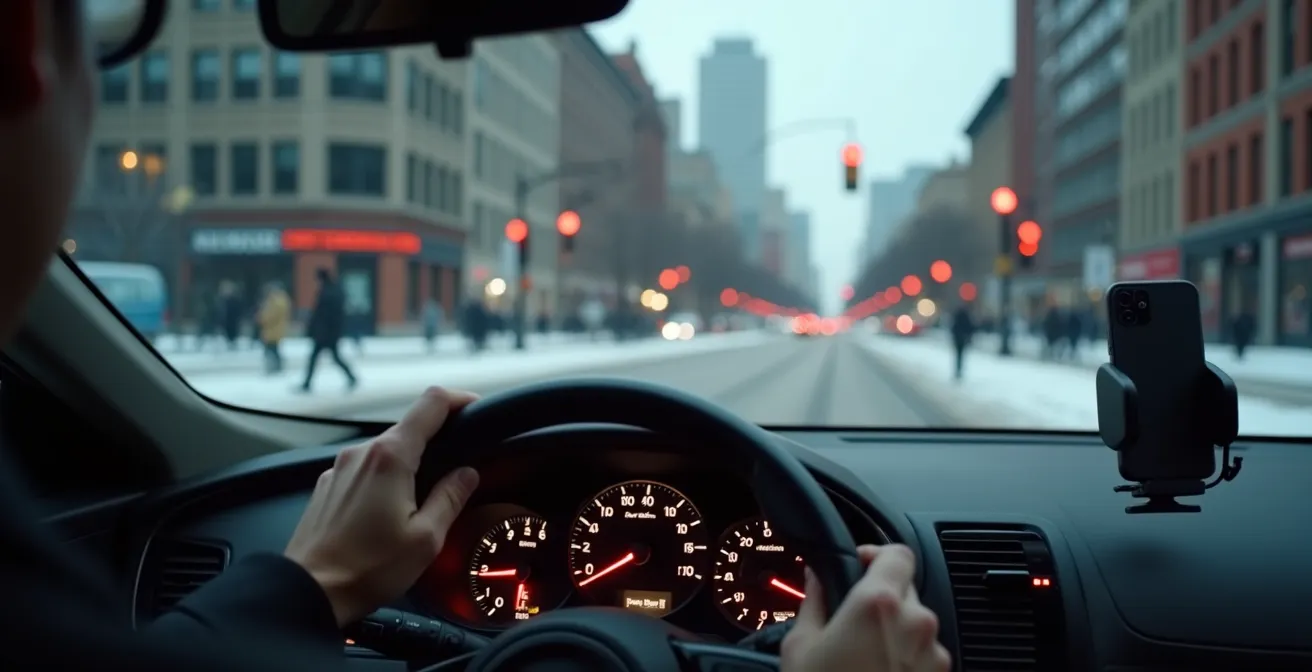
As this driver’s perspective shows, even when stationary, a driver must be ready to react to a complex and dynamic environment. The Ontario Court of Appeal made the legal position crystal clear, as highlighted in the ruling on the *R. v. Kazemi* case, which sets a precedent across Canada:
The accused testified that she had picked up her phone at a red light after it had dropped on the floor of the car. This is when the police officer observed her holding the phone. The trial court found that the accused’s admission that the phone was in her hand was sufficient to show that she was ‘holding’ it.
– Ontario Court of Appeal, R. v. Kazemi, 2013 ONCA 585
Turning around to scold the children: a major, often ignored accident risk
While electronic devices get the most attention, one of the most common and dangerous forms of distraction comes from the back seat: interacting with passengers, especially children. Turning around to discipline a child, pick up a dropped toy, or even just engage in an intense conversation pulls your attention away from the road in multiple ways. You experience visual distraction (taking your eyes off the road), manual distraction (if you reach into the back), and significant cognitive distraction as your focus shifts from driving to parenting.
This type of internal distraction is particularly insidious because it feels necessary and unavoidable. However, from a legal and safety standpoint, it’s just as dangerous as any other form of inattention. A moment of looking away can be enough to miss a vehicle stopping ahead or a change in road conditions. If this behavior leads to erratic driving, it can result in a “careless driving” charge. The responsibility to maintain full control of your vehicle is absolute, regardless of what’s happening inside the car.
Proactive strategies are essential for managing this risk. Before you even start the car, set clear expectations for behavior with your children. Ensure they have everything they need within their reach. For longer trips, plan for regular stops to allow them to stretch and release energy. If a situation arises that requires your immediate attention, the only safe and legal response is to pull over to a safe location before addressing it. Your primary responsibility is to operate the vehicle safely; everything else is secondary.
Action Plan: Minimizing In-Car Distractions
- Pre-trip Briefing: Before starting the car, set ground rules with passengers, especially children, about noise levels and behavior.
- Secure All Items: Ensure snacks, toys, and drinks are in secure, easily accessible locations for passengers to prevent requests to retrieve dropped items.
- Plan for Stops: On any trip longer than an hour, build in scheduled breaks. This allows children and other passengers to address their needs without distracting you while driving.
- Pull Over Policy: Establish a firm rule for yourself: if a situation in the car demands more than a quick glance (e.g., a child’s tantrum, a significant spill), you will pull over at the next safe opportunity. Do not attempt to resolve it while in motion.
- Delegate and Empower: If you have another adult in the car, designate them as the person responsible for managing passenger needs.
How to configure your phone to automatically block notifications while driving?
The most effective way to eliminate the temptation of your phone is to make it invisible—digitally. Both iPhone and Android operating systems have built-in “Driving” or “Do Not Disturb” modes specifically designed to minimize distractions. Activating these features is one of the most powerful preventive measures you can take. These modes go beyond simply silencing alerts; they can block notifications, automatically reply to text messages, and limit your phone’s functionality to essential apps like navigation.
Setting this up is a one-time process that pays continuous safety dividends. You can configure the mode to turn on automatically whenever it detects you’re in a moving vehicle or when it connects to your car’s Bluetooth system. This “set it and forget it” approach removes the need for willpower. You won’t be tempted by a notification you never receive. It also sends a clear signal to those trying to contact you that you are on the road and will respond later, managing their expectations and reducing the social pressure to reply immediately.
Here’s how to enable these life-saving features on your device:
- For iPhone Users (iOS): Navigate to Settings > Focus. Tap the ‘+’ icon and select the ‘Driving’ Focus. You can then choose to have it turn on ‘Automatically’ or ‘When Connected to Car Bluetooth’. Customize which contacts or apps, if any, can break through.
- For Android Users: Go to Settings > Safety & emergency > Silence notifications while driving. Alternatively, in some versions, it is under Settings > Connected devices > Connection preferences > Driving mode. You can set it to turn on when driving is detected or when connected to a Bluetooth device.
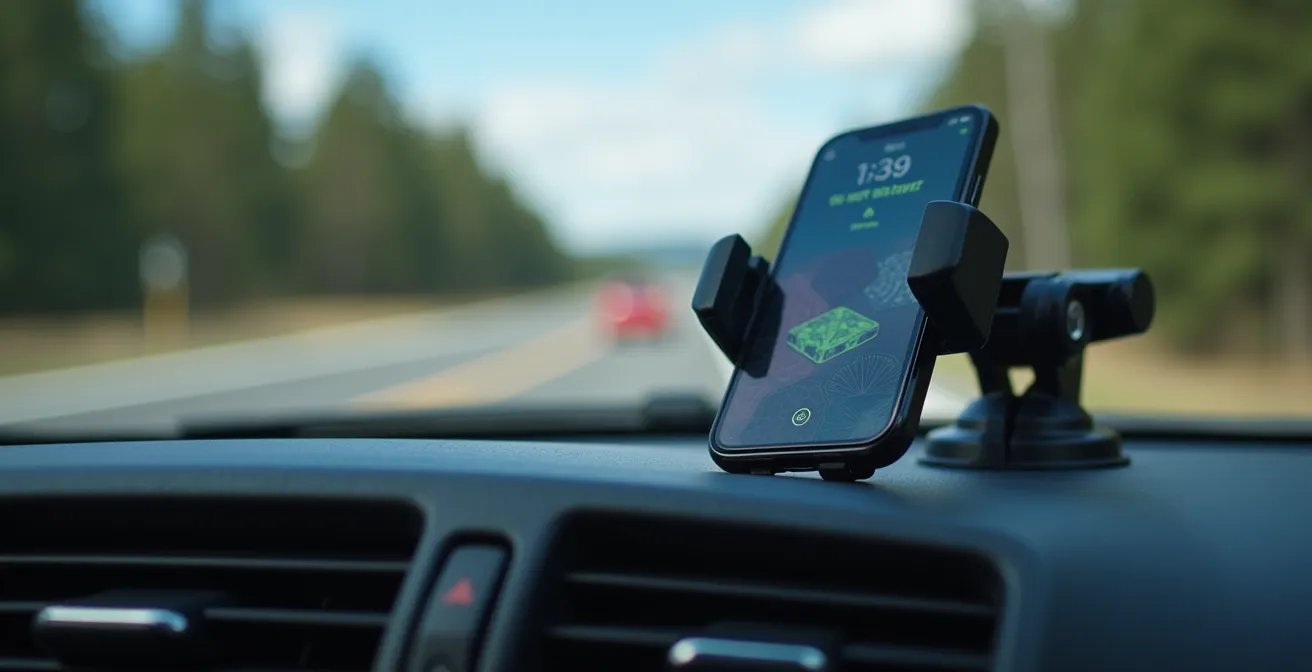
Using these built-in tools is a simple, effective strategy to enforce your own safety. It takes the decision-making out of the equation once you’re on the road, allowing you to dedicate your full cognitive attention to driving.
Wired to wireless adapter: is it reliable or does it constantly disconnect?
As cars get smarter, many drivers with older vehicles look to adapters to enable features like wireless Apple CarPlay or Android Auto. These devices plug into your car’s USB port and create a wireless connection to your phone, eliminating the need for a cable. From a legal perspective, using a hands-free system, whether it’s a factory-installed Bluetooth or a third-party wireless adapter, is permitted across Canada. For instance, the Ontario Ministry of Transportation explicitly states that you are allowed to use hands-free wireless communications devices with an earpiece or Bluetooth connection. This means interacting with your mounted phone via voice commands or brief touches to answer a call is generally acceptable.
However, legal compliance does not equal zero risk. The reliability of these adapters can vary significantly. Lower-quality models are prone to frequent disconnections, which can create a new and dangerous distraction. If your navigation suddenly cuts out in a complex intersection or your music stops, the instinct to grab your phone to troubleshoot the connection is strong—and illegal. This act of picking up the device, even for a moment, puts you in violation of distracted driving laws.
Therefore, while a high-quality, reliable wireless adapter can be a great convenience, it’s crucial to recognize that it does not eliminate cognitive distraction. A complex or stressful conversation on a hands-free call still consumes significant mental bandwidth. The best practice is to limit conversations while driving and to handle any technical issues only after you have safely pulled over. The adapter is a tool for convenience, not a license to multitask.
Why can Google Maps send you down a dangerous cul-de-sac in the forest?
Navigation apps like Google Maps and Waze are indispensable tools, but over-reliance on them can lead to dangerous situations, particularly in a country with vast remote and rugged terrain like Canada. These apps are designed to find the shortest or fastest route, but their algorithms don’t always account for road quality, seasonal closures, or the suitability of a route for your specific vehicle. A “road” on the map could be an unpaved logging trail, a private driveway, or a path that’s impassable in winter conditions.
This creates a unique form of distracted driving. When the digital route conflicts with physical reality, drivers can become cognitively overloaded. You might be focused on the screen, trying to reconcile the map with the dead-end in front of you, instead of watching for wildlife or changes in the road surface. This fixation on the device, even when mounted and used for navigation, is a form of distraction. The act of programming a new destination while driving is also explicitly illegal and highly dangerous.
To use GPS safely in Canada, especially outside of major urban centers, a defensive approach is required. Don’t blindly trust the app. Always engage your critical thinking.
- Cross-Reference Your Route: Before heading into rural areas, check your GPS route against official provincial resources like DriveBC, Alberta 511, or Ontario 511, which provide real-time information on road conditions and closures.
- Use App Settings Wisely: Most navigation apps have an option to “Avoid unpaved roads.” Ensure this is enabled before any long-distance trip.
- Download Offline Maps: Cell service is unreliable in many parts of Canada. Download maps for your entire region beforehand so you don’t lose navigation if you lose your signal.
- Keep a Backup: For truly remote travel, nothing beats a physical paper map. It’s a reliable backup that doesn’t depend on batteries or cell towers.
Key Takeaways
- The law targets cognitive impairment, meaning any activity that takes your mind off driving—not just texting—can lead to a conviction.
- Even when stopped at a red light, holding a phone is an “absolute prohibition” and is fineable in most provinces.
- Proactive measures like enabling your phone’s driving mode and planning your trip to manage passenger needs are your best defense against distraction.
Defensive Driving Principles: The Smith System and Anticipating Hazards
Ultimately, avoiding distracted driving penalties isn’t just about knowing what *not* to do; it’s about adopting a proactive mindset of defensive driving. Principles like the Smith System shift a driver’s focus from simply reacting to traffic to actively anticipating and managing potential hazards. This system is built on five key habits: Aim High in Steering, Get the Big Picture, Keep Your Eyes Moving, Leave Yourself an Out, and Make Sure They See You. By consciously practicing these habits, your brain is fully engaged in the task of driving, leaving no cognitive space for distractions.
This level of engagement is the ultimate antidote to distraction. When you’re actively scanning for potential threats far down the road and maintaining a space cushion around your vehicle, you’re less likely to be surprised by sudden events and have more time to react. This proactive awareness makes the temptation of a phone notification seem trivial by comparison. Enrolling in an accredited defensive driving course is one of the best investments a driver can make. These courses teach these principles in a structured way and can have tangible benefits beyond safety.
For example, Ontario’s demerit point system shows that completing an approved course can remove demerit points from your record. Furthermore, many insurance companies recognize the value of this training and may offer premium reductions to drivers who complete a course, as it signals a lower risk profile. The benefits vary by province, but the core value remains the same: it makes you a safer, more aware driver.
The advantages of completing a defensive driving course are recognized by authorities and insurers across Canada, offering benefits that can include demerit point reductions and potential insurance discounts.
| Province | Demerit Point Reduction | Insurance Benefits | Course Provider |
|---|---|---|---|
| Ontario | 3 merit points | Possible premium reduction | Canada Safety Council |
| Alberta | 3 demerit reduction | May reduce rates | AMA/Government approved |
| PEI | 3 merit points | Risk profile improvement | Safe Drivers PEI |
Driving safely in the modern world requires more than just following rules; it demands a conscious commitment to managing your attention. By understanding the cognitive science behind distraction and adopting proactive defensive driving habits, you protect not only your driving record and finances but also the well-being of everyone on the road. Take the next step by consciously implementing these strategies on your every drive.