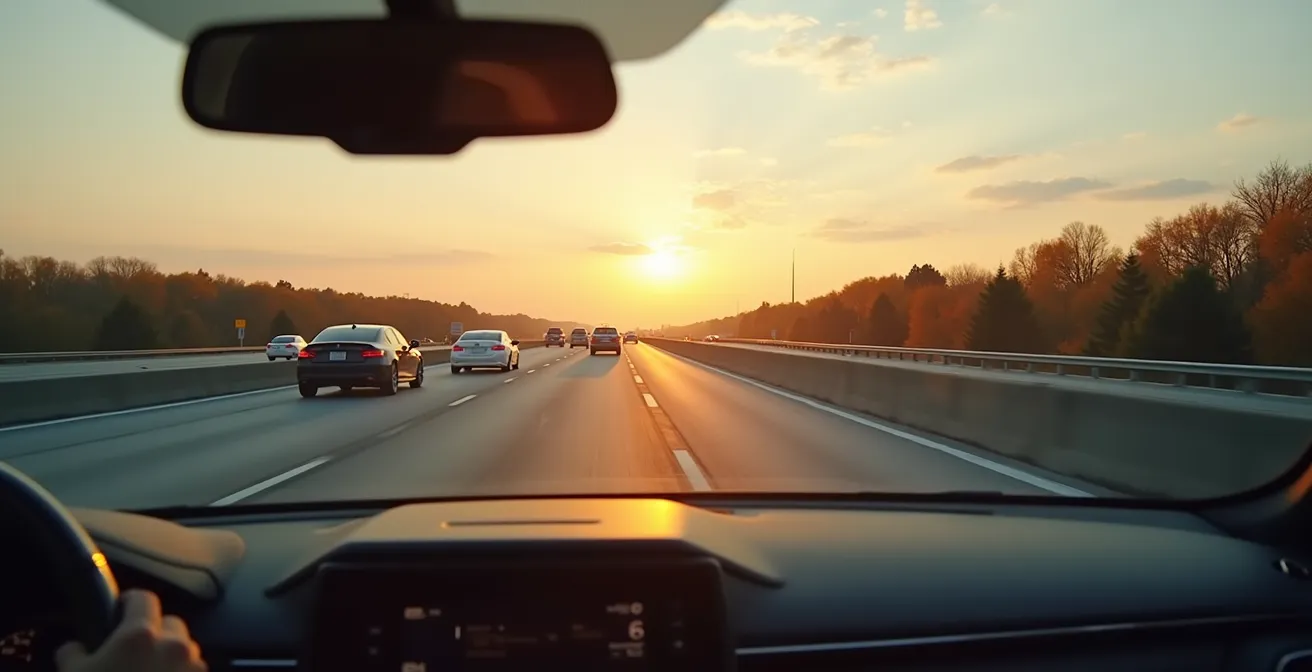
Driving in dense traffic doesn’t have to be a stressful battle. True defensive driving is a mental discipline, not just a set of rules. By adopting the Smith System’s philosophy of proactive perception, you learn to manage space and time effectively. This transforms driving from a reactive chore into a calm, controlled practice, significantly reducing both your risk and your stress on the road.
The feeling is familiar to any Canadian driver: the slow crawl on the 401, the sudden stop-and-go on the Décarie, or the tension of a four-way stop in a busy downtown core. The common advice is to “be careful” and “follow the rules,” but this passive approach often leaves you reacting to dangers rather than preventing them. We’re told to leave space and check our mirrors, but these actions become mechanical, divorced from the deeper awareness that truly keeps us safe. The constant barrage of small decisions, near misses, and unpredictable behaviour from other drivers slowly drains our mental energy, turning a simple commute into a source of stress.
But what if the key to safer, calmer driving wasn’t about reacting better, but about seeing the road so differently that most hazards become irrelevant before they even form? This is the core of the Smith System, a philosophy that reframes defensive driving from a list of obligations into a proactive art of perception. It’s not about memorizing rules; it’s about changing your mindset. It’s about cultivating an awareness that gives you the most valuable resource a driver can have: time. This system teaches you to read the road like a story, anticipating the next chapter instead of being surprised by it.
This guide explores that philosophy. We will deconstruct the core principles of the Smith System, moving beyond the ‘what’ to understand the ‘why’. We’ll see how these principles apply directly to the unique challenges of Canadian driving, from icy winter roads to the hypnotic monotony of the prairies, ultimately showing you how to become not just a safer driver, but a more relaxed and confident one.
To help you master this proactive approach, this article breaks down the essential pillars of the Smith System philosophy. The following sections will guide you through each concept, transforming your perspective on what it means to be in control behind the wheel.
Summary: Defensive Driving Principles: The Smith System and Anticipating Hazards
- How does looking far ahead give you more time to react?
- How to position yourself in traffic to have an escape route?
- Left-Centre-Right: why never trust a green light blindly?
- The eye contact: why never cross in front of a car without seeing the driver’s eyes?
- How does the accumulation of small decisions at the wheel drain your vigilance?
- Why never use high beams in heavy snow? (White Out Effect)
- Why is the monotony of the Saskatchewan a challenge for the driver’s vigilance?
- Stopping Distances Explained: The 3-Second Rule and Weather Factors
How does looking far ahead give you more time to react?
Driving is fundamentally an exercise in managing time and space. Most drivers, however, fixate on the car directly in front of them, effectively limiting their world to the next 50 metres. This puts them in a constant state of reaction. The Smith System’s first principle, “Aim High in Steering,” is a philosophical shift. It’s about lifting your gaze and looking as far down the road as possible, typically 15 seconds ahead. This isn’t just about seeing; it’s about proactive perception. When you see a potential hazard 15 seconds away—a swerving truck, a cloud of brake lights, a pedestrian preparing to cross—you are no longer surprised by it. You have an abundance of time to make small, calm adjustments to your speed and position.
This principle is a direct antidote to the stress of sudden events. It turns driving from a series of frantic reactions into a smooth, flowing process. The tragic reality is that road safety is a critical issue. A report from Transport Canada confirms that there were 1,964 fatalities on Canadian roads in 2023, a stark reminder of the stakes involved. Adopting a system focused on foresight is not just a technique; it’s a commitment to safety. Studies have consistently shown that fleets implementing the Smith System have seen accident rates drop by over 60%.
By aiming high, you are essentially buying yourself time. Time to think, time to plan, and time to act gracefully. You’re no longer a victim of the traffic ahead; you become an observer who can anticipate its flow and navigate it with tranquility. It is the foundation upon which all other defensive driving skills are built, transforming your windshield from a small screen into a wide-screen view of the future.
How to position yourself in traffic to have an escape route?
If looking ahead buys you time, positioning yourself correctly buys you options. The second core idea, “Leave Yourself an Out,” is about actively managing the space around your vehicle. Think of it not as empty road, but as your personal buffer of calm. Many drivers unconsciously cluster together, creating a “wolf pack” on the highway. This dramatically limits their options. If the car in front slams on its brakes, or a driver in the next lane swerves, you have nowhere to go. This principle teaches you to see traffic as a fluid chessboard and to position your vehicle strategically, always maintaining an open space—an escape route—to the side.
This means consciously avoiding other drivers’ blind spots and resisting the urge to drive side-by-side with another car. It involves adjusting your speed, not to get ahead, but to open up a pocket of space around you. This space is your safety net. It allows you to swerve safely to avoid debris on the road or to move away from an aggressive or erratic driver without having to brake violently. It’s about ensuring you are the master of your own destiny, not trapped by the decisions of others.
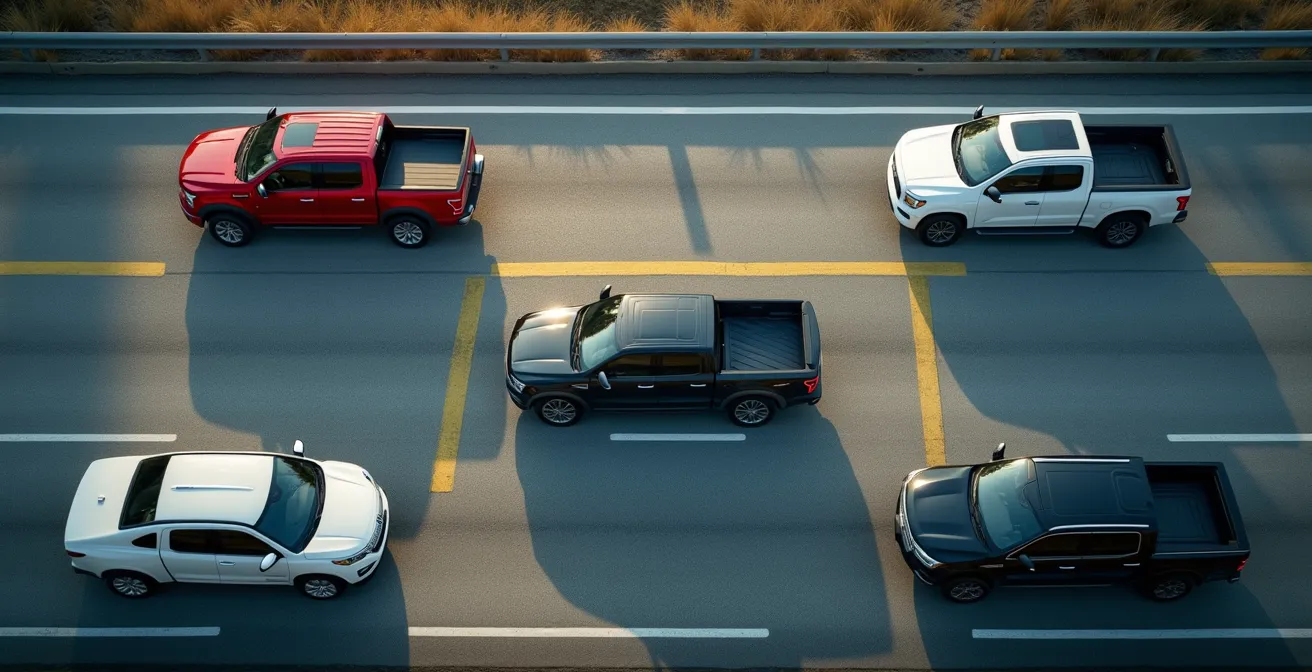
As the image above illustrates on a busy Canadian highway, a strategic driver maintains a “space cushion” on all sides whenever possible. This isn’t about being antisocial; it’s about being smart. By choosing the lane with the best visibility and flow, and maintaining that buffer, you give yourself the ability to make a move in any direction if an emergency arises. It is the physical manifestation of having a plan B, and a plan C, at all times.
Left-Centre-Right: why never trust a green light blindly?
A green light is not a guarantee of safety; it is merely a suggestion that it should be safe to proceed. The principle “Get the Big Picture” extends to every aspect of driving, but it is most critical at intersections. These junctions are where the paths of multiple vehicles, cyclists, and pedestrians converge, creating a high potential for conflict. Relying solely on the colour of a traffic light is a dangerous assumption. It assumes every other road user is attentive, obedient, and predictable—a trio of assumptions that can have catastrophic consequences.
The defensive driver treats every intersection as a potential hazard zone. Before entering, even with a green light, the correct practice is a deliberate scan: left, centre, right, and left again. You are looking for the driver who is about to run the red light, the pedestrian stepping off the curb against the signal, or the cyclist emerging from behind a large truck. This habit, which takes only a second, can be the difference between a safe passage and a serious collision.
This philosophy is backed by hard data and expert advice. As the experts at Comedy Guys Defensive Driving point out when explaining Smith System fundamentals:
Scan every intersection before you drive into it. Intersections make up a small percentage of the roadway system but have a large percentage of the crashes.
– Comedy Guys Defensive Driving, Smith System Defensive Driving Fundamentals
Never assume the green light creates a forcefield around your vehicle. It is your responsibility to verify that the path is truly clear. This isn’t about paranoia; it’s about professional-level awareness. By actively clearing every intersection with your eyes, you replace blind faith with confirmed information, a cornerstone of the defensive driving mindset.
The eye contact: why never cross in front of a car without seeing the driver’s eyes?
In our metal-and-glass boxes, it’s easy to forget that driving is a deeply human activity. We are not robots navigating a grid; we are people communicating—or failing to communicate—with one another. The fourth principle, “Make Sure They See You,” is about breaking through the anonymity of traffic and establishing a clear, human connection. The most powerful tool for this is eye contact. Never assume another driver, pedestrian, or cyclist sees you. You cannot be sure until you have established contact and received a signal of acknowledgement, like a nod or a wave.
This is especially critical at four-way stops or when a pedestrian is waiting to cross. Until you see their eyes and they see yours, you must assume you are invisible to them. The driver you think is waiting for you could be looking at their phone, adjusting the radio, or lost in thought. Indeed, distraction is a major factor in accidents; statistics show that driver distraction is a factor in around 16% of fatal crashes. Making eye contact is your final confirmation that the “dialogue” of the road is understood by both parties.
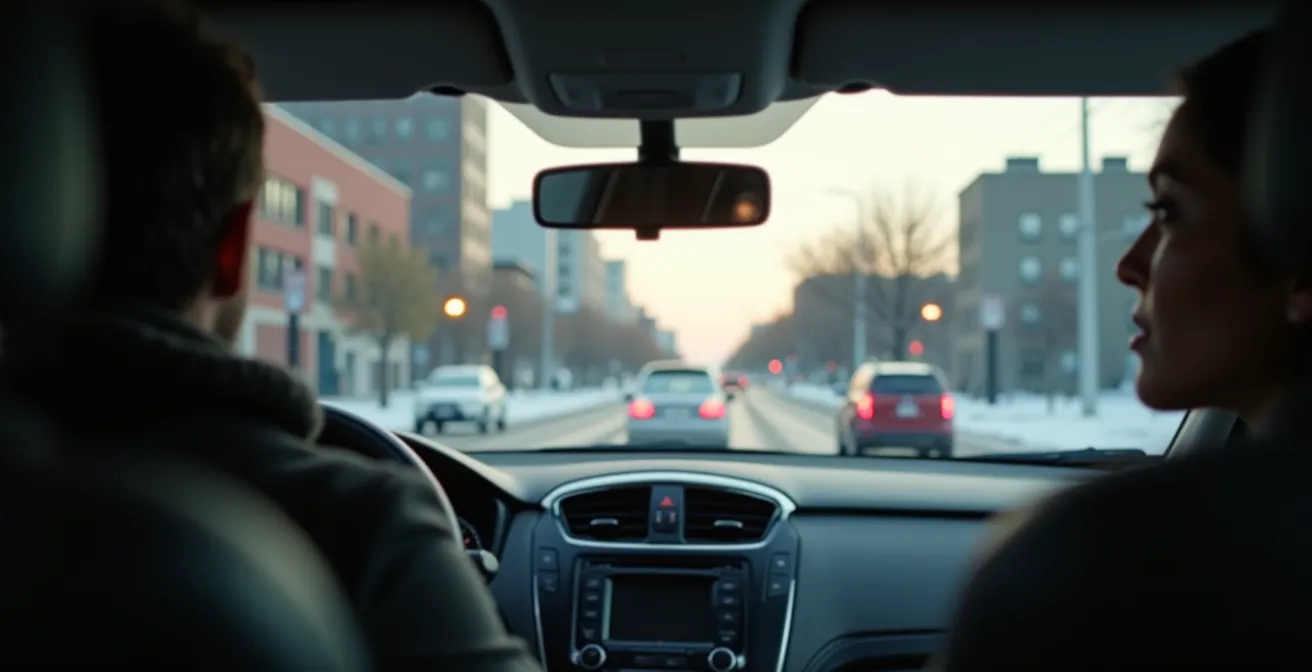
This moment of connection, as shown above, is a powerful safety tool. It’s a non-verbal agreement that says, “I see you, and I understand your intention.” Beyond eye contact, this principle includes using your turn signals well in advance, tapping your brakes to catch the attention of a tailgater, or even a light tap of the horn to wake a driver who seems unaware of your presence. It’s about making your intentions clear and ensuring your message has been received.
How does the accumulation of small decisions at the wheel drain your vigilance?
The human brain is not designed for the sustained, monotonous focus that long-distance driving demands. Staring at a single point—the car ahead, the centre line—for too long leads to a state known as “highway hypnosis.” Your peripheral vision narrows, your mind starts to wander, and your reaction time plummets. This is a primary source of cognitive load and fatigue at the wheel. The final principle of the Smith System, “Keep Your Eyes Moving,” is the direct countermeasure to this dangerous trance-like state.
This is not about frantic, random glances. It is a disciplined, systematic scanning pattern. Every two seconds, your eyes should move, checking your rearview mirror, your side mirrors, your instrument panel, and different points near and far ahead. This constant eye activity does two critical things: it keeps your brain stimulated and engaged, and it feeds you a continuous stream of information about the entire “big picture” around your vehicle. An active mind is far more resistant to fatigue than a passive one.
Relying on caffeine or loud music are temporary crutches that ultimately fail. As Top Driver Driving School wisely notes:
Energy drinks can only do so much before they cause the body to crash, and any repetitive motion sends us into a trance. Combat fatigue and inattentiveness by constantly scanning your environment.
– Top Driver Driving School, 5 Keys of Smith System Driving
By keeping your eyes moving, you are not just looking; you are actively processing. You are noticing the car merging onto the highway three cars back, the cyclist half a block ahead, and the temperature gauge on your dash. This constant data intake prevents the mental “shutdown” that leads to so many preventable accidents. It is the engine that powers the entire defensive driving philosophy.
Why never use high beams in heavy snow? (White Out Effect)
The principles of defensive driving are not abstract rules; they must be adapted to real-world conditions. For Canadian drivers, no condition is more challenging than winter. Snow, ice, and poor visibility demand a heightened application of the Smith System. A classic mistake many drivers make is using their high beams in a heavy snowfall. The intense light reflects off the millions of falling snowflakes, creating a blinding “wall of white” right in front of the car. This phenomenon, known as the white out effect, severely reduces your visibility, often to just a few feet.
In this situation, your high beams become a liability, not an asset. The correct approach is to switch to low beams. The light is aimed lower, illuminating the road surface beneath the falling snow rather than the snow itself, which can dramatically improve what you can see. This is a perfect example of adapting a tool—your headlights—to the specific environment. Canadian drivers consistently face challenging road conditions due to weather, and mastering these specific adaptations is not optional.
Winter driving requires exaggerating the core principles. Following distances must be increased, speeds must be reduced, and all control inputs—steering, braking, and accelerating—must be smoother and more deliberate. The Smith System provides the mental framework for these adjustments.
Your Action Plan: Adapting the Smith System for Canadian Winters
- Increase Following Distance: On snow or ice, extend your standard 3-second rule to at least 8-10 seconds to account for drastically longer stopping distances and potential black ice.
- Reduce Speed Proactively: Drive significantly below the posted speed limit when visibility is poor or roads are slippery. Your speed should be dictated by conditions, not the sign.
- Master Your Lights: Use low beams in heavy snow or fog to prevent the “white out” effect. Ensure your lights are cleared of snow and ice before every trip.
- Scan for Slippery Surfaces: Actively look for shiny, wet-looking patches on the road, especially on bridges and in shaded areas, as they may be black ice.
- Smoothness is Key: Apply all inputs (steering, brakes, accelerator) with gentle, smooth motions to avoid breaking traction and losing control.
Why is the monotony of the Saskatchewan a challenge for the driver’s vigilance?
While dense city traffic presents obvious hazards, the vast, open roads of the Canadian Prairies pose a different, more insidious threat: monotony-induced inattentiveness. Driving for hours on a dead-straight section of the Trans-Canada Highway in Saskatchewan, with a seemingly unchanging landscape of fields and sky, can lull the brain into a dangerous state of complacency. This is the perfect environment for highway hypnosis to set in. The lack of external stimuli—curves, intersections, changing traffic—causes the mind to disengage.
This is where the principle of “Keep Your Eyes Moving” becomes a vital survival tool. In a low-stimulus environment, you must actively create your own points of interest. You scan the horizon for distant farm equipment, check your mirrors even when no one is behind you, monitor the fence posts for wildlife, and read the road signs far in advance. You are manufacturing the mental engagement that the environment itself fails to provide. This proactive scanning keeps your mind alert and ready to respond to the unexpected, like a deer darting onto the road or a sudden patch of rough pavement.

The danger of these “empty” roads is real. While urban areas have more collisions, remote and rural areas often have more severe ones due to higher speeds and longer emergency response times. For perspective, statistics from some of Canada’s vast territories show that fatalities can reach as high as 20.8 per billion vehicle-kilometres, illustrating the unique risks of long, uninterrupted drives. The hypnotic drone of the tires on endless asphalt is not a call to relax, but a signal to increase your mental discipline and fight the trance of the open road.
Key takeaways
- True defensive driving is a proactive philosophy of managing time and space, not just a reactive set of rules.
- The core principles involve aiming high, maintaining a space cushion, scanning intersections, ensuring you’re seen, and keeping your eyes moving to combat fatigue.
- These principles must be adapted to specific Canadian challenges, including extreme winter weather and the hypnotic monotony of prairie highways.
Stopping Distances Explained: The 3-Second Rule and Weather Factors
All the observational skills in the world are useless if you don’t have the physical space to act on what you see. This is why a core application of the Smith System is the diligent management of following distance. The most common guideline is the 3-second rule. To use it, you watch the vehicle ahead of you pass a fixed object, like a sign or a shadow on the road. You then count “one-one-thousand, two-one-thousand, three-one-thousand.” If you reach the object before you finish counting, you are following too closely.
This three-second gap is not arbitrary. It is designed to give you enough time to perceive a hazard, react to it, and bring your vehicle to a safe stop under normal, dry conditions. However, as any Canadian knows, conditions are rarely “normal.” Rain, snow, and ice drastically reduce the friction between your tires and the road, significantly increasing the distance it takes to stop. Therefore, the 3-second rule is a minimum that must be adjusted for conditions.
The following table, based on common safety recommendations, provides a clear guide for adjusting your following distance to match Canadian road conditions. As this comparative analysis for Canadian drivers shows, adapting to the weather is critical.
| Condition | Recommended Following Distance | Key Consideration |
|---|---|---|
| Normal/Dry | 3 seconds | Standard Smith System recommendation |
| Rain | 5 seconds | Reduced traction on wet surfaces |
| Heavy Traffic | Maintain space cushion | Especially critical in GTA/major cities |
| Snow/Ice | 8-10 seconds | Black ice common Canadian hazard |
Ignoring these adjustments has severe consequences. Speeding, which effectively shortens your available reaction time and extends your stopping distance, remains a major problem. In 2023, speeding was a contributing factor in 24.8% of fatal collisions in Canada. Respecting stopping distance isn’t just about avoiding a fender-bender; it’s a life-saving discipline that gives you the space you need to execute the decisions you make through proactive perception.
By internalizing these principles, you do more than just follow rules. You adopt a philosophy of awareness and control that transforms your relationship with driving. The next step is to consciously apply these techniques on every trip, turning each drive into a practice session until this calm, proactive mindset becomes second nature.