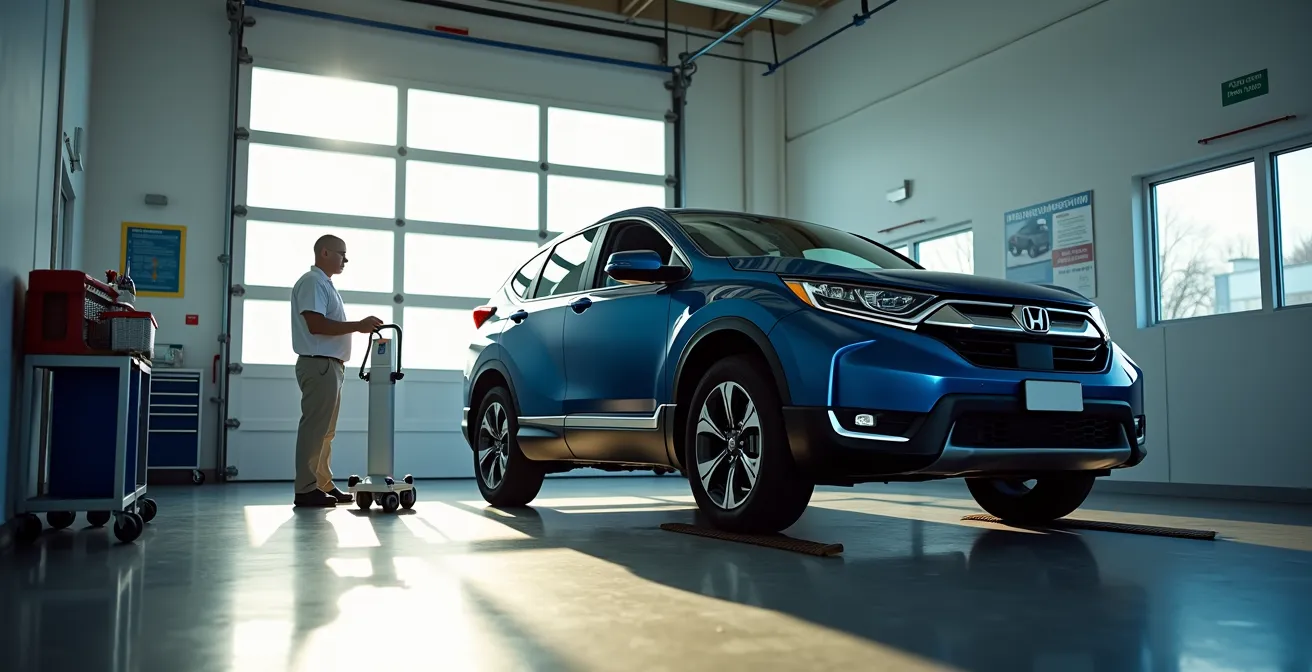
Buying a used car in Canada isn’t about reading a CARFAX report; it’s about investigating it like a detective to find what sellers try to hide.
- Minor damage claims under $3,000 are often a deliberate tactic in Canada to bypass mandatory branding and conceal severe structural issues.
- Data gaps between US and Canadian reports, especially for imported vehicles, can mask critical history like flood damage or un-transferred salvage titles.
Recommendation: Triangulate data from the report, provincial records, and a physical inspection of hidden VINs and frame rust points before making any decision.
For the meticulous Canadian car buyer, obtaining a CARFAX Canada report is a standard first step. You scan for accidents, check for liens, and glance at the ownership history. But treating this document as a simple checklist is a critical error. The truth of a vehicle’s past isn’t always in the bold headlines of the report; it’s often buried in the nuances, the omissions, and the seemingly insignificant details that most buyers overlook. A clean report does not always mean a clean car. Fraud is sophisticated, and sellers, both private and unscrupulous dealers, know how to play the system.
This is not a guide on what to look for in a CARFAX report. This is a manual on how to investigate it. We will move beyond the surface-level checks and adopt the mindset of a claims expert and a fraud investigator. You will learn to connect the dots between a minor bodywork claim and potential frame damage, interpret the velocity of ownership changes to spot a “lemon,” and understand the jurisdictional blind spots that can hide an American salvage title. We will treat the report not as a summary, but as the starting point of a forensic analysis. Your goal is to uncover the story the seller doesn’t want you to know.
This deep dive will equip you with the analytical tools to deconstruct a vehicle’s history. By learning to identify the subtle telltales of structural damage, VIN cloning, rust, and odometer fraud, you can protect yourself from the significant financial and safety risks of purchasing a compromised vehicle.
Summary: CARFAX Canada and VIN Checks: What Hidden Damages Look Like
- Pourquoi une petite réclamation de carrosserie peut cacher un problème structurel ?
- Comment repérer une voiture “citron” grâce à la fréquence des changements de propriétaires ?
- Carfax US ou Canada : lequel consulter pour une voiture importée ?
- Le risque d’acheter un véhicule “VGA” (gravement accidenté) sans le savoir
- Où trouver les numéros de série cachés pour confirmer que le rapport correspond à l’auto ?
- Rouille esthétique ou danger de sécurité : quand faut-il fuir une voiture ?
- Pourquoi les assurances exigent-elles le système TAG et comment cela aide-t-il à retrouver l’auto ?
- Odometer Fraud in Canada: How to Spot a Rolled-Back Mileage?
Pourquoi une petite réclamation de carrosserie peut cacher un problème structurel ?
One of the most common deceptions in the used car market involves minimizing the severity of accident repairs. A CARFAX report might show a minor claim for “$2,500 in bodywork,” leading a buyer to believe it was a simple parking lot scrape. The reality can be far more sinister. In many Canadian provinces, like Ontario, damage estimates over a certain threshold (typically $3,000) trigger mandatory disclosures or even a “Salvage” brand on the vehicle’s title. Consequently, there is a strong financial incentive to keep repairs just below this line.
An unscrupulous body shop might perform a shoddy, cosmetic-only repair on significant structural damage to produce an invoice under the reporting limit. They use excessive body filler (Bondo), mismatched paint, and ignore underlying frame or unibody issues. While the car looks fine, its crash integrity is now compromised. An investigator knows that a small claim is not a sign of a small accident, but a potential sign of a deliberately concealed major accident. A recent analysis found that many body shops intentionally keep repairs under the provincial reporting threshold to avoid branding the vehicle.
To uncover this, a physical inspection is non-negotiable. One of the key tools for a forensic examination is a paint depth gauge. This device measures the thickness of the paint and filler on a vehicle’s panels, revealing areas that have been heavily reworked.
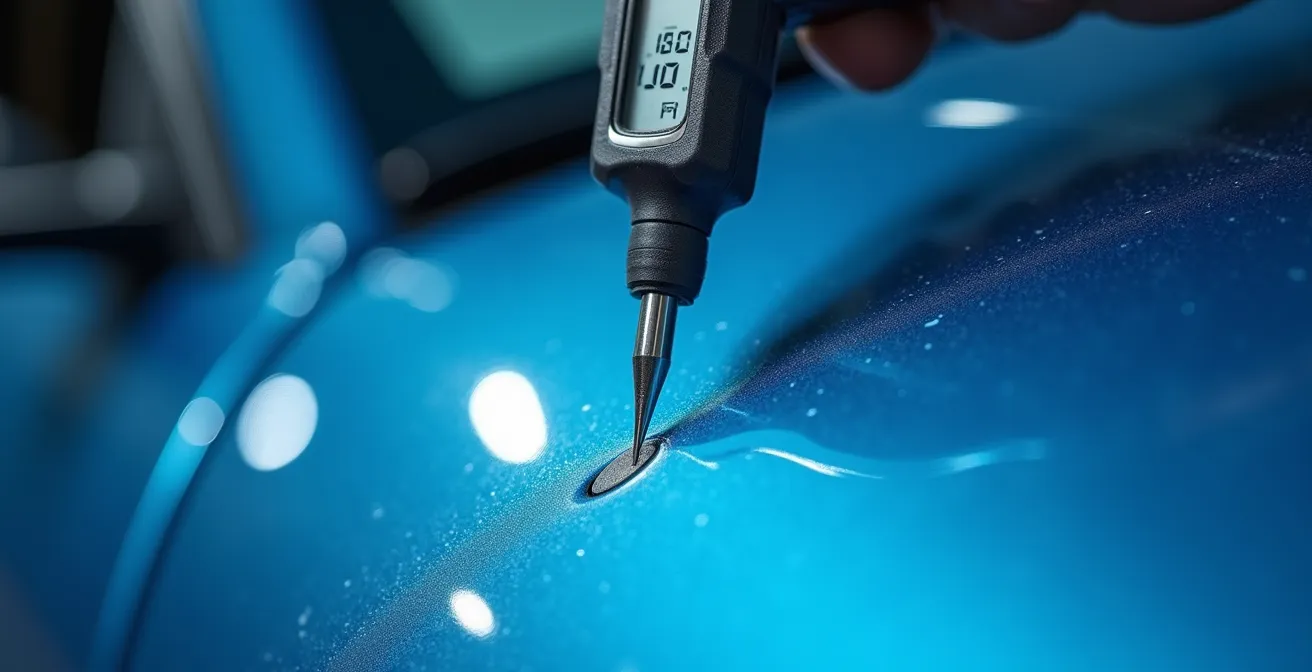
As the image demonstrates, a professional gauge can instantly show readings far above the factory standard (typically 90-140 microns), indicating thick layers of filler. This is a definitive structural telltale that the damage was much more than a minor scratch. Always check panel gaps for inconsistency, look for paint overspray on window seals, and use a magnet on steel body panels; it won’t stick firmly to areas thick with plastic filler.
Comment repérer une voiture “citron” grâce à la fréquence des changements de propriétaires ?
A “lemon” is a vehicle with persistent, unfixable mechanical or electrical issues. These cars are often passed from one unsuspecting owner to the next in a practice known as “curbstoning.” A curbstoner is an unlicensed dealer who poses as a private seller to flip multiple cars, often problematic ones, while evading provincial regulations and consumer protection laws. A key indicator of this activity on a CARFAX report is high “ownership velocity”—a vehicle changing hands multiple times in a short period, sometimes across different provinces to obscure its history.
If a car has had three owners in the last two years, it’s a major red flag. Legitimate owners don’t typically sell a vehicle so quickly unless there’s a serious underlying problem they couldn’t or wouldn’t fix. The curbstoner buys the car cheap, does the bare minimum to make it appear functional, and quickly sells it to the next victim before the major issue resurfaces. The CARFAX report provides the timeline; your job is to question its logic. Why would someone sell a late-model car after only six months?
Spotting a curbstoner requires a specific investigative approach, as they are skilled at appearing legitimate. They often use burner phones and meet in neutral locations like shopping mall parking lots. Verifying the seller’s identity against the vehicle’s ownership documents is the single most important step you can take.
Your Action Plan: Curbstoner Identification Checklist for Canadian Buyers
- Verify Identity: The seller’s name and address on their driver’s license must match the vehicle’s official ownership document (the “registre”) exactly. Any discrepancy is a deal-breaker.
- Check for Multiple Listings: Search the seller’s phone number or name online. Are they selling multiple vehicles from a residential address? This is a classic curbstoner tactic.
- Request Service History: A legitimate long-term owner will almost always have a file of maintenance and repair records. A curbstoner will have excuses and no documentation.
- Question the Purchase Story: Ask where and when they bought the car. If their story is vague (“I got it from a friend,” “I don’t remember”), be highly suspicious.
- Confirm Dealer Status: Be wary if the seller refuses to meet at their home or only accepts cash. You can check their name against the provincial regulator’s database (e.g., OMVIC in Ontario, AMVOQ in Quebec) to see if they are a registered dealer.
Carfax US ou Canada : lequel consulter pour une voiture importée ?
With the high volume of vehicles crossing the border, it’s common to find US-registered cars for sale in Canada. For these vehicles, relying solely on a CARFAX Canada report is a dangerous oversight. While CARFAX aggregates data from thousands of sources, including Canadian provinces and US states, there are critical jurisdictional blind spots where information can be lost or delayed in translation. As CARFAX’s own support team notes, they do receive information from every Canadian Province, but the nature of that data transfer is key.
A vehicle could be branded “Salvage” in Texas due to flood damage, be given a clean title in a different state with lax laws (a process called “title washing”), and then be imported into Canada where the US history may not immediately or fully transfer. For any vehicle with a history in the United States, you must pull both a CARFAX Canada report and a US CARFAX or AutoCheck report. This allows you to cross-reference the timelines and look for discrepancies.
The following table, based on common data transfer issues, highlights the risks of not checking both reports. As shown in the data coverage comparison, critical safety information can easily fall through the cracks.
| Data Type | CARFAX US | CARFAX Canada | Risk if Missing |
|---|---|---|---|
| State Salvage/Junk Titles | Comprehensive across all 50 states | May not transfer immediately or correctly | High: Vehicle could be a dangerous rebuild. |
| Flood Damage History | Extensive data from insurance and state sources | Very limited visibility into US flood events | Critical: Major safety, electrical, and rust risk. |
| Failed Emissions Tests | Recorded in many state-level databases | Often not included from US records | Medium: Can indicate underlying engine or exhaust problems. |
| Accidents in Small Municipalities | Good coverage from local police departments | Typically only captures major incidents | Medium: A history of minor accidents can be lost. |
| State-Level Lien Information | Complete lien data from all states | Lien may not transfer, creating ownership risk | High: You could buy a car with an outstanding loan against it. |
The bottom line is clear: for any vehicle that has spent time in the US, one report is not enough. The small investment in a second report is negligible compared to the catastrophic risk of unknowingly buying a flood-damaged or salvaged American vehicle.
Le risque d’acheter un véhicule “VGA” (gravement accidenté) sans le savoir
The most severe classification a vehicle can receive is a non-repairable or salvage title. In Canada, each province has a system to “brand” the vehicle’s identity to warn future buyers. As The Co-operators Insurance explains, “If a vehicle is badly damaged or stolen, your province’s transportation ministry adds a brand to its Vehicle Identification Number (VIN) to indicate the extent of the damage.” This is a crucial consumer protection mechanism.
However, the terminology varies by province, creating confusion. In Quebec, the term is “Gravement Accidenté” (VGA), while in Ontario and other provinces, it’s typically “Salvage.” A “Salvage” vehicle cannot be legally driven until it is repaired and passes a rigorous structural and mechanical inspection, at which point it is rebranded as “Rebuilt” or “Reconstruit.” The danger for a buyer is twofold: unknowingly purchasing a vehicle that is still branded “Salvage” and is not road-legal, or purchasing a “Rebuilt” vehicle without understanding the implications—compromised safety, difficulty getting insurance, and drastically reduced resale value.
Unscrupulous sellers may try to obscure this history. It’s imperative to check the vehicle’s official ownership documents, not just the CARFAX report, for these brands. The following table, compiled from information like that provided by the Canadian insurance industry, shows how different provinces handle this critical information.
| Province | Term Used for Damaged Status | Inspection to Re-license | Insurance Availability |
|---|---|---|---|
| Ontario | Salvage → Rebuilt | Mandatory Structural Inspection Certificate | Limited; higher premiums, often no collision coverage. |
| Quebec | Gravement Accidenté → Reconstruit | SAAQ technical and mechanical inspection | Restricted coverage; some insurers will refuse. |
| British Columbia | Salvage → Rebuilt | Designated ICBC inspection facility | Case-by-case; may refuse comprehensive/collision. |
| Alberta | Salvage → Rebuilt | Mandatory Out-of-Province or Salvage inspection | Difficult to obtain full coverage. |
As a buyer, you must be proactive. In Ontario, for example, a dealer is legally required by OMVIC to disclose if a vehicle has sustained damage exceeding $3,000. Always demand this disclosure in writing. For private sales, make a signed declaration stating the vehicle’s damage history a condition of the sale. If a seller refuses, walk away.
Où trouver les numéros de série cachés pour confirmer que le rapport correspond à l’auto ?
The most audacious form of automotive fraud is VIN cloning. This is where thieves steal a vehicle, then replace its public Vehicle Identification Number (VIN) with one from a legitimate, legally registered car of the same make, model, and year. They create fraudulent ownership documents to match the “cloned” VIN, and the stolen vehicle is then sold to an unsuspecting buyer. The CARFAX report you pull for the cloned VIN will come back clean, because it belongs to a different car. The scale of this problem is staggering; CARFAX Canada estimates that there are over 372,000 potentially cloned VINs in the country.
This is why VIN cloning forensics—the physical verification of multiple VINs on the car itself—is the ultimate step in your investigation. Do not trust the single VIN plate visible on the dashboard. A car has its VIN stamped or stickered in multiple locations, some of which are difficult for thieves to access and replace. Your job is to confirm that the VIN on the CARFAX report and ownership papers matches the VIN in these hidden locations.
The act of checking these hidden VINs is a powerful deterrent and a core part of a true vehicle inspection. It shows the seller you are a serious, knowledgeable buyer.
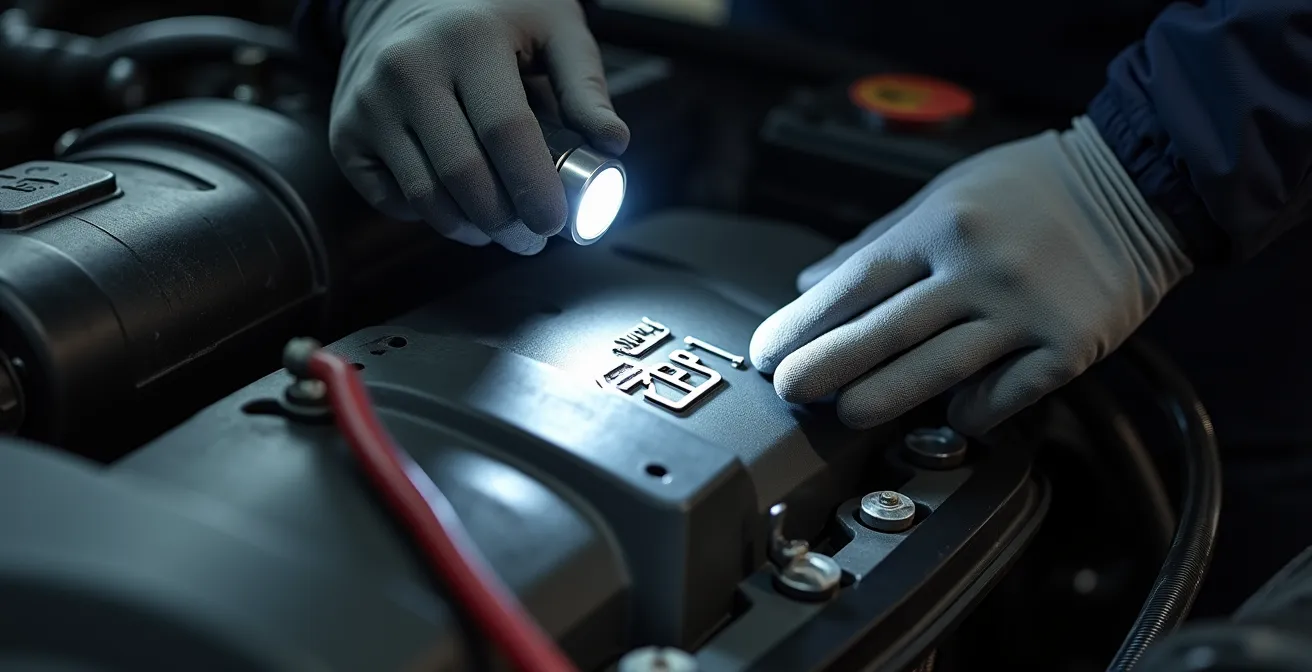
While locations vary, most modern vehicles have VINs in several predictable places. Bring a flashlight and don’t be afraid to look. Here are common locations for some of Canada’s most popular vehicles:
- Ford F-150: Dashboard plate (driver’s side), driver’s door jamb sticker, stamped on the frame rail behind the front passenger wheel, on the engine block.
- Toyota RAV4: Dashboard plate, driver’s door frame sticker, stamped on the firewall in the engine bay, sometimes in the spare tire well in the trunk.
- Honda Civic/CR-V: Dashboard plate, driver’s door jamb sticker, often on a sticker on the radiator support bar at the front of the engine bay, and sometimes stamped on the engine block itself.
Any mismatch between these numbers is a definitive sign of major fraud. You are likely looking at a stolen vehicle. Report it to the police immediately and walk away from the deal.
Rouille esthétique ou danger de sécurité : quand faut-il fuir une voiture ?
In the harsh Canadian climate, especially within the “Rust Belt” of Ontario, Quebec, and the Atlantic provinces, rust is an unavoidable reality. However, there is a critical difference between minor surface rust on a replaceable body panel and deep, penetrating corrosion on the vehicle’s structural components. The former is a cosmetic issue; the latter is a life-threatening safety hazard. A CARFAX report will rarely mention rust unless it was noted during a specific inspection, making a physical examination essential.
As experts from Double L Motors in Calgary point out:
Rust, especially in critical areas like the frame or suspension, can compromise the safety of the vehicle and lower its lifespan.
– Double L Motors Calgary, How to Spot Hidden Damage On A Used Car
Structural rust can cause suspension components to fail or a subframe to detach from the unibody during a collision or even normal driving. The cost of repairing severe structural rust can be astronomical and often exceeds the value of the vehicle. For example, a vehicle with a badly corroded frame will instantly fail a provincial safety inspection, such as Ontario’s Safety Standards Certificate or Quebec’s SAAQ mechanical fitness test. The required repairs could easily cost upwards of $4,000 before the vehicle can be legally registered, turning an apparent bargain into a financial nightmare.
To assess rust like an expert, you need to get on the ground and inspect the vehicle’s underbelly. Focus on these critical areas:
- Frame Rails and Subframes: These are the backbone of the vehicle. Look for flaky, scaling rust or soft spots. Gently poke suspect areas with a screwdriver; if it’s soft or goes through, run away.
- Suspension Mounting Points: Check where control arms, shocks, and springs attach to the frame. Rust here is a major structural red flag.
- Steel Brake and Fuel Lines: Surface discoloration is common, but pitted, swollen, or heavily scaled lines are a failure waiting to happen.
- Rocker Panels and Floor Pans: Inspect from underneath and inside the door sills. These areas are notorious for trapping salt and moisture.
Pourquoi les assurances exigent-elles le système TAG et comment cela aide-t-il à retrouver l’auto ?
In high-theft areas across Canada, particularly in Ontario and Quebec, insurance companies increasingly offer significant premium discounts or even mandate the installation of an anti-theft tracking system. While many people are familiar with GPS-based trackers, the system most favored by insurers and law enforcement for recovery is the TAG Tracking System. The reason for this preference lies in how modern vehicle theft operates in Canada.
The vast majority of thefts of desirable SUVs and trucks are not for local joyriding; they are carried out by organized crime rings for export to international markets. The stolen vehicles are quickly driven into metal shipping containers to be loaded onto ships at major hubs like the Port of Montreal. This is where GPS trackers fail. A GPS signal cannot penetrate a metal container, rendering the device useless the moment the vehicle is loaded. The TAG system, however, works differently.
It uses multiple, tiny, self-powered radio-frequency (RF) transmitters hidden in random locations throughout the vehicle. These RF beacons are not easily found and removed by thieves, and their signal can be detected by tracking teams even when the vehicle is inside a shipping container, underground garage, or a warehouse. This has made it an indispensable tool for law enforcement in recovering vehicles before they leave the country.
Case Study: TAG Technology vs. Port of Montreal Export Operations
Organized crime syndicates target high-value Canadian SUVs and trucks for their strong resale value in markets across the Middle East, Africa, and Eastern Europe. According to data from insurance experts like those at ThinkInsure, the standard operating procedure is to place the stolen vehicle in a shipping container within hours. Law enforcement tracing a GPS signal will see the car “disappear” once it enters the port. However, a police vehicle equipped with a TAG scanning unit can drive through rows of shipping containers and get a signal from the hidden RF beacons inside, allowing them to pinpoint the exact container holding the stolen vehicle before it’s loaded onto a ship. This has led to the recovery of tens of millions of dollars in stolen assets.
The presence of a TAG system, often noted on a CARFAX report or by a small sticker on the window, is therefore a positive sign. It indicates the vehicle was protected, is less likely to have been a theft recovery, and will be cheaper to insure.
Key Takeaways
- A forensic mindset is required; treat a CARFAX report as the start of an investigation, not the conclusion.
- Damage claims under the provincial threshold (e.g., $3,000 in Ontario) are a red flag for deliberately concealed structural issues.
- Physically verify multiple hidden VINs on the vehicle to rule out sophisticated VIN cloning fraud, which a “clean” report will not catch.
- For any US-imported vehicle, you must pull both a US and a Canadian report to uncover “title washing” and jurisdictional data gaps.
Odometer Fraud in Canada: How to Spot a Rolled-Back Mileage?
Odometer fraud, or “rolling back” the mileage, is one of the oldest scams in the book, yet it remains a persistent problem in Canada. Sellers do this to artificially inflate a vehicle’s value, making a high-mileage car appear to be a low-mileage gem. While it’s impressive to see legitimate high-mileage heroes— the highest odometer reading recorded on CARFAX Canada reports in 2024 was an incredible 999,998 kilometres on a 2010 Lincoln MKS—fraudsters aim for the opposite. They might take a vehicle with 250,000 km and digitally alter the odometer to read 120,000 km, instantly adding thousands to its perceived value.
A CARFAX report is your single best tool for uncovering this, but not by looking at the last reading alone. You must apply data triangulation, using the timeline of service records, registration renewals, and emissions tests to find inconsistencies. An odometer reading should only ever go up. If it goes down, or if the progression doesn’t make logical sense, you’ve found a major red flag.
Consider this real-world detective method: A CARFAX report shows a 2018 sedan being serviced at a dealership in London, Ontario, in March 2023 with an odometer reading of 150,000 km. The same report then shows the vehicle being registered by a new owner in Calgary, Alberta, in September 2023, but this time the mileage is listed as 110,000 km. This is a physical impossibility. The mileage has been rolled back by 40,000 km. It’s also critical to analyze the dates and locations. A small discrepancy from five years ago is less concerning than a major rollback that happened just months before the sale.
Examine the report for the frequency of mileage recordings. A long period with no recorded services or inspections is a “dark” period where the mileage could have been racked up before being rolled back just prior to a sale or a new registration event. The more data points you have, the harder it is for fraud to hide.
Now that you are armed with a forensic methodology, the final step is to apply this investigative rigor to every potential purchase. Do not take shortcuts. A few hours of detailed analysis can save you from years of financial loss and safety risks. Evaluate every used vehicle with the critical eye of an expert.