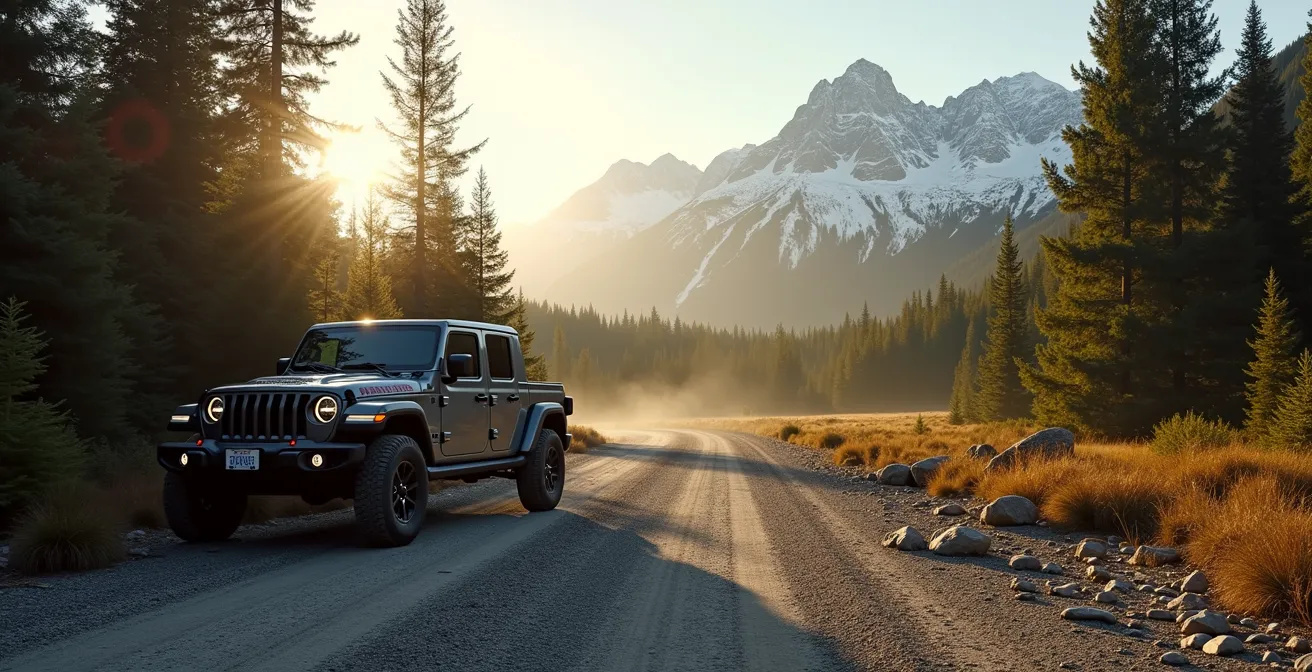
Contrary to popular belief, the greatest danger in Canada’s remote landscapes isn’t wildlife, but misplaced faith in everyday technology like Google Maps and consumer vehicles like crossovers. This guide dismantles these assumptions, revealing that backcountry roads are often unmaintained industrial routes, not park trails. True safety lies in adopting a professional’s mindset: understanding your equipment’s real-world limitations and using specialized navigation tools to avoid getting stranded far from help.
The allure of Canada’s backcountry is undeniable. For an amateur photographer or nature enthusiast, the promise of a pristine lake at sunrise or a landscape untouched by crowds is a powerful motivator. The plan often seems simple: find a remote spot on a digital map, hop in your trusty crossover SUV, and follow the blue line to adventure. This is a romantic notion, but in the rugged reality of the Canadian wilderness, it’s also a dangerously flawed one.
Many assume that basic precautions—a full tank of gas and a reliable vehicle—are enough. But what if the very tools you trust are setting you up for failure? What if Google Maps can’t distinguish between a public highway and a decommissioned logging road? The conventional wisdom about backcountry travel often overlooks a critical truth: you are not entering a recreational park, but an active or abandoned industrial zone. The key to safety isn’t just about being prepared for the wilderness; it’s about fundamentally shifting your perspective.
This guide will challenge your assumptions. Instead of just listing what to bring, we will explore *why* standard approaches fail. We will dissect the crucial differences between your all-wheel-drive crossover and a true 4×4, explain the industrial nature of Canada’s vast network of resource roads, and provide a prudent, reality-based framework for exploration. By the end, you will have a new respect for the backcountry and a concrete strategy to access its beauty without becoming another cautionary tale.
This article provides a comprehensive overview of the essential strategies for safe backcountry travel. From navigation and equipment choices to wildlife encounters and vehicle limitations, we will cover the critical knowledge needed to explore with confidence and prudence.
Summary: Exploring Canada’s Backcountry: How to Reach Remote Landscapes Safely
- Pourquoi Google Maps peut-il vous envoyer dans un cul-de-sac dangereux en forêt ?
- Traction boards ou treuil : quel équipement privilégier pour une exploration en solo ?
- Orignaux et ours : comment réagir si un animal bloque votre chemin forestier ?
- Le piège des roches cachées : pourquoi votre crossover n’est pas un vrai 4×4 ?
- Quand faire le plein : la règle du “moitié du réservoir” pour les régions isolées
- Pourquoi Google Maps ne suffit-il pas dans les Rocheuses ou les Maritimes ?
- Quoi ajouter à la trousse standard pour gérer les blessures mineures sur la route ?
- Off-Roading for Beginners: Essential Techniques to Avoid Getting Stuck
Pourquoi Google Maps peut-il vous envoyer dans un cul-de-sac dangereux en forêt ?
The most common mistake novice explorers make is placing absolute trust in consumer navigation apps like Google Maps or Waze. These tools are designed for public road networks, but they lack the critical data to differentiate between a paved highway, a maintained gravel road, and a decommissioned Forestry Service Road (FSR) that has been washed out for years. The app sees a line on a map and calculates a route, unaware that the “road” it has selected may now be an impassable trench or a dead end blocked by a landslide.
The heart of the problem lies in the nature of Canada’s backcountry. Much of it is crisscrossed by a massive network of industrial “resource roads” built for logging, mining, or energy projects. These are not public roads. As the government of British Columbia clarifies, these routes present unique hazards. According to their official guidance, resource roads are not built or maintained to public highway standards, and many are narrow, have rough surfaces, and may be unmaintained entirely. Your navigation app has no way of knowing this. It may confidently direct you onto a path that requires a high-clearance, industrial vehicle, leading you into a situation your car cannot handle and from which you cannot easily retreat.
This “digital illusion” is a primary cause of backcountry incidents. A driver follows their GPS deep into the forest, only to find the road progressively deteriorating until they are stuck, damaged, or lost, often with no cell service to call for help. Understanding this limitation is the first and most critical step in safe backcountry travel: your smartphone is a tool, not an infallible guide. It must be supplemented with specialized knowledge and resources.
Traction boards ou treuil : quel équipement privilégier pour une exploration en solo ?
When you get stuck—and if you explore enough, you will—your recovery equipment is your lifeline. For the solo explorer or someone in a typical crossover, the debate often comes down to two options: modern traction boards or a traditional winch. While a winch has immense power, it presents significant risks and costs that make it unsuitable for most amateur adventurers. For 90% of the situations you’re likely to encounter, such as mud, snow, or sand on an FSR, traction boards are the superior choice for solo recovery.
Traction boards, also known as recovery boards, are simple, effective, and vastly safer for one-person operation. They are reinforced nylon planks with aggressive cleats that you wedge under your spinning tire to provide grip. The process is straightforward, requires minimal training, and carries almost no risk of injury. In contrast, operating a winch involves high-tension steel cables that can snap with lethal force, complex rigging, and the need for a solid anchor point (like a large tree), which may not be available. A winch is a professional tool that demands specialized training to be used safely.
The table below breaks down the key differences, making the choice clear for the prudent explorer.
This comparison highlights why traction boards are the more practical and safer investment for non-extreme off-roading.
| Factor | Traction Boards | Winch System |
|---|---|---|
| Cost Range | $300-$500 | $2000+ |
| Solo Operation Safety | Low-risk, one-person operation | High-risk (cable snap, complex rigging) |
| Best Terrain | Mud, snow, sand (90% of FSR situations) | Rock crawling, deep ditches |
| Setup Time | Minutes | 30+ minutes |
| Training Required | Minimal | Specialized training needed |
Investing in a quality set of traction boards is one of the smartest decisions you can make. They are lightweight, easy to store, and provide a reliable solution to the most common challenges, ensuring a minor inconvenience doesn’t turn into a major emergency.
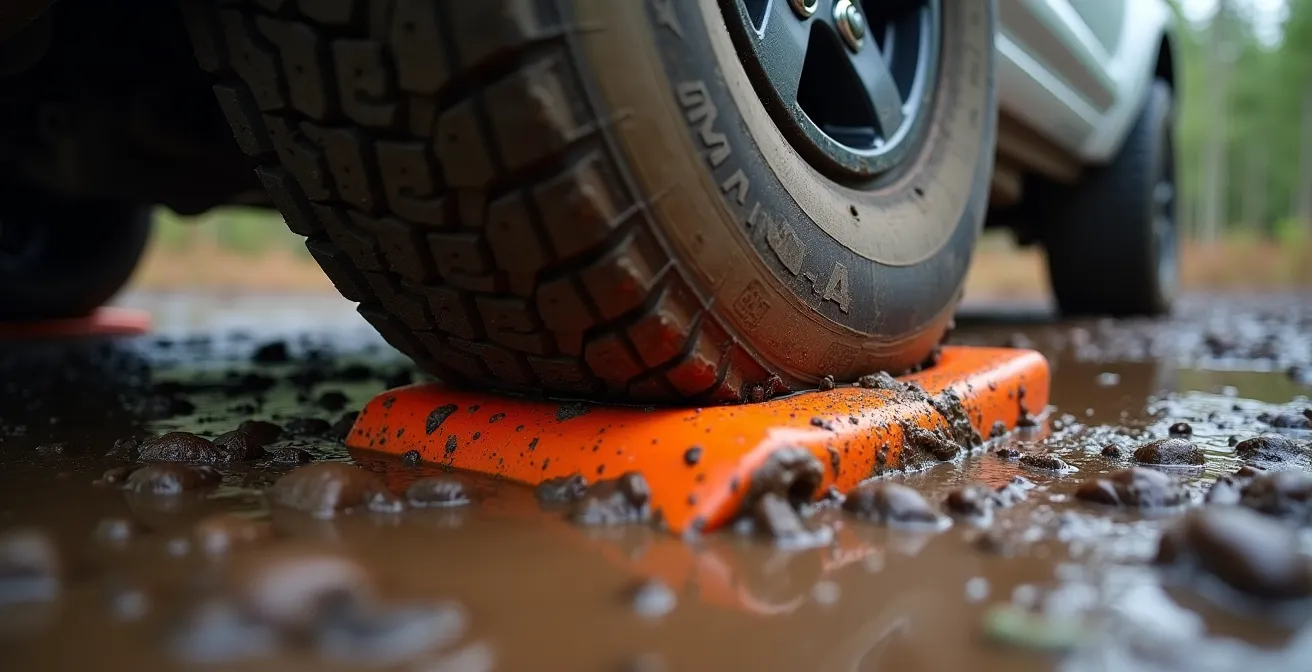
As shown, the application is direct and intuitive. By creating a solid, high-traction surface, the boards allow the vehicle to use its own power to lift itself out of the mud or snow, getting you back on your way in minutes.
Orignaux et ours : comment réagir si un animal bloque votre chemin forestier ?
An encounter with Canada’s iconic megafauna—a moose standing defiantly in the middle of a narrow forest road, or a bear ambling across your path—is a quintessential backcountry experience. It can be awe-inspiring, but it also requires a calm, respectful, and safe response. Your vehicle is your greatest asset in these moments; it is your “hard-sided viewer” and your safe space. The first and most important rule is to stay inside your vehicle.
Different animals require slightly different protocols. A moose, especially a bull during the fall rut or a cow with a calf, can be unpredictable and aggressive. Honking your horn or revving your engine can be interpreted as a challenge. The best course of action is patience. Turn off your engine, turn down your music, and wait. Give the animal space and time to move on of its own accord. Never, under any circumstances, attempt to drive around a moose in a tight space or position your vehicle between a mother and her calf.
For bears, the approach is similar: give them space. Your goal is to let the bear know you are there without startling it. It will typically want to avoid you. If it doesn’t move on immediately, a short, soft tap of the horn might encourage it. The key is to ensure it has a clear escape route. If you are outside your vehicle in known bear country, it’s crucial to make noise as you move (talking, singing) to avoid surprising an animal. Always carry bear spray and know how to use it as a last resort. Your response should always be guided by respect, not fear or impatience.
- Stay inside your vehicle.
- For a moose, turn off your engine and wait patiently. Do not use your horn.
- For a bear, make your presence known calmly and ensure it has an escape path.
- Never feed wildlife or get out of your car for a photo.
- Report any aggressive wildlife encounters to the local conservation officer service.
Le piège des roches cachées : pourquoi votre crossover n’est pas un vrai 4×4 ?
The marketing for crossover SUVs (like a Honda CR-V or Toyota RAV4) often shows them parked near a scenic vista, implying a rugged capability they don’t truly possess. While their All-Wheel Drive (AWD) systems provide excellent traction on snowy pavement or graded gravel, they are not designed for the challenges of unmaintained resource roads. The most significant and often most damaging limitation is the “capability gap” in ground clearance, suspension, and driveline components.
A true 4×4 (like a Jeep Wrangler or Toyota 4Runner) is built differently from the ground up. It features a body-on-frame construction, higher ground clearance, more robust suspension, and a 4-wheel drive system with a “low-range” gear for crawling over obstacles. Your crossover has a unibody frame (like a car) and an AWD system that is primarily reactive, designed to manage slip on relatively smooth surfaces. It lacks the brute-force mechanics and physical clearance needed to navigate common FSR obstacles like “water bars”—deep ditches dug across the road for drainage—or hidden, tire-shredding rocks.
The table below starkly illustrates the physical differences that define this capability gap.
Attempting to cross an obstacle that exceeds your vehicle’s clearance can lead to getting hopelessly stuck (“high-centered”) or, worse, damaging critical components like the oil pan, transmission, or fuel tank, leaving you stranded with a disabled vehicle.
| Feature | Typical Crossover (CR-V, RAV4) | True 4×4 (Wrangler, 4Runner) |
|---|---|---|
| Ground Clearance | ~20cm | 25cm+ |
| Drive System | AWD (reactive, on-road focused) | 4WD with Low-Range gearing |
| Approach Angle | 15-20 degrees | 35-40 degrees |
| Standard Tires | All-season, thin sidewalls | All-terrain, reinforced sidewalls |
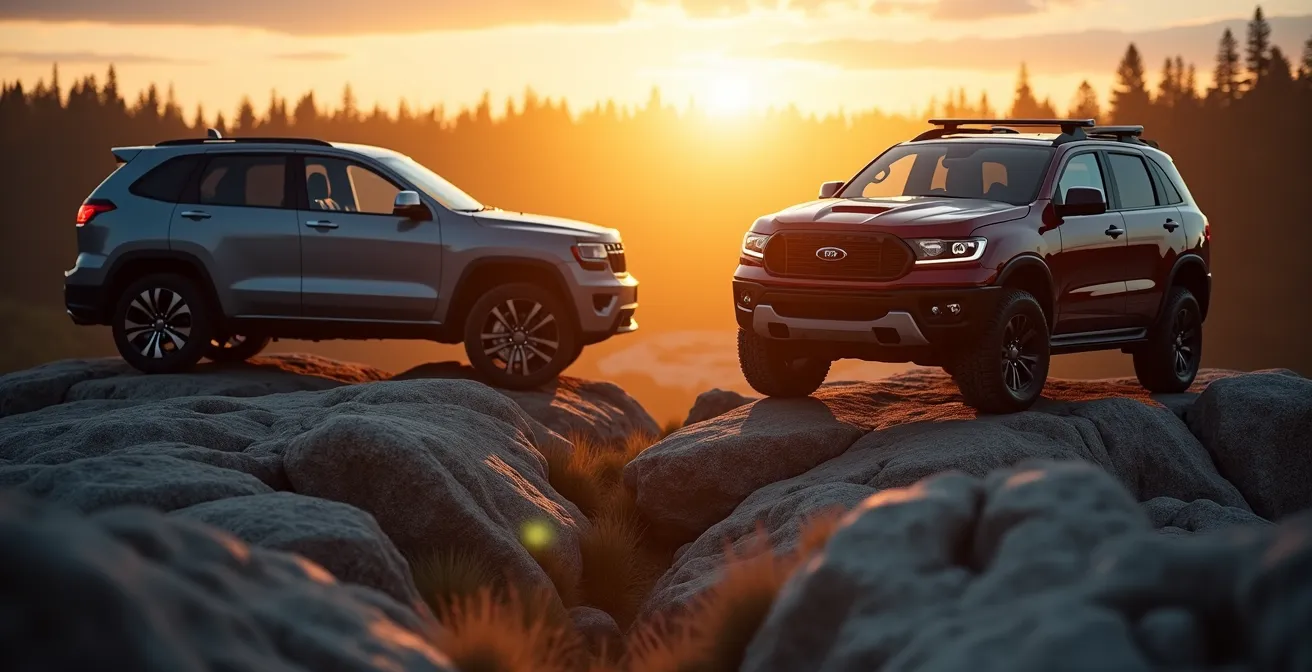
This visual comparison makes it clear. The limited ground clearance and shallow approach angle of the crossover put its underbelly at high risk, while the 4×4 is engineered to clear such obstacles. Knowing this difference is not about disparaging your vehicle; it’s about respecting its limits and choosing your routes accordingly to prevent a costly and dangerous mistake.
Quand faire le plein : la règle du “moitié du réservoir” pour les régions isolées
In urban driving, the fuel gauge is a minor concern. In the Canadian backcountry, it is a critical lifeline. Distances between fuel stations can be vast and unpredictable. A station marked on a map may be closed for the season, or permanently. This is why experienced travellers live by a simple, non-negotiable principle: the “half-tank rule.” The rule is straightforward: the moment your fuel gauge hits the halfway mark, you begin actively searching for the next gas station. Never let your tank fall below half when travelling in a remote region.
This isn’t just about avoiding the anxiety of running on fumes. It’s a calculated strategy for managing the unexpected. A wrong turn, an impassable road forcing a long detour, or an emergency situation requiring you to idle your engine overnight for warmth can consume far more fuel than planned. Your reserve fuel isn’t just for driving; it’s your survival margin. On legendary remote routes like the Trans-Labrador Highway or Highway 17 across Northern Ontario, where service stations can be 200 to 400 kilometres apart, this rule is not optional—it’s essential.
Furthermore, running your tank close to empty can be mechanically risky. It can stir up sediment from the bottom of the tank, potentially clogging your fuel filter or injectors. The “half-tank rule” ensures you always have:
- A significant buffer for detours and unforeseen delays.
- Reserve fuel for emergency overnight idling.
- Fuel to account for increased consumption during difficult driving (like mud or snow).
- A safety margin to protect your vehicle’s fuel system.
This disciplined approach to fuel management transforms the fuel gauge from a simple indicator into a strategic tool for risk mitigation. It’s a simple habit that removes a major source of potential disaster from your backcountry adventures.
Pourquoi Google Maps ne suffit-il pas dans les Rocheuses ou les Maritimes ?
While we’ve established that Google Maps fails to understand road quality, its unreliability in Canada’s diverse geography goes deeper. In mountainous regions like the Rocky Mountains or the complex coastal networks of the Maritimes, two additional factors make relying solely on consumer GPS a dangerous gamble: lack of signal and lack of data on land ownership.
In the Rockies, deep valleys and massive mountain ranges frequently block both cellular and GPS signals. Your blue dot will freeze, leaving you completely blind if you haven’t pre-planned. This is why authorities like BC Parks state unequivocally that for backcountry travel, you must carry a dedicated communication device. As they note, many backcountry locations have no cellphone service, making a satellite device like a personal locator beacon (PLB) or satellite phone essential for calling for help. Your smartphone’s offline map feature is useless if the device itself can’t get a GPS fix.
In the Maritimes, the challenge is different. The region is a complex patchwork of Crown land and private woodlots, all crisscrossed by logging roads that look identical. Google Maps has no concept of land ownership. It may route you onto a private, gated road, leading to a dead end or a confrontation with a landowner. This is where specialized tools become indispensable. To navigate safely, you must build a layered system:
- Backroad Mapbooks (BRMB): These are the bible for the Canadian backcountry, available in paper and digital formats. They show FSR numbers, differentiate road types, and importantly, display land ownership.
- Gaia GPS or similar apps: These powerful GPS applications allow you to overlay BRMB or other topographical maps, giving you real-time location on a map that actually reflects reality.
- Paper Maps: Electronics can and do fail. A paper copy of the BRMB for your region is the ultimate foolproof backup.
- Satellite Messenger (e.g., InReach, Spot): This is your emergency link to the outside world when there is no cell signal.
Relying on Google Maps in these environments is like navigating the ocean with a city street map. It’s the wrong tool for the job and invites serious trouble.
Key Takeaways
- Your crossover SUV is not a true 4×4; respect its ground clearance and mechanical limits on rough roads.
- Consumer GPS like Google Maps is unreliable in the backcountry; use specialized tools like Backroad Mapbooks (BRMB) and satellite messengers.
- The “half-tank rule” is a non-negotiable safety principle for managing fuel in remote areas with few gas stations.
Quoi ajouter à la trousse standard pour gérer les blessures mineures sur la route ?
A standard vehicle first-aid kit is designed for minor cuts and scrapes from everyday life, not for the specific injuries that can occur during backcountry travel and vehicle recovery. When you are hours from the nearest clinic, your ability to effectively treat a more specific injury becomes paramount. Enhancing your kit with a few key items tailored to the Canadian wilderness and off-road scenarios can make a world of difference.
Think about the unique risks. A simple walk to scout a trail could result in a sprained ankle on uneven ground. Recovering a stuck vehicle can lead to burns from a winch cable or deep lacerations from sharp, hidden rocks. And Canada’s vibrant insect life brings its own challenges. A basic kit won’t have what you need to manage a severe allergic reaction to a black fly bite or properly remove a tick to prevent Lyme disease.
Your goal is to upgrade your kit from a simple “boo-boo kit” to a robust “minor trauma and wilderness response” system. This doesn’t require a paramedic’s bag, but a thoughtful selection of items that address the most probable risks. Before your next trip, take an inventory of your standard kit and consider adding these crucial backcountry-specific supplies.
Your Action Plan: Upgrading Your Backcountry First-Aid Kit
- Assess Existing Kit: Lay out your current first-aid supplies. Discard any expired items and note what’s missing from the list below.
- Purchase Wilderness-Specific Items: Acquire high-quality versions of a tick remover, antihistamines (like Benadryl), heavy-duty work gloves, a SAM splint, and water purification tablets.
- Organize for Access: Repack your kit in a durable, waterproof bag. Group items by function (wound care, sprains, meds) for quick access in a stressful situation.
- Learn Basic Skills: You don’t need to be a doctor, but watch videos on how to properly use a SAM splint and how to safely remove a tick. Knowledge is the most important supply.
- Brief Your Companions: Ensure everyone on the trip knows where the first-aid kit is located and what’s inside. In an emergency, you may not be the one using it.
By taking these proactive steps, you are preparing not just for what might happen, but for what is reasonably likely to happen in the unique environment of the Canadian backcountry. It is a core component of a prudent explorer’s mindset.
Off-Roading for Beginners: Essential Techniques to Avoid Getting Stuck
The best way to handle getting stuck is to avoid it in the first place. While having the right equipment is crucial, the most powerful tool at your disposal is technique. Driving in the backcountry is a skill that requires active engagement and a light touch, not brute force. Speed is the enemy; steady, low-speed momentum is the key. This allows your tires to maintain traction and your suspension to articulate over uneven ground without the violent impacts that cause damage.
One of the most valuable techniques is learning to “read” the road surface. Is that mud a “greasy” top layer over a hard base, or is it a bottomless bog that will swallow your vehicle? Getting out of the car to scout a difficult section on foot is a sign of an expert, not a coward. Another critical skill is airing down your tires. Lowering the pressure to 15-20 PSI dramatically increases the tire’s footprint, improving traction on soft surfaces like sand or deep mud. Remember to bring a portable air compressor to re-inflate them before returning to the highway.
As off-road experts at on-xmaps.com emphasize, preparation is everything. They state:
When heading into the backcountry, advance preparation is vital to whether an off-road outing ends up enjoyable or agonizing. Vehicles can become stuck in mud, sand, snow, and other terrain, which is why recovering a stuck vehicle is something everyone should practice and prepare for in advance. Lacking the appropriate tools can leave you stuck for hours or even days—especially when in isolated areas with no cell service.
– onxmaps.com, Off-Road Recovery Guide
Finally, on active logging roads, safety means communication. Industrial traffic moves fast and expects you to get out of the way. Using a VHF radio to call out your position (e.g., “Up at km 22 on Harrison Main”) is standard protocol and a critical safety measure. Mastering these fundamental techniques will not only keep you from getting stuck but will transform your relationship with your vehicle and the terrain, turning a stressful drive into a confident and enjoyable exploration.
To put these principles into practice, start small. Begin by assessing your vehicle’s true capabilities and planning a short, low-risk trip on a well-documented FSR. This hands-on experience is the best way to build the confidence and prudence needed to explore the vast, beautiful, and challenging Canadian backcountry safely.