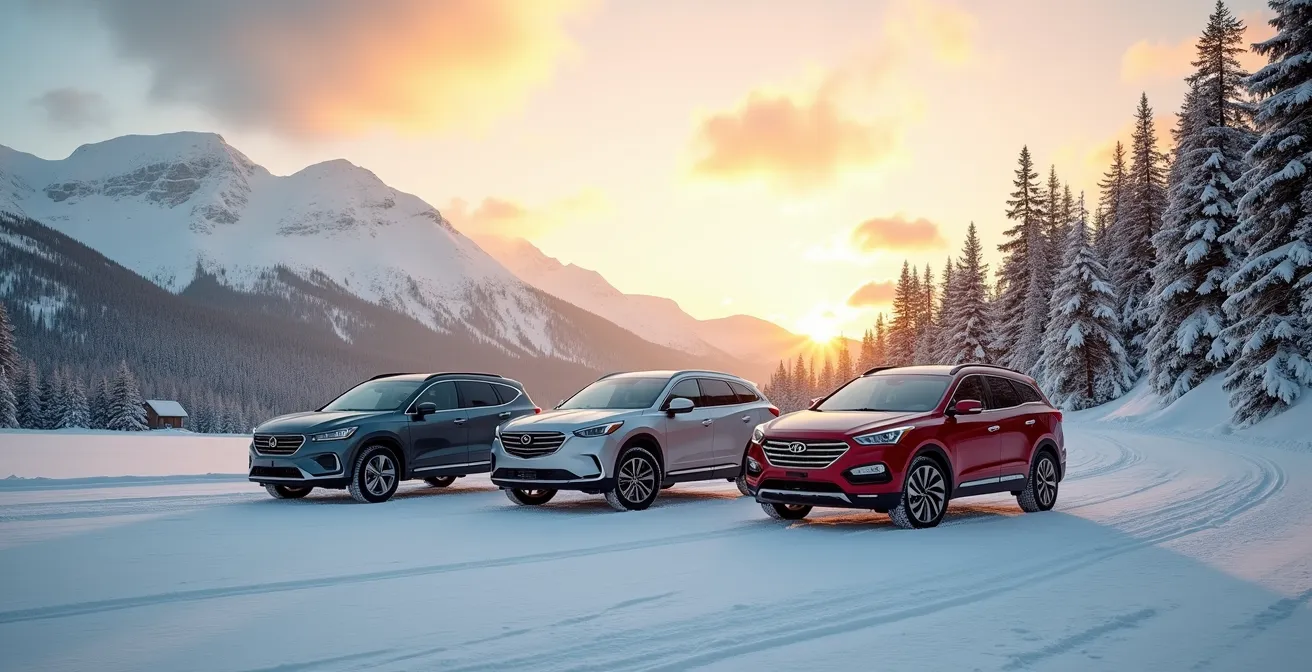
Choosing the right compact SUV for a Canadian winter isn’t about finding the “best” on paper, but mastering the real-world trade-offs between deep snow capability and urban practicality.
- True winter performance hinges on dedicated winter tires and understanding the physics of weight, not just on having All-Wheel Drive.
- For urban families, practical cargo space and the ease of installing multiple car seats often matter more day-to-day than maximum horsepower.
Recommendation: Prioritize vehicles based on their interior flexibility and ground clearance, and always factor in the cost of a dedicated set of high-quality winter tires for your specific region.
For a young family in Toronto or Vancouver, the first heavy snowfall presents a familiar dilemma. You need a vehicle that can confidently handle a suddenly unplowed side street and navigate icy commutes, but that can also squeeze into a tight condo parking spot and not break the bank on fuel during the 90% of the year the roads are clear. The default answer is always a compact SUV with All-Wheel Drive (AWD). It seems like the perfect Canadian solution.
But the conversation often stops there, focusing on brochure specs like horsepower and AWD systems. This approach misses the critical nuances that determine if a vehicle is truly effective or merely adequate. We’re told to get AWD and winter tires, but rarely is the physics of why a heavier SUV still slides, or the real-world frustration of trying to fit hockey gear into a cleverly marketed but impractical cargo bay, discussed. The secret isn’t just about having the features; it’s about understanding their limitations and the compromises they entail.
This guide moves beyond the spec sheets. We’re taking on the role of a critical test driver to explore the practical realities of living with a compact SUV through a Canadian winter. We will dissect the trade-offs between stability, clearance, interior packaging, and long-term value to reveal what truly matters. Instead of just listing top models, we will answer the tough questions that arise when the snow starts falling and family life doesn’t stop.
text
This article will delve into the critical questions every Canadian family should ask, breaking down the factors that truly define a great winter vehicle. Below is a summary of the key areas we will cover to help you make an informed decision.
Summary: A Real-World Guide to Winter-Ready Compact SUVs
- Why 2 pouces de garde au sol supplémentaires changent tout dans un banc de neige ?
- Honda CR-V ou Toyota RAV4 : lequel avale le mieux deux sacs de hockey sans rabattre les sièges ?
- Le mythe du 4×4 invincible : pourquoi votre VUS glisse quand même sans bons pneus ?
- Comment installer trois sièges enfants à l’arrière d’un VUS compact sans crise de nerfs ?
- Quand vendre votre VUS pour maximiser sa valeur sur le marché de l’occasion ?
- Pneus homologués hiver ou vrais pneus à neige : lequel choisir pour Montréal vs Vancouver ?
- Pourquoi un VUS chargé met-il 20% plus de distance à s’arrêter qu’une petite auto ?
- AWD Sedans: Are They Sufficient for Driving in Quebec Snow?
Why 2 extra inches of ground clearance matter in a snowbank
Automakers love to advertise ground clearance, but the number on a spec sheet—often just a couple of centimetres different from a sedan—can feel abstract. In a Canadian winter, however, that difference is profoundly practical. It’s the difference between driving home and waiting for a tow truck. The main adversary isn’t just the snow on the road, but the dense, compacted ridge of snow left by the city plow at the end of your driveway or along your street parking spot. A typical sedan with 5-6 inches of clearance will often bottom out, its undercarriage hung up on the icy mound, wheels spinning uselessly.
A compact SUV offers a significant advantage here. According to industry analysis, leading winter-ready SUVs offer between 8.7 to 10.8 inches of clearance. Those extra two or three inches are your margin of safety. They allow the vehicle to ride over that plow-ridge without turning it into a high-centering ramp. This “practical clearance” is also crucial on unplowed residential streets after a major dump, where deep ruts form. Less clearance means your vehicle’s belly is constantly scraping and dragging, increasing resistance and the risk of getting stuck.
This isn’t about extreme off-roading; it’s about urban winter survival. It’s about having the confidence that you can pull out of your parking spot on a Monday morning after a Sunday snowstorm. While more clearance slightly raises the vehicle’s center of gravity (which we’ll discuss later), for the specific challenge of conquering urban snow obstacles, it’s a non-negotiable advantage. It’s one of the most compelling arguments for an SUV over an AWD sedan for many Canadian drivers.
Honda CR-V or Toyota RAV4: Which one best swallows two hockey bags without folding the seats?
For a Canadian family, “cargo capacity” isn’t about generic litres or cubic feet; it’s about passing the hockey bag test. Can the vehicle swallow two bulky player bags, sticks, and a goalie’s equipment without forcing you to fold down the seats needed for the kids? This is a test of usable shape and volume, where the Honda CR-V and Toyota RAV4, two of Canada’s best-sellers, reveal different philosophies. It’s a practical puzzle I call “Cargo Tetris.”
On paper, the numbers are close, but in practice, differences emerge. The following comparison highlights how seemingly small design choices impact real-world usability, especially when it comes to fitting a standardized set of cargo items.
| Model | Cargo Behind Seats | Carry-on Boxes Fit |
|---|---|---|
| Honda CR-V | More spacious | 12 boxes |
| Toyota RAV4 | Standard capacity | 10 boxes |
As the data from a Car and Driver comparison test shows, the CR-V’s ability to fit two extra carry-on-sized boxes translates directly to its advantage in our hockey bag test. The CR-V often features a lower load floor and more squared-off wheel wells, creating a wider, more uniform space. The RAV4, while ample, can have a slightly higher liftover height and more intrusive wheel wells, making the strategic placement of bulky bags more challenging. The visualization below shows how an optimized space, free of intrusions, is key to managing bulky winter gear.
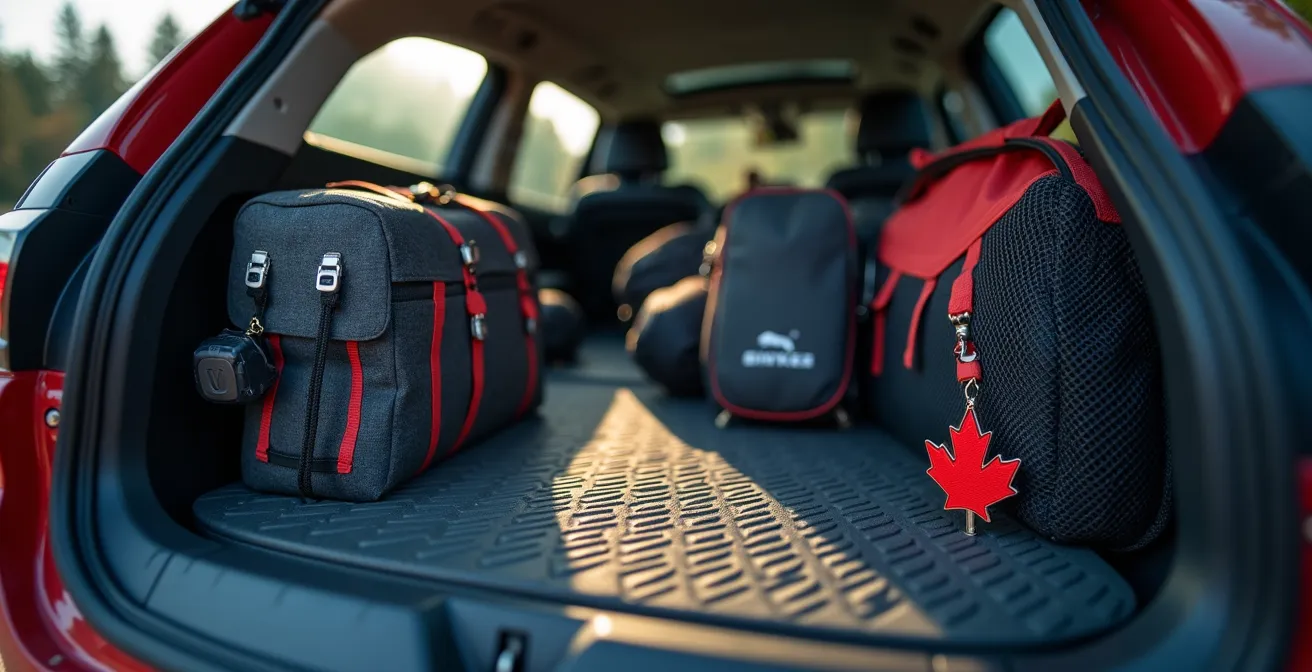
Ultimately, the CR-V’s design often provides that crucial extra bit of wiggle room. It’s the difference between effortlessly tossing the bags in and having to strategically repack them. For any family juggling sports equipment and groceries, this practical edge in cargo design can be a significant quality-of-life improvement during the long winter months.
The myth of the invincible 4×4: Why your SUV still slides without good tires
One of the most dangerous winter driving traps is AWD complacency. An All-Wheel-Drive system is brilliant at one thing: sending power to the wheels that have traction to get you moving. It’s why your SUV can pull away from a snowy intersection while a front-wheel-drive car spins its tires. However, AWD does absolutely nothing to help you stop or turn. The only things keeping your two-tonne SUV connected to that icy road are four postcard-sized patches of rubber. If those patches can’t grip, you’re just a passenger.
This is where the distinction between “all-season” and “winter” tires becomes a matter of physics, not marketing. All-season tires use a rubber compound that becomes hard and brittle, like a hockey puck, as temperatures drop below 7°C. A winter tire uses a silica-rich compound that stays soft and pliable in the cold, allowing it to conform to the road’s microscopic imperfections for better grip. As one expert aptly puts it, the benefit is tied to temperature, not just snow.
We call these winter tires and not snow tires for a reason: their benefits come with cold weather, not just when driving in snowy weather conditions.
– Stephanie Wallcraft, CarGurus Canada – 2024 Canadian Automotive Journalist of the Year
An SUV on all-seasons in the cold is a recipe for a false sense of security. You can accelerate well, which encourages you to drive at a speed your tires cannot possibly handle when it’s time to brake or swerve. A front-wheel-drive car on proper winter tires will consistently out-brake and out-corner an AWD SUV on all-seasons. Investing in a quality set of winter tires isn’t an upgrade; it’s the fundamental activation key for your vehicle’s entire safety system.
Action Plan: Your Winter Tire Effectiveness Checklist
- Tire Installation Timing: Install winter tires before temperatures consistently drop below 7°C to ensure optimal compound performance.
- Legal & Safety Compliance: Look for the Three-Peak Mountain Snowflake (3PMSF) symbol, which is legally required for winter driving in Quebec and on many B.C. mountain passes.
- Pressure Monitoring: Check tire pressure weekly. Cold air is denser, causing pressure to drop by approximately 1 PSI for every 5°C decrease in ambient temperature.
- Tread Depth Inspection: Maintain a minimum tread depth of 4/32″ (about 3.2 mm). This is crucial for evacuating snow and slush to prevent hydroplaning and maintain grip.
- Regional Consideration: Consider studded tires if you live in regions with frequent black ice or freeze-thaw cycles, such as northern Ontario or rural areas.
How to install three child seats in a compact SUV without a nervous breakdown
The marketing photos show smiling families, but the reality of fitting three child seats across the back of a compact SUV is a wrestling match against awkward angles, buried anchors, and sheer lack of space. For urban families, this is often the ultimate test of a vehicle’s practicality. It’s a game of millimetres, where a vehicle’s interior passenger volume and the design of its rear bench can make all the difference. More space is always better, and some models offer a tangible advantage.
For instance, comparing two popular models, the Honda CR-V’s design prioritizes interior room. A detailed look at the specs reveals the Honda CR-V offers more passenger volume at 106 cubic feet vs 98.9 for the Toyota RAV4. That extra 7% of volume is most felt in shoulder room and hip room in the rear, which is precisely the dimension that matters when trying to buckle three seats side-by-side. It can mean the difference between a successful installation and giving up.

Beyond raw space, the design of the bench itself is critical. Look for a flat seat cushion rather than heavily sculpted “bucket” style outboard seats. Sculpted seats can cause car seats to tilt, making a secure installation impossible. Also, check the location of the Universal Anchorage System (UAS) latches. Are they easily accessible or buried deep within the seat cushions? Trying to find those anchors with cold, gloved hands in a snowy parking lot is a uniquely Canadian form of torture. The vehicles that make these anchors visible and easy to access are the true family-friendly champions.
The “three-across” dream is achievable in some compact SUVs, but it often requires using specific narrow-profile car seats. Before you buy the vehicle, it’s wise to bring your car seats to the dealership and attempt a real-world test fit. It’s the only way to be sure your chosen SUV won’t cause a daily installation crisis.
When to sell your SUV to maximize its value on the Canadian used market
Owning a vehicle is a cycle, and a smart exit strategy is just as important as a smart purchase. For SUV owners in Canada, timing the sale of your vehicle can mean a difference of thousands of dollars. The key is to sell when demand is highest, and for winter-capable vehicles, that demand is highly seasonal. While convertible owners cash in during the spring, SUV owners have a clear window of opportunity in the autumn. Market data shows that SUV demand typically peaks in September and October, as buyers anticipate the coming winter and look to upgrade their ride.
This is the “Value Apex.” Listing your SUV in the fall means you’re meeting a wave of motivated buyers. Delaying until January or February is a mistake; by then, many buyers have already made their purchase, and the market is often flooded with trade-ins, driving prices down. To maximize your return, you should prepare your vehicle for sale in late summer, have professional photos taken on a bright day (a clean car looks best in sunlight!), and list it at the beginning of September.
p>
Brand reputation plays a massive role in resale value, and this is where certain manufacturers have a distinct, quantifiable advantage in the Canadian market. They are perceived as more reliable and durable, making them a safer bet for used-car buyers. This is consistently validated by industry awards. For example, Toyota Canada Inc. has been recognized by Canadian Black Book (CBB) with nine 2024 Best Residual Value Awards, including the overall award for SUV/Truck. Owning a vehicle from a brand with a proven track record of strong residual value means you will recover a larger percentage of your initial investment, significantly lowering your total cost of ownership.
Winter-approved or true snow tires: which to choose for Montreal vs. Vancouver?
The term “winter tire” isn’t one-size-fits-all in a country as vast as Canada. The tire that excels in Montreal’s deep freeze may be a poor choice for Vancouver’s wet, slushy conditions. The Three-Peak Mountain Snowflake (3PMSF) symbol is the legal minimum in places like Quebec, but it’s merely the starting point. The real decision lies in matching the tire’s specific strengths to your region’s dominant winter weather. Canada’s diverse climates demand a nuanced approach; as data shows, cities like Quebec City can see over 300 cm of snowfall annually, while even milder cities like Vancouver face their own unique winter hazards like slush and black ice.
Choosing the right tire is about understanding your local “weather profile.” A driver in Montreal needs a tire that remains pliable at -30°C and has deep, aggressive tread blocks to bite into dry, powdery snow. In contrast, a Vancouver driver’s biggest enemy is often slush and standing water at temperatures hovering around 0°C. For them, a tire with wide circumferential grooves for maximum water evacuation is more critical to prevent hydroplaning and maintain grip on wet pavement.
Here is a breakdown of tire strategies for different Canadian regions:
- Montreal & Quebec City: Prioritize tires with a severe snow service rating. Look for deep tread patterns and consider studdable options if you frequently drive on icy secondary roads. The compound must be rated for extreme cold.
- Vancouver & Lower Mainland: Focus on tires with superior performance in wet and slushy conditions. Asymmetrical tread patterns with wide grooves to channel water away are key. Grip at temperatures just above or below freezing is more important than deep snow performance.
- Toronto & GTA: This region’s mixed bag of light snow, ice, and clear-but-cold roads makes high-quality “all-weather” tires (not to be confused with all-season) a viable option. They carry the 3PMSF symbol but offer better-than-winter-tire performance on dry and wet pavement.
- Prairie Provinces (Calgary, Edmonton, Winnipeg): Deep, consistent cold and dry snow make traditional, deep-tread snow tires the primary choice. Ice performance is also critical, so look for compounds with advanced biting-edge technology.
- Atlantic Canada: The constant freeze-thaw cycles create notoriously icy conditions. Tires with a specialization in ice grip, often featuring specific compounds or being factory-studded, are a wise investment here.
Ultimately, buying tires is not just about meeting a legal standard. It’s about investing in the specific technology designed to handle the most common and dangerous conditions you will face. Don’t ask for “winter tires”; ask for the right tire for your city.
Why a loaded SUV takes 20% more distance to stop than a small car
This is where we confront the most misunderstood aspect of winter driving: the physics of grip. All-Wheel Drive creates a sense of security during acceleration, but that security vanishes when you hit the brakes. The fundamental principle is that mass is the enemy of deceleration. A heavier vehicle has more inertia, and it takes more energy—and therefore more distance—to bring it to a stop. A compact SUV, loaded with a family and their gear, can easily outweigh a small car by 500 kg or more. This added mass directly translates to longer stopping distances, a fact that is dangerously amplified on slick surfaces.
While a larger vehicle like a Chevrolet Tahoe boasts impressive features, its increased mass affects stopping distances, especially on low-grip surfaces. This is simple physics: Force = Mass x Acceleration (or Deceleration). To achieve the same rate of deceleration as a lighter car, your tires need to generate significantly more braking force. On ice or snow, the maximum available grip is limited. Once you exceed that limit, the wheels lock, ABS kicks in, and your stopping distance extends dramatically.
Furthermore, an SUV’s higher center of gravity works against it during emergency maneuvers. When you brake hard, weight transfers to the front wheels. In a taller vehicle, this effect is more pronounced, potentially making the rear end feel light and unstable. While advanced systems help, the underlying physics remain. Vehicles praised for their handling, like the Subaru Outback, benefit from excellent weight distribution and a lower center of gravity compared to more truck-like SUVs, which helps mitigate this effect. But even then, the rule holds: a loaded vehicle requires you to adjust your following distance and anticipate stops much earlier. Never let an SUV’s commanding driving position fool you into thinking it can defy the laws of physics.
Key Takeaways
- Dedicated winter tires are more important than All-Wheel Drive. AWD helps you go, but tires help you stop and turn.
- Practical interior design, like a flat load floor and accessible car seat anchors, is more critical for daily family life than brochure specifications.
- An SUV’s extra weight and higher center of gravity increase stopping distances and reduce stability in emergencies, a reality that AWD cannot change.
AWD Sedans: Are They Sufficient for Driving in Quebec Snow?
With the rise of capable AWD systems in sedans like the Subaru Legacy or Toyota Camry, a compelling question arises for many families, especially in heavy-snow provinces like Quebec: is a bulky SUV truly necessary? The answer is a clear “it depends on your trade-offs.” An AWD sedan can be an outstanding winter vehicle and is often superior to an SUV in several key areas, but it comes with one significant compromise. General wisdom holds that cars that perform well in winter have features like AWD and good ground clearance, and the balance between these is key.
The primary advantage of a sedan is its lower center of gravity. This translates to greater stability, more responsive handling, and less body roll in corners. On a winding, snow-covered road, a sedan feels more planted and confidence-inspiring. It’s also significantly more fuel-efficient due to its lower weight and better aerodynamics, a major plus for long commutes. However, it gives up the one thing an SUV excels at: ground clearance.
This table breaks down the core trade-offs between a typical AWD sedan and a compact SUV for winter driving:
| Factor | AWD Sedan | Compact SUV |
|---|---|---|
| Ground Clearance | 5-6 inches typical | 8-9 inches typical |
| Center of Gravity | Lower – better stability | Higher – more tippy feel |
| Fuel Economy | Better by 15-20% | Lower due to weight/drag |
| Snow Capability | Good on cleared roads | Better in deep snow |
For a driver in Quebec who primarily sticks to well-plowed highways and urban streets, an AWD sedan equipped with excellent winter tires is often more than sufficient—and arguably more enjoyable and economical to drive. The challenge arises with unplowed side streets, cottage roads, or the plow-ridge at the end of the driveway. In those specific “deep snow” scenarios, the SUV’s ground clearance is the clear winner. The choice, therefore, isn’t about which is “better,” but which tool is right for your most common and most challenging winter driving tasks.
The next step is to test drive your top contenders not on a sunny day, but in the rain or, if possible, on a slippery surface, to truly feel these dynamics at play. It’s the only way to move past the spec sheet and find the vehicle that best handles your real-world Canadian winter.