The single most impactful tax decision for your work truck in Canada is made before you even buy it: choosing a model with a Gross Vehicle Weight Rating (GVWR) over 3,856 kg (8,500 lbs).
- This strategic choice reclassifies the truck from a “passenger vehicle” with strict write-off limits to a “motor vehicle,” unlocking 100% of its capital cost for depreciation.
- Day-to-day expense tracking is secondary to this structural decision, which dictates the entire financial lifecycle and tax potential of the asset.
Recommendation: Prioritize GVWR in your purchasing criteria over all other features to establish the most favourable tax foundation for your business.
For any Canadian entrepreneur, a pickup truck is more than a vehicle; it’s a fundamental business tool. The immediate focus often falls on deducting expenses like fuel and maintenance. However, this surface-level approach misses the most critical opportunities for tax optimization and audit risk mitigation. The common advice to simply “keep a good logbook” is incomplete. It fails to address the structural decisions that the Canada Revenue Agency (CRA) scrutinizes most heavily, and it overlooks the operational realities of using a truck for business across the country.
The true path to maximizing your truck’s financial return lies in understanding its status as a strategic capital asset. This involves a deeper look into concepts like Capital Cost Allowance (CCA) classes, the pivotal role of Gross Vehicle Weight Rating (GVWR), and the lifecycle of the asset from purchase (claiming Input Tax Credits) to its eventual sale (navigating recapture and terminal losses). Thinking like an accountant means seeing beyond the fuel receipts and focusing on the high-impact fiscal tripwires that can either cost you thousands or save you a fortune.
This guide moves past the generic advice. We will dissect the specific CRA rules and real-world scenarios that define effective work truck tax strategy in Canada. From the near-certain audit trigger of a 100% business use claim to the precise calculations that prevent overpaying for fuel, we will provide a framework for making informed, defensible, and financially sound decisions about your most important mobile asset.
To navigate these complex but crucial financial considerations, we’ve broken down the key strategic areas you must master. This article will guide you through the critical decisions that transform your work truck from a simple expense into a powerful, tax-optimized business asset.
Summary: A Canadian Entrepreneur’s Guide to Work Truck Taxes
- Why declaring 100% business use triggers an almost certain tax audit?
- Half-ton or three-quarter ton: which truck to pull your construction trailer?
- The calculation error that costs $1500 in extra fuel per year
- How to protect $5000 of tools in your truck bed from theft?
- When to renew your work truck to optimize accounting value?
- Why you can’t tow 10,000 lbs if your truck is full of passengers?
- What channel to use and what to say to not be a danger on a forestry road?
- Towing safely: Understanding Payload, Tongue Weight, and GVWR
Why declaring 100% business use triggers an almost certain tax audit?
Declaring that your work truck is used 100% for business purposes is one of the most significant red flags for a Canada Revenue Agency (CRA) auditor. From a fiscal perspective, it often signals a disconnect from reality. Unless your business structure can prove it is logistically impossible for the vehicle to be used personally—for instance, if it’s a highly specialized vehicle left at a job site nightly and you own a separate personal car—the claim is immediately suspect. In fact, tax experts consistently warn that this is a leading cause for audits.
The CRA’s position is rooted in common sense: auditors are trained to question claims that defy normal human behaviour. For a sole proprietor or small business owner, it is highly probable that the work truck will, at some point, be used for a personal errand, such as a trip to the grocery store or a doctor’s appointment. Claiming a full 100% suggests either meticulous, and perhaps improbable, separation of duties or an attempt to overclaim expenses.
To build a defensible position, a more realistic claim is between 50% and 85% business use. This range acknowledges the mixed-use nature of the vehicle. The cornerstone of defending this percentage is a detailed, contemporaneous logbook. This logbook must meticulously track every trip, detailing the date, starting and ending odometers, total kilometres driven, and the specific business purpose of the journey. Without this audit-proof documentation, a CRA challenge to your claimed business use percentage is almost impossible to refute, potentially leading to disallowed expenses, interest, and penalties.
Half-ton or three-quarter ton: which truck to pull your construction trailer?
The choice between a half-ton (like a Ford F-150 or Ram 1500) and a three-quarter-ton truck (like a Ford F-250 or Ram 2500) extends far beyond towing capacity; it is a critical structural decision with profound tax implications in Canada. The defining factor is the Gross Vehicle Weight Rating (GVWR). Trucks with a GVWR under 8,500 lbs (3,856 kg) often fall into the “passenger vehicle” category for tax purposes. This classification is a significant financial constraint.
Specifically, the CRA imposes a strict $36,000 capital cost limit (for 2024) on vehicles it defines as passenger vehicles (Class 10.1). This means if you purchase a $60,000 half-ton truck, you can only depreciate a maximum of $36,000 of its value over its lifetime. In stark contrast, a truck with a GVWR exceeding 8,500 lbs is typically classified as a “motor vehicle” (Class 10), which is exempt from this capital cost ceiling. This allows you to depreciate the full purchase price of the vehicle, a substantially more favourable tax outcome.
This strategic choice is not just about federal taxes. As the table below illustrates, heavier trucks can also trigger different provincial licensing and safety requirements, which must be factored into the total cost of ownership. The higher initial cost of a three-quarter-ton truck can often be offset by the significantly larger capital cost allowance it unlocks.
This side-by-side comparison at a Canadian construction site shows the clear size difference between a lighter half-ton and a heavier three-quarter-ton pickup, a visual cue to their different tax classifications.
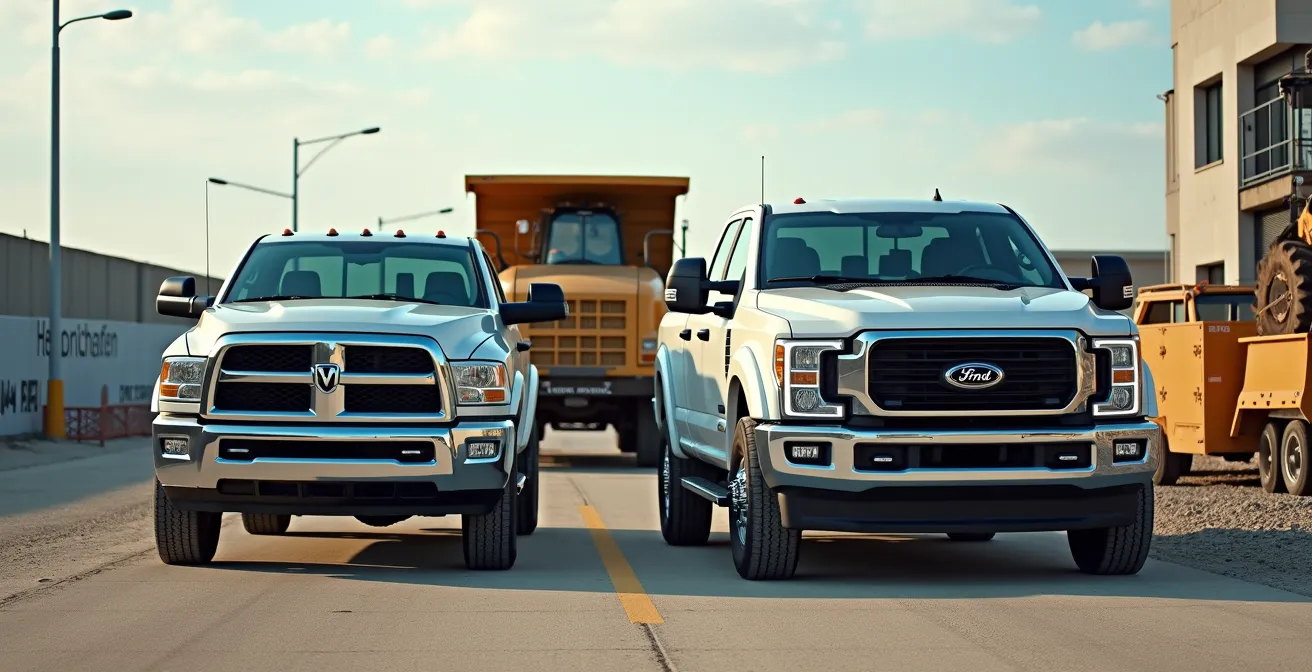
As you can see, the choice is not merely about power, but about positioning your asset for maximum tax efficiency from day one.
| Feature | Half-ton (F-150, Ram 1500) | Three-quarter ton (F-250, Ram 2500) |
|---|---|---|
| CCA Limit | Often limited to $36,000 (Class 10.1) | Usually exempt from passenger vehicle limits |
| GVWR Threshold | Under 8,500 lbs (3,856 kg) | Over 8,500 lbs (3,856 kg) |
| Tax Classification | May be ‘passenger vehicle’ | Typically ‘motor vehicle’ |
| Provincial Requirements | Standard licensing | May require CVOR (ON) or SFC (AB) |
| Insurance Costs | Lower commercial rates | Higher commercial vehicle premiums |
The calculation error that costs $1500 in extra fuel per year
Simply collecting fuel receipts is an incomplete strategy for claiming your vehicle expenses. Fuel costs are a major deductible, but relying on estimates or incomplete records often leads entrepreneurs to underclaim their actual costs by a significant margin. The operational realities of using a work truck in Canada introduce several factors that increase consumption far beyond standard vehicle ratings, and failing to account for them is a costly error.
A comprehensive fuel cost calculation must include several uniquely Canadian variables. For instance, the use of winter tires, a necessity for 5-6 months in most of the country, increases fuel consumption. Similarly, significant idling time at frigid -15°C job sites to keep the cabin warm or power equipment is a real, deductible fuel cost. Every 100kg of tools and equipment permanently stored in the truck bed adds a constant payload penalty, further increasing fuel burn. Finally, the frequent use of 4WD on unplowed or muddy Canadian job sites is another major factor.
When these elements are ignored, a business owner might estimate their fuel costs based on standard mileage, missing hundreds or even thousands of dollars in legitimate deductions annually. The key to accuracy and maximizing your claim is twofold:
- Track actual receipts: This is non-negotiable for CRA compliance.
- Contextualize the spending: Use your logbook not just to record kilometres, but to note conditions that justify higher-than-average fuel use (e.g., “idling for 1 hour at -20°C,” “4WD engaged on logging road,” “hauling 500kg of material”).
This detailed approach transforms a simple expense claim into a robust, defensible, and fully optimized deduction that accurately reflects the true cost of operating a vehicle for business in Canada.
How to protect $5000 of tools in your truck bed from theft?
For a contractor, the tools in the back of a truck can be as valuable as the vehicle itself. However, a common and costly fiscal tripwire is the assumption that a commercial auto insurance policy covers this equipment. In the vast majority of cases, it does not. As insurance experts emphasize that standard commercial auto policies do NOT cover tools, a separate “Tools and Equipment Floater” policy is required to protect against theft or damage.
Beyond insurance, securing your tools with physical hardware is a crucial operational step. Fortunately, the CRA recognizes these security upgrades as legitimate business expenses, allowing you to protect your assets while also generating a tax deduction. The key is to classify these expenses correctly in your accounting records. Different security measures fall under different CCA classes or can be claimed as current expenses.
For example, a permanently installed toolbox is typically capitalized along with the truck as a Class 10 asset. An alarm system or GPS tracker, on the other hand, would likely be a Class 8 asset with a 20% depreciation rate. The insurance premiums for your specific tool coverage are fully deductible in the year they are paid. By investing in security, you not only prevent the operational disaster of tool theft but also create a new stream of tax deductions.
To properly implement and claim these protective measures, follow a clear plan of action.
Action Plan: Securing and Deducting Your Tool Protection
- Permanent toolbox installations: Capitalize with the truck under Class 10 CCA to include it in the vehicle’s depreciation schedule.
- Alarm systems and GPS trackers: Claim these as Class 8 assets, allowing for a 20% depreciation rate per year.
- Secure parking fees: If you pay for secure parking at a job site or overnight, these are fully deductible as business parking expenses.
- Insurance premiums for tool coverage: Deduct the full cost of your “Tools and Equipment Floater” policy as a business insurance expense.
- Documentation: Keep all receipts for security hardware, installation, and insurance premiums for CRA audit compliance.
When to renew your work truck to optimize accounting value?
Deciding when to replace a work truck is a complex financial decision that goes far beyond its mechanical condition. The goal is to identify the “sweet spot” in the value optimization cycle, where the tax benefits of depreciation (CCA) are diminishing and maintenance costs are beginning to rise. Holding onto a truck for too long can be as financially inefficient as replacing it too soon.
A key concept here is the truck’s Undepreciated Capital Cost (UCC), which is the remaining portion of the truck’s cost that you have not yet claimed as CCA. The timing of the sale relative to the UCC is critical. For instance, an analysis of a $60,000 Ram 1500 suggests the optimal trade-in time is often in year 4 or 5. At this point, the annual CCA deduction is smaller, and repair bills are typically increasing. If you sell the truck for more than its UCC, the difference creates a taxable “recapture” of depreciation. Conversely, selling it for less than its UCC generates a valuable “terminal loss,” which is fully deductible against business income in that year.
Another strategic consideration is cash flow. As tax strategists note that timing the purchase of a new truck can be advantageous. A large GST/HST Input Tax Credit (ITC) refund on a new vehicle purchase can provide a significant cash injection for your business. The decision to renew should therefore be a calculated one, weighing the declining CCA, rising maintenance costs, potential for recapture or terminal loss, and the cash flow impact of an ITC refund.

This decision-making moment, weighing financial documents against the real-world utility of the vehicle, is central to managing your capital assets effectively. It’s about finding the precise moment when the numbers align for a renewal.
Why you can’t tow 10,000 lbs if your truck is full of passengers?
A truck’s advertised maximum towing capacity is a deeply misleading figure. That number is calculated under ideal conditions, assuming an empty truck with only a 150-lb driver. In the real world, every kilogram of payload—passengers, tools, equipment, and even the trailer’s tongue weight—directly subtracts from the truck’s ability to safely and legally tow. This is a critical distinction that many entrepreneurs overlook, leading to dangerous and legally precarious situations.
The governing metric is the Gross Combined Weight Rating (GCWR), which is the maximum allowable weight of the truck, trailer, and everything in them combined. For example, towing calculations demonstrate that a typical Ram 1500 with an 1,800 lb payload capacity can be pushed to its limit quickly. Four crew members might weigh 800 lbs, and the tongue weight of a heavy trailer can easily add another 1,000 lbs. At this point, the truck is at its maximum payload before a single tool has even been loaded into the bed. Attempting to tow a 10,000 lb trailer in this scenario would dangerously exceed the GCWR.
The consequences of being overweight are severe. In Canada, exceeding a vehicle’s GCWR is a breach of your duty of care. In the event of an accident, it can void your commercial liability insurance, exposing your business to catastrophic financial risk. Furthermore, provincial transport officers (like the MTO in Ontario or CVSE in British Columbia) are empowered to issue steep fines and demerit points against your company’s safety rating (e.g., CVOR). They can even order an overweight trailer to be unhitched on the spot, leaving you stranded and your operations halted. Understanding that payload and towing capacity are an inverse relationship is fundamental to safe and legal operation.
What channel to use and what to say to not be a danger on a forestry road?
Operating a work truck on Canadian resource and logging roads introduces a unique set of risks and communication protocols that are non-negotiable for safety. Unlike public highways, these roads are often narrow, have limited visibility, and are actively used by heavy industrial traffic like fully loaded logging trucks that have the absolute right of way. Failure to communicate your position and intentions correctly makes you a significant hazard.
The standard for communication is a VHF radio. Your mobile phone will have no service in most of these areas. Proper protocol involves using specific channels and standardized language. Before entering a resource road network, you must know the required channels, which are typically posted at the entrance. The communication must be clear, concise, and informative.
The essential on-road radio protocol includes:
- Programming both Resource Road (RR) channels and Ladd channels into your VHF radio.
- Calling out your position using kilometre markers, stating your direction (e.g., “Up the 201 at kilometre 15,” or “Down the main, empty, at km 22”).
- Listening for calls from other vehicles, especially heavy trucks, to anticipate encounters.
- Announcing when you are clear of the main road system.
From a tax perspective, the equipment required for this safety protocol is a deductible business expense. As official sources on resource road communications confirm, a VHF mobile radio and the associated ISED (Innovation, Science and Economic Development Canada) license are mandatory for safe operation in many regions. This equipment can be fully expensed or capitalized as a Class 8 asset (20% CCA), turning a safety necessity into a legitimate tax deduction. Documenting the kilometre markers in your CRA logbook also serves to validate the business use of the vehicle in these remote areas.
Key takeaways
- The GVWR (Gross Vehicle Weight Rating) is the single most critical factor for tax purposes; a truck over 3,856 kg (8,500 lbs) bypasses restrictive passenger vehicle CCA limits.
- Claiming 100% business use is a major CRA audit trigger; a well-documented 50-85% claim is far more defensible.
- Your truck’s true towing capacity is its GCWR minus all payload, including passengers, tools, and trailer tongue weight—not the advertised maximum.
Towing safely: Understanding Payload, Tongue Weight, and GVWR
A comprehensive understanding of your truck’s weight ratings is not just a matter of performance—it is a cornerstone of legal compliance, insurance validity, and fiscal responsibility in Canada. The three key acronyms every truck owner must master are GVWR (Gross Vehicle Weight Rating), Payload, and GCWR (Gross Combined Weight Rating). Misinterpreting these figures can lead to significant penalties and financial exposure. As we’ve established, the GVWR is paramount for tax classification, and regulations from the CRA regulations specify that the threshold over 3,856 kg is key for favourable treatment.
Payload is the total weight a truck can carry in its cab and bed, including passengers, cargo, and the trailer’s tongue weight (the downward force the trailer exerts on the hitch). Exceeding your payload is illegal and unsafe. The GCWR is the absolute maximum weight of the loaded truck and loaded trailer combined. Adhering to this limit is a legal requirement enforced differently across the provinces.
In Canada, provincial regulations dictate when a truck and trailer combination is considered a commercial vehicle, triggering requirements for special licenses, annual safety inspections, and commercial vehicle operator registrations. This is a critical operational reality for any contractor towing heavy equipment.
The following table outlines how these triggers vary across three major Canadian provinces, highlighting the importance of knowing your local laws.
| Province | Commercial Inspection Trigger | Special License Required | Safety Certificate |
|---|---|---|---|
| Ontario | GVWR over 4,500 kg | Class D or A | CVOR required |
| British Columbia | GVWR over 5,000 kg | Class 1, 3, or 5 | NSC required |
| Alberta | GVWR over 4,500 kg | Class 1, 3, or 5 | SFC/CVIP required |
By moving beyond simple expense tracking and adopting a strategic approach to vehicle selection, documentation, and lifecycle management, you can transform your work truck into a powerful tool for business growth and tax optimization. To put these strategies into practice, the next logical step is a personalized review of your specific vehicle and business structure. Evaluate how these principles can be applied to your situation to ensure you are not only compliant but also maximizing your financial return.